The Unbearable Lightness Of Being
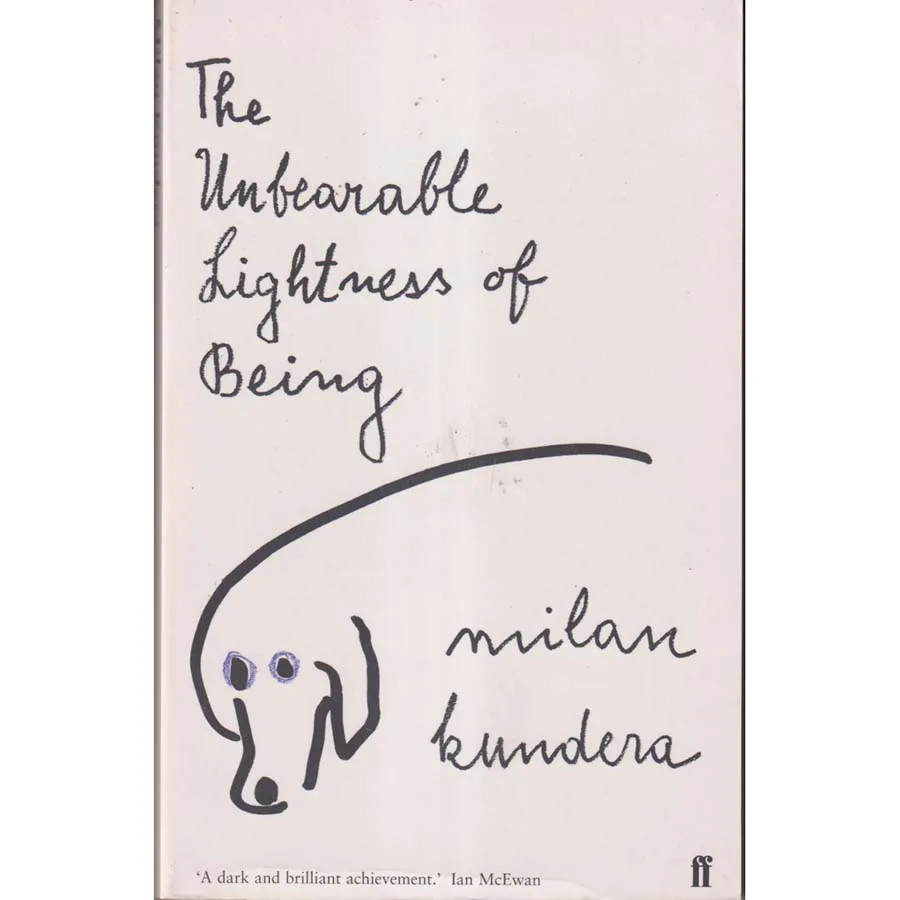
Publisher: Faber and Faber
Format: Paperback
ISBN: 9780571135394
Life is full of difficult decisions. Should one marry for love, pursue personal freedom, remain faithful, embrace political idealism or simply abandon the entire business and move somewhere with better weather? Milan Kundera, unfortunately, has very little intention of making these decisions any easier. Indeed, he would probably argue that the difficulty is rather the point.
The Unbearable Lightness of Being (1995), published by Faber and Faber, is one of the most celebrated novels of the twentieth century, a dazzling mixture of romance, philosophy, political history and the extraordinary human talent for making life considerably more complicated than it needs to be.
Set largely in Czechoslovakia during the Prague Spring of 1968 and the subsequent Soviet invasion, the novel follows the intertwined lives of Tomas, a successful surgeon with an impressive commitment to romantic freedom; Tereza, his devoted but deeply troubled wife; Sabina, an artist with a talent for escaping both conventional relationships and political expectations; and Franz, an earnest intellectual whose idealism occasionally exceeds his understanding of reality.
Together, they form a wonderfully complicated arrangement of love, desire, jealousy, betrayal and philosophical speculation. Tomas, in particular, demonstrates the remarkable ability to be genuinely affectionate while simultaneously behaving in ways that would make most marriage counsellors consider early retirement.
At the heart of Kundera’s novel lies a deceptively simple philosophical question: if we live only once, and our choices can never be repeated or tested against alternative outcomes, does life possess extraordinary significance or almost none at all?
Drawing upon Nietzsche’s concept of eternal recurrence, Kundera explores the tension between lightness and weight, freedom and responsibility, love and independence. His characters pursue happiness with varying degrees of success, frequently discovering that obtaining what they thought they wanted introduces an entirely new collection of problems.
Meanwhile, the machinery of history continues its relentless progress. Soviet tanks arrive, political freedoms disappear, careers are destroyed and private lives become entangled with the absurdities of ideological conformity. Kundera examines political oppression with the same sharp intelligence he brings to personal relationships, revealing how grand historical events intrude upon the intimate and frequently ridiculous details of everyday existence.
The novel is also gloriously unconventional in its construction. Kundera interrupts his own narrative with philosophical reflections, examines his characters as though they were particularly interesting psychological experiments, and occasionally reminds the reader that fiction has no obligation to behave like ordinary life.
First published in 1984, the novel remains a provocative, witty and deeply moving examination of love, mortality, politics and the endless contradictions of human existence.
Condition: As New. This 1995 Faber and Faber edition is in exceptionally well-preserved condition, showing little or no apparent evidence of previous reading or handling. An impressive achievement for a book concerned with the inevitability of change, the fleeting nature of experience and the general impossibility of keeping anything exactly as it was.
Offered by Crappy Old Books, where we firmly believe that life is too short to spend every waking moment worrying about its philosophical significance. On the other hand, Kundera makes an extraordinarily persuasive case for doing precisely that.
A brilliant, seductive and intellectually mischievous novel that asks whether life is unbearably light or impossibly heavy, then cheerfully leaves the reader to deal with the consequences. At least this particular copy has managed to remain remarkably untroubled by the passage of time.
Keep browsing: See more Fiction books Other books by Milan Kundera