Games People Play - The Psychology Of Human Relationships
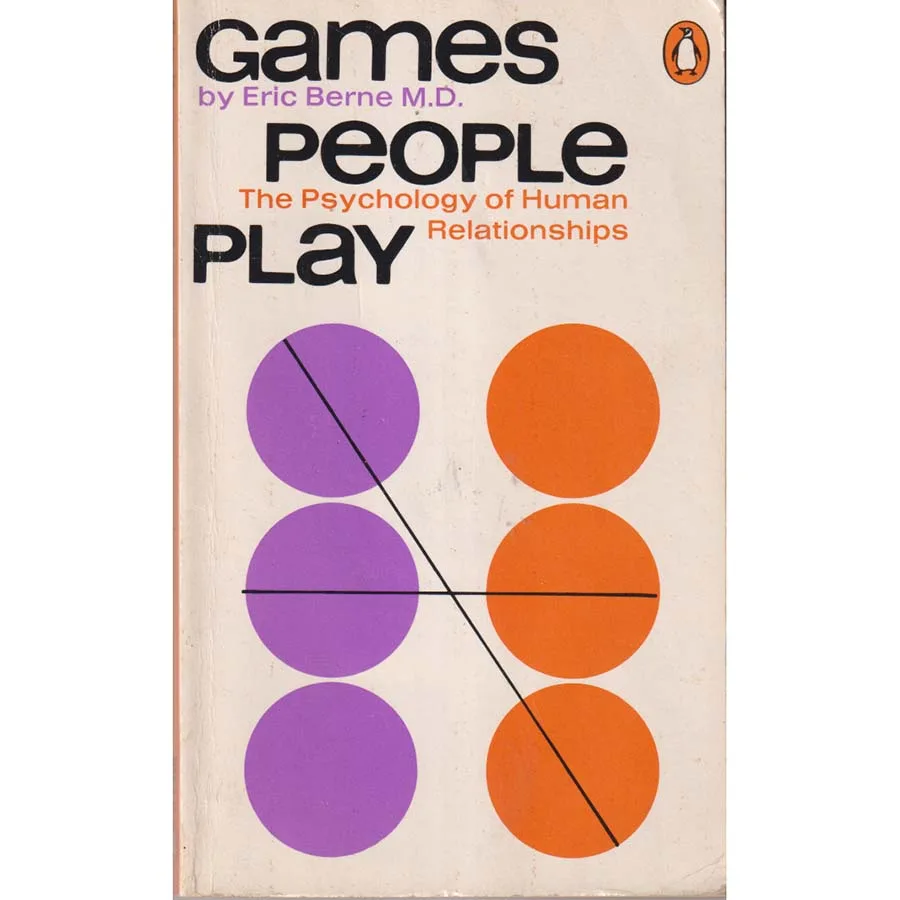
Publisher: Penguin
Format: Paperback
ISBN: 0140027688
Human relationships are complicated enough without discovering that half the conversations we have are actually elaborate psychological games, complete with hidden rules, unspoken objectives and the occasional emotional booby trap. Unfortunately, psychiatrist Eric Berne decided to investigate precisely this possibility, and the results were sufficiently unsettling to make ordinary social interaction seem like a competitive sport played by people who haven’t bothered to read the instructions.
Games People Play: The Psychology of Human Relationships (1981) is Berne’s enormously influential exploration of the peculiar little manoeuvres through which human beings communicate, manipulate, misunderstand and occasionally drive one another completely round the bend. First published in the 1960s, the book introduced millions of readers to transactional analysis, a psychological approach suggesting that our everyday interactions are often rather less spontaneous than we would like to believe.
According to Berne, we operate through three principal ego states: Parent, Adult and Child. Unfortunately, these do not necessarily correspond to our actual ages, which explains why a perfectly respectable fifty-year-old executive can occasionally behave like a sulking six-year-old, while a teenager may demonstrate considerably more common sense than the entire board of directors.
Berne identifies a colourful collection of recurring psychological games, including such delights as "Why Don’t You—Yes But", "If It Weren’t for You" and "Now I’ve Got You, You Son of a Bitch". The titles alone suggest that the human race has been conducting a remarkably elaborate programme of emotional sabotage, largely without realising it.
These games, Berne argues, allow people to pursue hidden emotional rewards while maintaining the comforting illusion that they are simply having an ordinary conversation. The person who asks for advice but rejects every suggestion, the individual who repeatedly creates crises requiring rescue, and the acquaintance who somehow manages to turn every innocent remark into a personal insult may all be following familiar psychological scripts.
What makes the book so entertaining is Berne’s combination of clinical observation, sharp wit and a distinctly unsentimental view of human behaviour. He manages to make psychological theory accessible without requiring the reader to possess a doctorate, a consulting room or an unusually expensive leather couch.
Of course, reading this book carries certain risks. Once you begin recognising these patterns, family dinners, office meetings and casual conversations may never look quite the same again. You may even discover that you have been playing several of the games yourself, which is frankly an unnecessary complication.
Condition: Good. This 1981 Penguin edition is a previously owned copy showing ordinary signs of age and handling, but remains ready to expose the psychological peculiarities of another generation.
Offered by Crappy Old Books, where the only game we’re playing is trying to sell interesting old books to people who appreciate them. Although, according to Eric Berne, that’s probably exactly what someone playing a game would say.
Keep browsing: See more Academic books Other books by Eric Berne