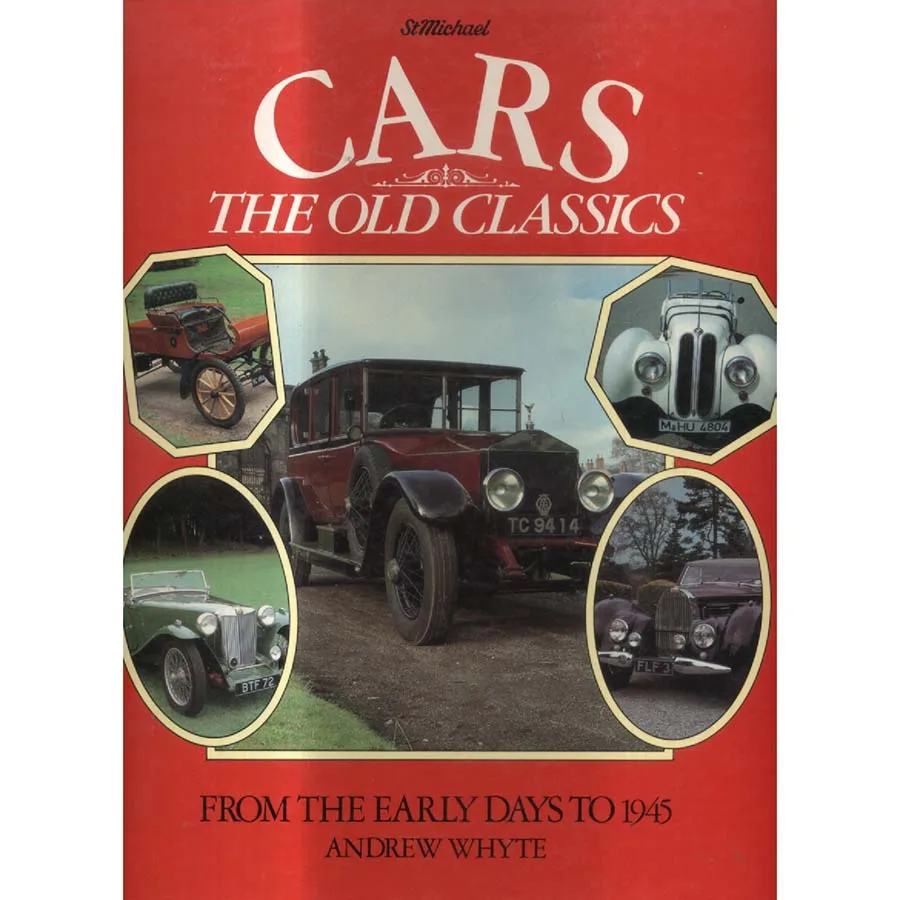
Cars - The Old Classics - From The Early Days To 1945
Publisher: St Michael
Format: Hardback
ISBN: 0862730724
There was a time when the motor car was a terrifying mechanical novelty, operated by adventurous gentlemen wearing goggles, enormous coats and expressions of determined optimism. Roads were largely unsuitable, engines were temperamentally unreliable, and the general public regarded the arrival of a horseless carriage with approximately the same enthusiasm as an escaped circus elephant. Yet from these uncertain beginnings emerged some of the most magnificent machines ever to grace the highway, complete with sweeping mudguards, polished brass and enough aristocratic grandeur to make an ordinary modern hatchback feel thoroughly inadequate.
In Cars – The Old Classics: From the Early Days to 1945 (1983), Andrew Whyte celebrates the extraordinary development of the automobile during its first half-century of widespread existence. Published by St Michael, this illustrated volume explores the pioneering inventions, elegant designs and remarkable engineering achievements that transformed the motor car from an eccentric curiosity into an indispensable feature of modern civilisation.
The early years of motoring were a glorious period of experimentation, when manufacturers competed to discover the most effective arrangement of engines, transmissions, steering systems and occasionally the wheels themselves. Some designs were masterpieces of ingenuity, while others suggested that their creators had approached the problem with enormous enthusiasm and only a passing acquaintance with mechanical common sense.
As the twentieth century progressed, automobiles became increasingly sophisticated, reliable and luxurious. Magnificent marques such as Rolls-Royce, Bentley, Bugatti and Hispano-Suiza demonstrated that the motor car could become an object of extraordinary craftsmanship and prestige, particularly for customers whose financial circumstances permitted the purchase of a vehicle costing approximately as much as a respectable country house.
Meanwhile, more modest manufacturers developed practical machines that gradually brought motoring within reach of ordinary families, although the definition of affordable remained somewhat flexible during the industry’s formative decades.
Whyte’s celebration of the old classics captures a vanished world of polished radiator grilles, sweeping running boards, elaborate coachwork and interiors that frequently resembled particularly well-appointed gentlemen’s clubs. These were machines designed when automotive styling was an art form, rather than an exercise in making every vehicle resemble an aerodynamic household appliance.
Of course, early motoring demanded considerable patience. Starting procedures could resemble elaborate religious ceremonies, punctures were frequent, and long-distance journeys involved an optimistic combination of mechanical preparation, spare components and the hope that somebody along the route possessed a telephone.
The period concludes in 1945, by which time the automobile had survived two world wars, remarkable technological developments and numerous spectacular commercial failures, establishing the foundations of the modern motor industry.
Condition: Very Good. This is a previously owned copy dating from 1983, displaying only modest signs of age and handling. Unlike many vehicles of comparable historical interest, it requires no replacement wooden body framing, specialist engine rebuilding or extensive expenditure on historically accurate upholstery.
Published by St Michael in 1983. ISBN: 0862730724.
Offered by Crappy Old Books, where we appreciate the magnificent elegance of early motoring, particularly when enjoying it does not involve purchasing a chauffeur’s uniform or acquiring a workshop capable of rebuilding a pre-war gearbox.
An excellent addition to any collection of vintage motoring literature, classic automobile history or nostalgic automotive photography. Particularly recommended for enthusiasts who appreciate that the earliest cars possessed extraordinary beauty, individuality and mechanical character, even if travelling fifty miles in one occasionally required the patience of a saint and the technical expertise of a locomotive engineer.
Keep browsing: See more Transport books Other books by Andrew Whyte