VW Kubelwagen Military Portfolio 1940-1990
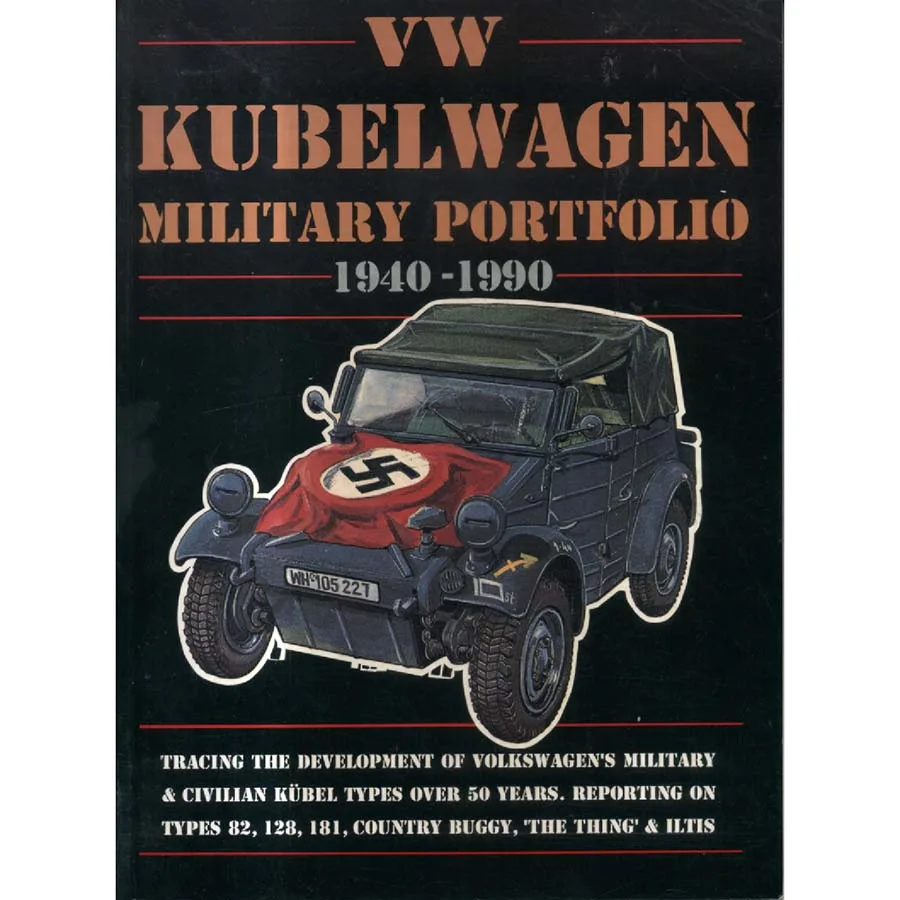
Publisher: Brooklands Books
Format: Paperback
ISBN: 9781855202184
There are military vehicles designed to intimidate the enemy with enormous guns, formidable armour and engines capable of consuming a small nation’s annual fuel supply. And then there is the Volkswagen Kübelwagen, a wonderfully peculiar German machine that looked rather like a bathtub mounted on wheels and demonstrated that military transport need not be particularly glamorous to be remarkably effective.
In VW Kubelwagen Military Portfolio 1940–1990 (2008), Konrad F. Schreier Jr. brings together a fascinating collection of material exploring one of the Second World War’s most distinctive military vehicles. Published by Brooklands Books, this specialist volume examines the design, engineering and operational history of the Volkswagen Type 82 Kübelwagen, a lightweight utility vehicle that became a familiar sight wherever German forces were deployed.
Developed from the mechanical foundations of Ferdinand Porsche’s Volkswagen Beetle, the Kübelwagen was an ingenious exercise in automotive simplicity. Its rear-mounted, air-cooled engine eliminated the inconvenience of radiators, while its lightweight construction and clever suspension helped it negotiate difficult terrain with surprising competence. It lacked conventional four-wheel drive, but compensated through low weight, useful ground clearance and an admirable determination to keep moving.
The resulting vehicle was hardly luxurious. Its occupants enjoyed basic seating, minimal protection from the elements and the unmistakable sensation that comfort had been omitted from the original design specification as an unnecessary extravagance. Nevertheless, the Kübelwagen proved highly practical for reconnaissance, communications and general military transport.
Unlike its American contemporary, the Jeep, the Kübelwagen relied upon relatively modest mechanical resources to achieve impressive mobility. It was a distinctly German solution to wartime transport requirements, combining economical engineering with straightforward construction and a remarkable capacity to operate in challenging conditions.
This Brooklands Books portfolio offers enthusiasts an opportunity to explore the vehicle through a collection of historical and technical material, reflecting its development, characteristics and lasting interest among military vehicle collectors. The period covered, 1940 to 1990, also places the Kübelwagen within a wider historical perspective, extending beyond its wartime service into the decades when surviving examples became objects of preservation, restoration and enthusiastic mechanical investigation.
There is something wonderfully ironic about a vehicle originally intended as inexpensive, expendable military transport eventually becoming a desirable collector’s item. What once represented utilitarian wartime engineering now inspires painstaking restorations, specialist parts searches and discussions about originality that can become considerably more complicated than the vehicle itself.
Condition: Good. This is a previously owned copy of the 2008 publication, displaying ordinary signs of age and handling. Unlike a surviving wartime Kübelwagen, it should require no replacement floor panels, specialist engine components or extensive negotiations with a restoration workshop.
Published by Brooklands Books in 2008. ISBN: 9781855202184.
Offered by Crappy Old Books, where we appreciate unusual military machinery, particularly when acquiring a piece of its history does not involve importing a seventy-year-old vehicle from continental Europe.
An excellent addition to any collection of Volkswagen history, Second World War military vehicles or specialist automotive literature. Particularly recommended for enthusiasts fascinated by the extraordinary engineering ingenuity behind a machine that managed to cross difficult terrain with a modest engine, two driven wheels and all the aesthetic refinement of a metal washing-up bowl.
Keep browsing: See more Transport books Other books by Konrad F Schreier Jr