


Essential Military Jeep - Willys Ford And Bantam Models 1941-45
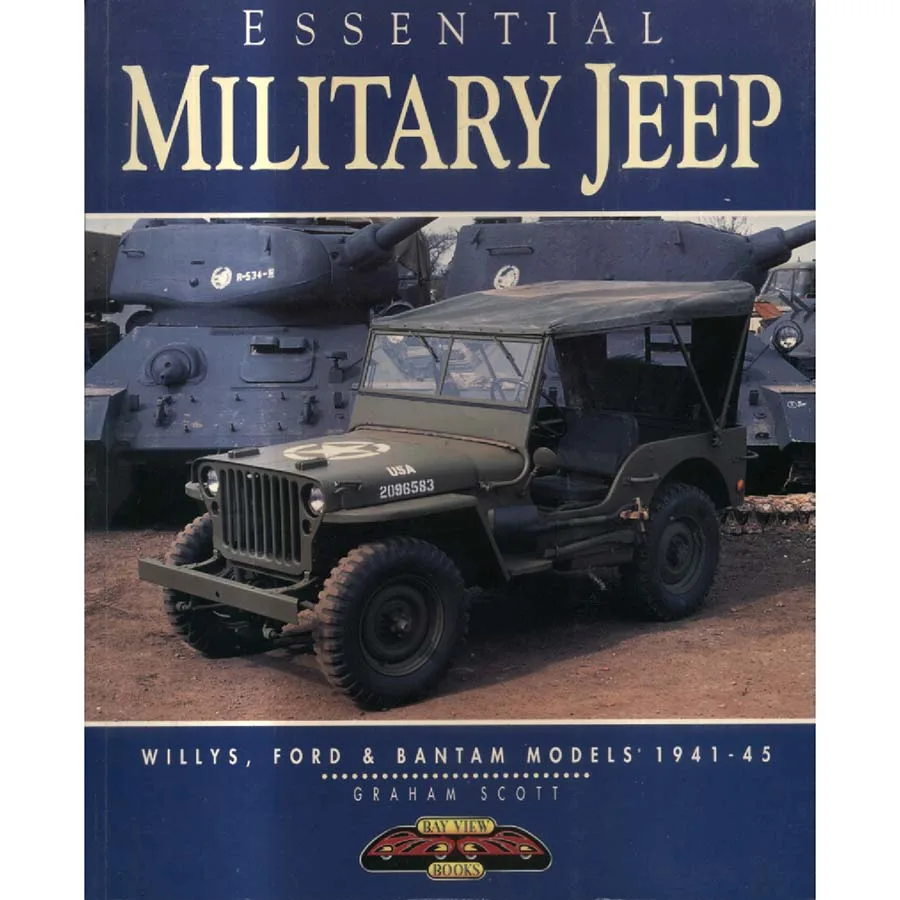
Publisher: Bay View Books
Format: Paperback
ISBN: 9781870979764
There are military vehicles designed to intimidate the enemy, vehicles intended to transport entire armies, and vehicles so enormously complicated that keeping them operational requires a small industrial workforce. Then there is the Jeep, a magnificent little contraption that helped win the Second World War while possessing approximately the same level of luxury as a wheelbarrow and considerably greater enthusiasm for climbing hills.
In Essential Military Jeep – Willys, Ford and Bantam Models 1941–45 (1998), Graham Scott celebrates one of the most famous and enduring military vehicles ever produced. Published by Bay View Books, this illustrated volume explores the development, design and wartime service of the legendary American Jeep, a machine whose extraordinary versatility made it indispensable to Allied forces across the globe.
The Jeep’s origins were wonderfully urgent. In 1940, the United States Army required a small, lightweight four-wheel-drive reconnaissance vehicle, preferably immediately and without the customary several decades of government deliberation. American Bantam produced an important pioneering design, while Willys-Overland and Ford subsequently became responsible for manufacturing the vehicles that would accompany Allied soldiers through some of the most demanding campaigns in military history.
The resulting Willys MB and Ford GPW were masterpieces of practical engineering. Compact, rugged and almost offensively basic, they were designed to transport soldiers, carry equipment, tow light artillery and negotiate terrain that would cause an ordinary civilian motorist to abandon the journey and telephone for assistance.
Comfort was not a particularly pressing consideration. The Jeep offered minimal protection from the weather, limited accommodation for personal belongings and suspension apparently designed to ensure that occupants remained constantly aware of the ground beneath them. Nevertheless, its mechanical simplicity, remarkable mobility and dependable four-wheel-drive system made it an extraordinarily successful military workhorse.
Scott examines the distinctive characteristics of the wartime Jeep and the differences between its principal manufacturers, providing an appealing introduction to machines whose similarities can conceal a surprising number of details. For dedicated enthusiasts, the distinction between a Willys and a Ford is a matter of considerable importance, capable of sustaining conversations longer than some military campaigns.
From European battlefields to the deserts of North Africa and the jungles of the Pacific, the Jeep earned an extraordinary reputation. It served as reconnaissance transport, ambulance, communications vehicle and general-purpose utility machine, proving that a small vehicle with a modest engine could accomplish remarkable things when driven by determined individuals with very little concern for their own comfort.
Condition: Very Good. This is a previously owned copy dating from 1998, displaying only modest signs of age and handling. Unlike a genuine wartime Jeep, it should require no replacement canvas, extensive welding or painstaking investigation into decades of questionable mechanical repairs.
Published by Bay View Books in 1998. ISBN: 9781870979764.
Offered by Crappy Old Books, where we admire the remarkable engineering achievements of wartime vehicle manufacturers, particularly their ability to create machines that could survive almost anything except several decades of enthusiastic amateur restoration.
An excellent addition to any collection of military vehicle literature, Second World War transport history or classic Jeep reference books. Particularly recommended for enthusiasts who appreciate that one of the most successful military vehicles ever produced was essentially a small metal box on wheels, with no doors, very little comfort and an absolutely magnificent determination to keep going.
Keep browsing: See more War books Other books by Graham Scott
