


World War II Small Arms
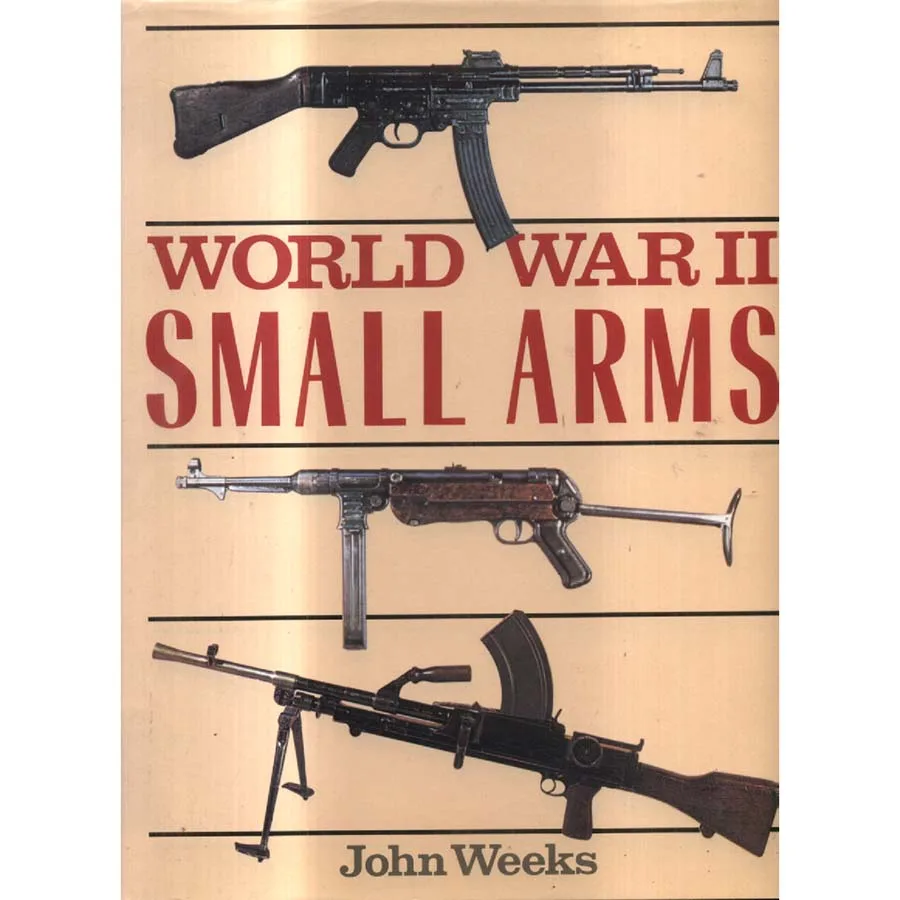
Publisher: Black Cat
Format: Hardback
ISBN: 9780748101115
There was a time when the outcome of a world war depended not upon satellites, artificial intelligence or the ability to operate a computer from several thousand miles away, but upon millions of men carrying rifles, pistols and submachine guns through mud, snow, sand and conditions that would have caused the average modern office worker to lodge an immediate complaint with Human Resources.
In World War II Small Arms (1988), John Weeks examines the extraordinary assortment of infantry weapons employed during the Second World War, exploring the engineering, development and battlefield roles of the firearms that equipped the world’s fighting forces. Published by Black Cat, this illustrated reference work takes readers into the fascinating world of military small arms, where practical ingenuity, industrial production and the occasional spectacular design miscalculation helped shape the conflict.
From the dependable British Lee-Enfield and the formidable American M1 Garand to the German MP40 and Soviet PPSh-41, the war produced an extraordinary variety of weapons, each reflecting the priorities, manufacturing capabilities and military philosophies of its country of origin.
Some were masterpieces of engineering, combining reliability, accuracy and durability under appalling conditions. Others were clearly designed by committees whose members had never attempted to operate complicated machinery while lying in a freezing ditch with somebody shooting at them.
Weeks explores the technical characteristics and historical significance of these weapons, recalling an era when military equipment needed to function despite mud, rain, extreme temperatures and the frequently indifferent maintenance practices of exhausted soldiers. Simplicity was often just as valuable as sophistication, particularly when a rifle had to be manufactured by the million and entrusted to recruits whose previous mechanical experience might have extended no further than repairing a bicycle.
The Second World War also accelerated the development of automatic firearms, changing infantry tactics and influencing weapons design for decades afterwards. Manufacturers raced to combine firepower, portability and economical production, while military planners attempted to determine precisely how much equipment an ordinary soldier could reasonably carry before becoming incapable of walking.
Beyond the machinery itself, the book provides an insight into the immense industrial effort behind wartime armaments. Every weapon represented raw materials, factory labour, logistical organisation and a remarkable determination to produce something sufficiently reliable to survive circumstances for which no sensible consumer product would ever be designed.
Condition: Good. This is a previously owned copy dating from 1988, displaying ordinary signs of age and handling. It remains a respectable reference and reading copy, with considerably fewer maintenance requirements than the military hardware described within its pages.
Published by Black Cat in 1988. ISBN: 9780748101115.
Offered by Crappy Old Books, where our interest in historic military equipment is happily confined to printed material, which is considerably easier to store, requires no ammunition and is unlikely to alarm the neighbours.
An excellent addition to any collection of Second World War history, military technology or historical firearms reference works. Particularly recommended for enthusiasts who appreciate the extraordinary engineering ingenuity behind wartime equipment, and the remarkable ability of military bureaucracies to make even the simplest mechanical problem considerably more complicated than necessary.
Keep browsing: See more War books Other books by John Weeks
