


Aristide Maillol
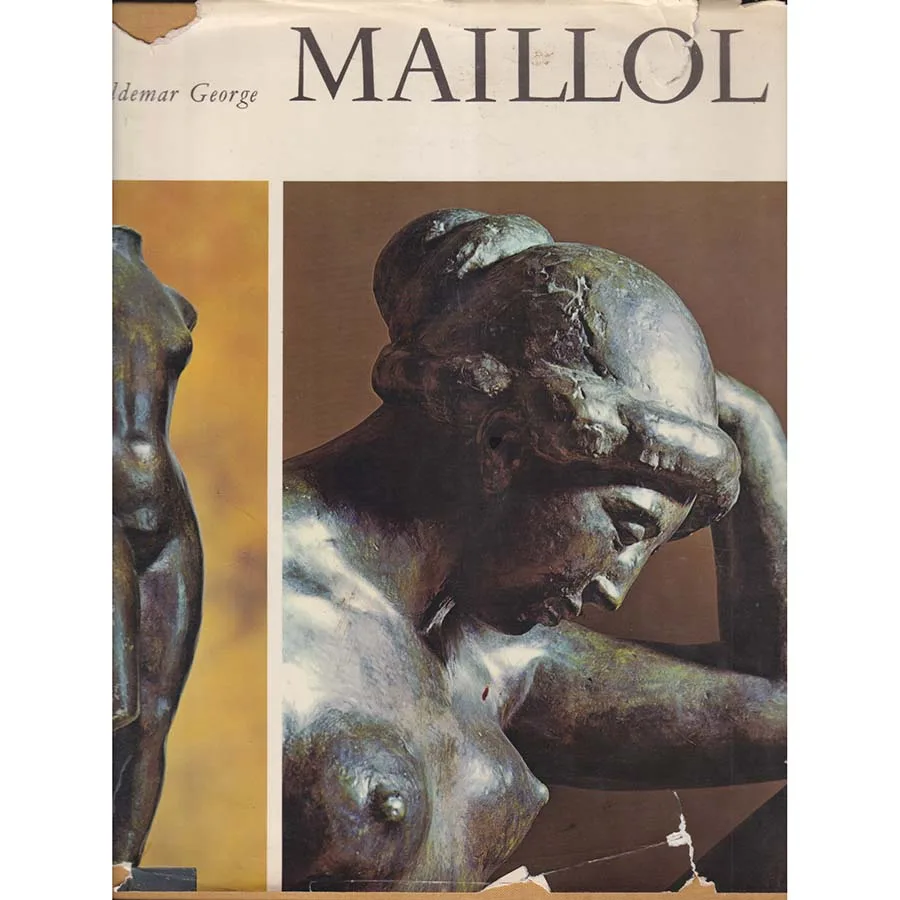
Publisher: New York Graphic Society
Format: Hardback
ISBN: none
Aristide Maillol (1977) – Waldemar George
New York Graphic Society | ISBN: None
Condition: Good – Slightly Tatty Dust Jacket | Sold by Crappy Old Books
The human body. A magnificent arrangement of curves, proportions, muscles and occasionally inconvenient anatomical details that has occupied artists for thousands of years. From ancient Greek sculptors to Renaissance masters, humanity has devoted extraordinary effort to representing itself in stone, bronze and marble, usually while maintaining the reassuring artistic conviction that everybody ought to look considerably more graceful without their clothes.
Welcome to Aristide Maillol, Waldemar George’s study of one of the great sculptors of modern France, a man who demonstrated that artistic revolution need not necessarily involve making everything angular, unrecognisable or apparently assembled from the remains of a railway accident.
Born in 1861, Aristide Maillol began his artistic career as a painter before turning increasingly towards sculpture, eventually developing a distinctive style celebrated for its calm simplicity, harmonious proportions and powerful sense of physical presence.
Where Auguste Rodin explored movement, emotional intensity and dramatic expression, Maillol pursued something altogether quieter. His figures possess an extraordinary stillness, their rounded forms suggesting balance, serenity and a timeless appreciation of the human body.
And, it must be admitted, he was particularly enthusiastic about the female nude.
Indeed, anyone hoping for an extensive selection of fully clothed Victorian gentlemen discussing municipal drainage arrangements may find themselves somewhat disappointed.
Maillol’s sculpture is dominated by the female figure, presented not as a theatrical spectacle but as an exploration of form, volume, structure and the relationship between the body and surrounding space.
His figures sit, stand, recline and contemplate existence with a composure that makes the frantic activity of modern civilisation appear positively unnecessary.
Waldemar George, an influential art critic and historian, examines Maillol’s artistic achievement and his distinctive contribution to modern sculpture, placing his work within the wider development of European art.
The book’s illustrated presentation offers an opportunity to appreciate the sculptor’s remarkable handling of form and the subtle variations that distinguish his apparently simple compositions.
There is something wonderfully ironic about an artist achieving international recognition through sculptures that frequently appear to be doing absolutely nothing.
No dramatic gestures, no heroic battles, no elaborate narratives.
Just the human figure, rendered with such extraordinary sensitivity that the absence of unnecessary activity becomes the entire point.
Published by the New York Graphic Society in 1977, this substantial art volume is an appealing addition to any collection devoted to twentieth-century sculpture, French art or the artistic representation of the human form.
Condition: Good. The book is accompanied by its original illustrated dust jacket, which is slightly tatty, with visible edge wear and minor damage. Importantly, there are no large tears or substantial sections missing. The jacket retains its attractive period design, including its striking photographic presentation of Maillol’s sculptural work.
Offered by Crappy Old Books, this is an appealing acquisition for art historians, sculptors, collectors of illustrated art books and anyone who appreciates the extraordinary skill required to make a solid piece of bronze appear graceful and alive.
A handsome celebration of an artist who understood that simplicity, when properly achieved, can be considerably more powerful than spectacle.
Because while modern art has occasionally demanded that audiences contemplate a pile of bricks, an unmade bed or something resembling a badly assembled bicycle, Maillol remained committed to the human figure.
Preferably unclothed.
And, judging by his remarkable career, humanity was perfectly happy to admire the results.
Keep browsing: See more Art books Other books by Waldemar George
