


English Cottages And Farmhouses
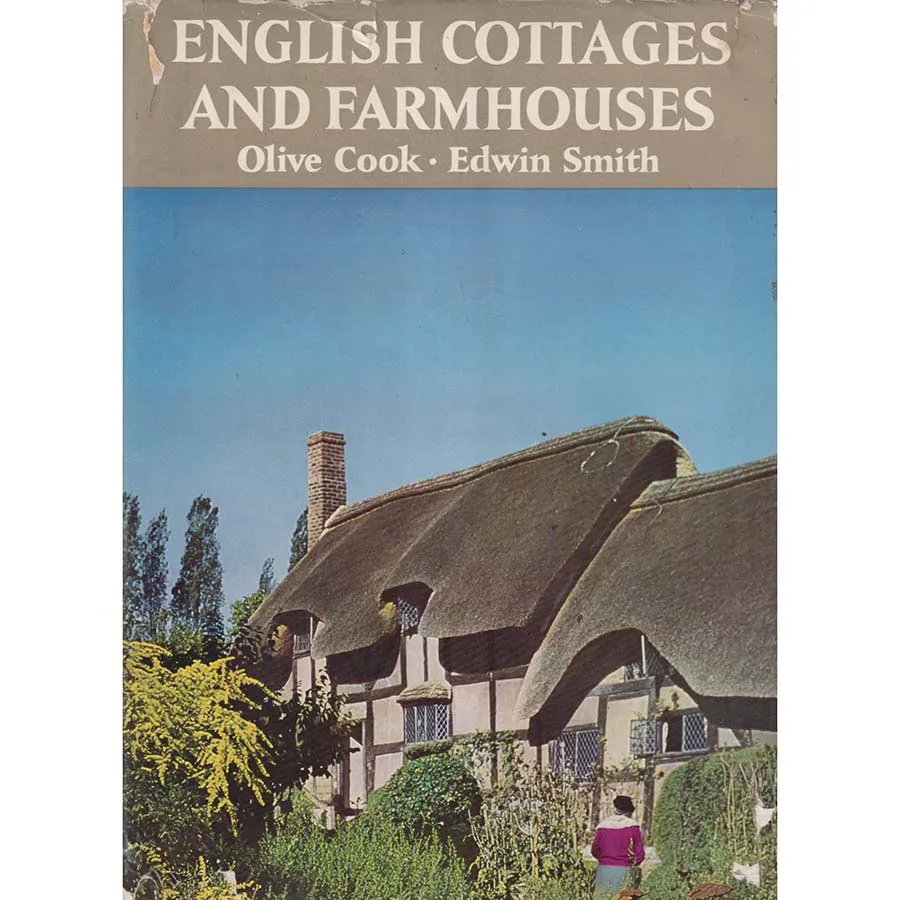
Publisher: Thames and Hudson
Format: Hardback
ISBN: none
English Cottages and Farmhouses (1960) – Olive Cook and Edwin Smith
Thames and Hudson | ISBN: None
Condition: Good | Sold by Crappy Old Books
The English countryside. A magnificent landscape of rolling hills, ancient hedgerows, picturesque villages and charming old buildings apparently constructed at a time when nobody had yet invented the straight line. For centuries, cottages and farmhouses have provided shelter to generations of rural inhabitants, surviving wars, economic upheavals and the extraordinary British enthusiasm for installing modern plumbing in buildings that were never designed to accommodate it.
Welcome to English Cottages and Farmhouses, Olive Cook and Edwin Smith’s beautiful exploration of England’s vernacular architecture, celebrating the extraordinary variety, character and craftsmanship of its traditional rural buildings.
Edwin Smith was one of Britain’s finest architectural photographers, renowned for his ability to capture the texture, atmosphere and quiet dignity of historic buildings. His photographs transform weathered timber, ancient stonework, crooked rooflines and humble domestic interiors into images of remarkable beauty.
Olive Cook, his wife and an accomplished writer and architectural historian, provides the accompanying literary perspective, bringing these buildings and their historical significance to life.
Together, they celebrate a world of timber-framed cottages, thatched roofs, stone farmhouses, ancient barns and picturesque dwellings whose architectural arrangements were frequently dictated by local materials, traditional craftsmanship and the practical necessities of rural existence.
There is something wonderfully appealing about buildings constructed before architects began insisting that everything should resemble an enormous glass refrigerator.
These houses possess individuality, irregularity and an extraordinary sense of belonging to their surroundings. Walls lean, beams twist, windows occupy unexpected positions, and entire structures appear to have settled into the landscape with the comfortable determination of an elderly gentleman refusing to leave his favourite armchair.
Yet beneath their picturesque appearance lies a fascinating history of practical construction. Traditional builders worked with oak, stone, brick, clay and thatch, creating buildings capable of surviving centuries despite the occasional absence of anything resembling a modern building regulation.
Published in 1960, this Thames and Hudson volume is itself an attractive historical record, capturing English rural architecture before decades of restoration, redevelopment and fashionable conversion transformed many traditional buildings.
An especially interesting feature of this particular copy is the inclusion of two additional black-and-white photographs showing the interior of an old timber roof. These appear to have belonged to a previous owner and have been retained with the book.
Their precise subject and provenance are unknown, but they provide a charming personal addition, suggesting that somebody once used this volume for more than casual admiration of pretty cottages.
Perhaps the original owner was studying historic roof construction, investigating an old property or simply possessed an unusually enthusiastic interest in ancient timberwork.
Whatever their story, the photographs make this copy a little more individual.
Offered in Good condition by Crappy Old Books, this 1960 Thames and Hudson edition is an appealing acquisition for architectural historians, conservation enthusiasts, photographers and admirers of England’s traditional countryside.
A beautiful celebration of rural buildings, skilled craftsmanship and an architectural heritage that has endured for generations.
Because modern houses may offer insulation, central heating and the reassuring certainty that the walls are approximately vertical.
But they rarely possess the character of a four-hundred-year-old cottage whose roof is supported by enormous oak beams.
Or the entertaining possibility that the entire building has been slowly leaning sideways since the reign of Elizabeth I.
And nobody has yet persuaded it to stop.
Keep browsing: See more Architecture books Other books by Olive Cook and Edwin Smith
