


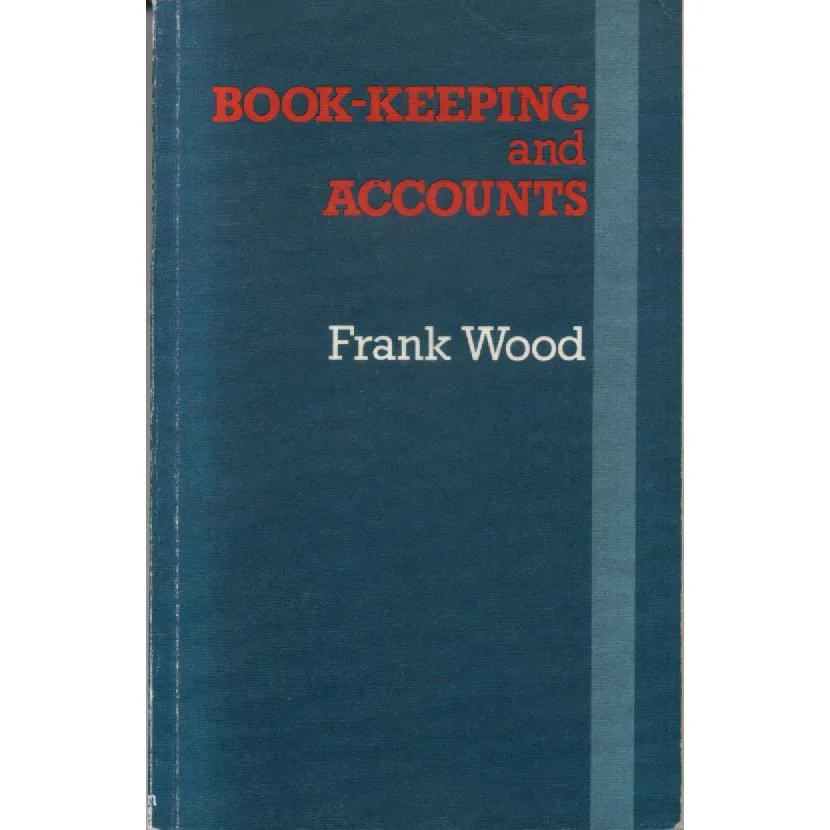
Book-Keeping And Accounts
Publisher: Longman
Format: Paperback
ISBN: 0582411777
Book-Keeping and Accounts (1982) – Frank Wood
Longman | ISBN: 0582411777
Condition: Good | Sold by Crappy Old Books
Accountancy. That noble profession dedicated to the proposition that every penny must be accounted for, every transaction must be recorded and every mysterious financial discrepancy must eventually be traced to somebody who has put a decimal point in the wrong place. While other people spend their lives pursuing excitement, adventure and the occasional romantic entanglement, accountants experience their greatest moments of exhilaration when the trial balance agrees.
Welcome to Book-Keeping and Accounts, Frank Wood’s classic introduction to the fascinating, occasionally bewildering and absolutely indispensable world of financial record-keeping.
Long before accounting software began reassuring business owners that everything was under control, somebody had to sit down with a ledger, a pencil and a considerable supply of patience to establish precisely where the money had gone.
Frank Wood was one of Britain’s best-known authors of accounting textbooks, helping generations of students, trainee accountants and aspiring businesspeople navigate the mysterious landscape of debits, credits, journals, ledgers and balance sheets.
At the heart of bookkeeping lies the magnificent principle of double-entry accounting, a system based upon the extraordinary idea that every financial transaction must be recorded twice. To the uninitiated, this sounds suspiciously like unnecessary paperwork. To the accountant, it represents one of civilisation’s greatest intellectual achievements.
After all, if money disappears from one account, it must presumably have appeared somewhere else.
Unless, of course, somebody has been embezzling it, in which case the bookkeeping becomes considerably more interesting.
This practical textbook introduces the principles of recording business transactions, organising financial information and preparing accounts, taking readers through the essential disciplines upon which sound financial management depends.
The subject encompasses the familiar machinery of commercial life: purchases, sales, receipts, payments, assets, liabilities, profit and loss. These may not possess the glamour of international espionage or mountaineering, but they do have the distinct advantage of explaining whether a business is actually making any money.
Something many enthusiastic entrepreneurs discover rather later than would be ideal.
Published in 1982, this Longman edition belongs to an era when bookkeeping was still overwhelmingly associated with handwritten records, paper documentation and mechanical calculators. Computerised accounting was developing, but the modern world of cloud-based financial systems, automated bank feeds and software subscriptions had yet to become an everyday reality.
Consequently, the book offers something beyond its original educational purpose: a fascinating glimpse into traditional accounting practice, when understanding the principles mattered rather more than knowing which button to press.
The underlying logic of double-entry bookkeeping remains fundamental today, although tax regulations, reporting standards and professional requirements have changed substantially since 1982.
This 1982 Longman edition, offered in Good condition by Crappy Old Books, is an appealing acquisition for accounting students, collectors of business textbooks, financial historians and anyone wishing to understand the foundations of bookkeeping without relying entirely upon a computer to do the thinking.
An instructive journey into the disciplined world of financial records, where order triumphs over confusion and every transaction has its proper place.
Because money may not buy happiness.
But accurately recording where it all went can at least explain why you haven’t got any left.
And if the books don’t balance, there is always the traditional accountant’s solution.
Check everything again.
Preferably before the auditor arrives.
Keep browsing: See more Business books Other books by Frank Wood
