


Heart Of The Storm - The Genesis Of The Air Campaign Against Iraq
Publisher: Air University Press
Format: Paperback
ISBN: 9781585660520
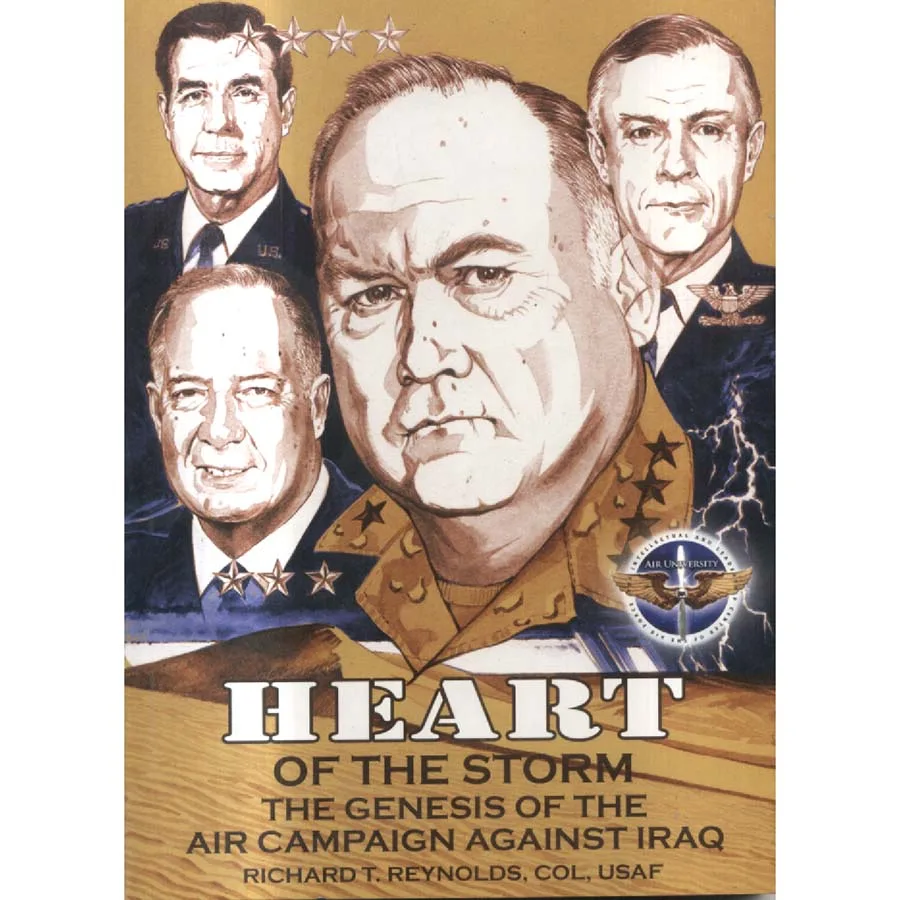
Heart of the Storm: The Genesis of the Air Campaign Against Iraq (1995) – Richard T. Reynolds
Air University Press | ISBN: 9781585660520
Condition: Good | Sold by Crappy Old Books
Modern warfare. A magnificent demonstration of humanity’s ability to combine extraordinary technological sophistication with the ancient and apparently incurable habit of settling political disagreements by blowing things up. By the late twentieth century, military aviation had progressed from fragile aircraft dropping bombs largely through optimism to immensely complicated flying weapons systems capable of striking targets hundreds of miles away with remarkable precision. Naturally, the politicians were delighted, particularly when somebody explained that the whole business might be concluded before the next election.
Welcome to Heart of the Storm: The Genesis of the Air Campaign Against Iraq, Richard T. Reynolds’s detailed examination of the planning and development of the coalition air offensive during the 1991 Gulf War, one of the most significant demonstrations of modern air power in military history.
The story begins with Iraq’s invasion of Kuwait in August 1990, when Saddam Hussein’s government decided that the neighbouring country’s sovereignty was an inconvenient obstacle to territorial ambition. Unfortunately for Baghdad, the international community took a rather dim view of this arrangement, and an enormous American-led military coalition began assembling in the Persian Gulf.
What followed was Operation Desert Shield, an extraordinary logistical undertaking involving the deployment of hundreds of thousands of personnel, aircraft, vehicles and enough military equipment to make even the Pentagon’s accountants reach nervously for their calculators.
But assembling an army was only part of the challenge. Before coalition ground forces could begin their offensive, military planners had to devise an air campaign capable of undermining Iraq’s command structure, air defences, communications, military infrastructure and ability to wage war.
Reynolds examines how that campaign was conceived, organised and refined, exploring the people, decisions and strategic thinking behind what became Operation Desert Storm.
Particular attention falls upon the development of the air plan, the competing priorities of military commanders and the complex relationship between strategic objectives and operational realities. Air warfare, it turns out, involves considerably more than selecting a target, climbing into an aircraft and hoping everybody remembers to bring the appropriate ammunition.
The campaign brought together stealth aircraft, precision-guided weapons, electronic warfare, conventional bombing and an unprecedented degree of coordination between different branches of the armed forces.
Yet behind the impressive technology stood human planners attempting to anticipate enemy reactions, reconcile conflicting requirements and transform ambitious strategic ideas into practical military operations.
There is something wonderfully ironic about the extraordinary complexity required to make modern warfare appear effortless. Television audiences watched carefully selected images of precision strikes, while behind the scenes enormous organisations struggled with intelligence assessments, targeting decisions, logistics and the familiar military difficulty of persuading different departments to agree upon anything.
Published in 1995 by Air University Press, this study offers a valuable perspective on the evolution of American air-power doctrine and the planning that preceded one of the defining military campaigns of the late twentieth century.
This 1995 edition, offered in Good condition by Crappy Old Books, is an excellent acquisition for military historians, aviation enthusiasts, students of strategy and readers interested in the operational history of the Gulf War.
A substantial examination of the intellectual and organisational machinery behind modern air warfare, demonstrating that military campaigns are often shaped as decisively in planning rooms as they are in the skies.
Because while the public sees aircraft, explosions and dramatic television briefings, somebody first has to work out precisely what the aircraft are supposed to accomplish.
And preferably ensure that everyone is working from the same map.
Keep browsing: See more War books Other books by Richard T Reynolds
