


Human Anatomy For Artists
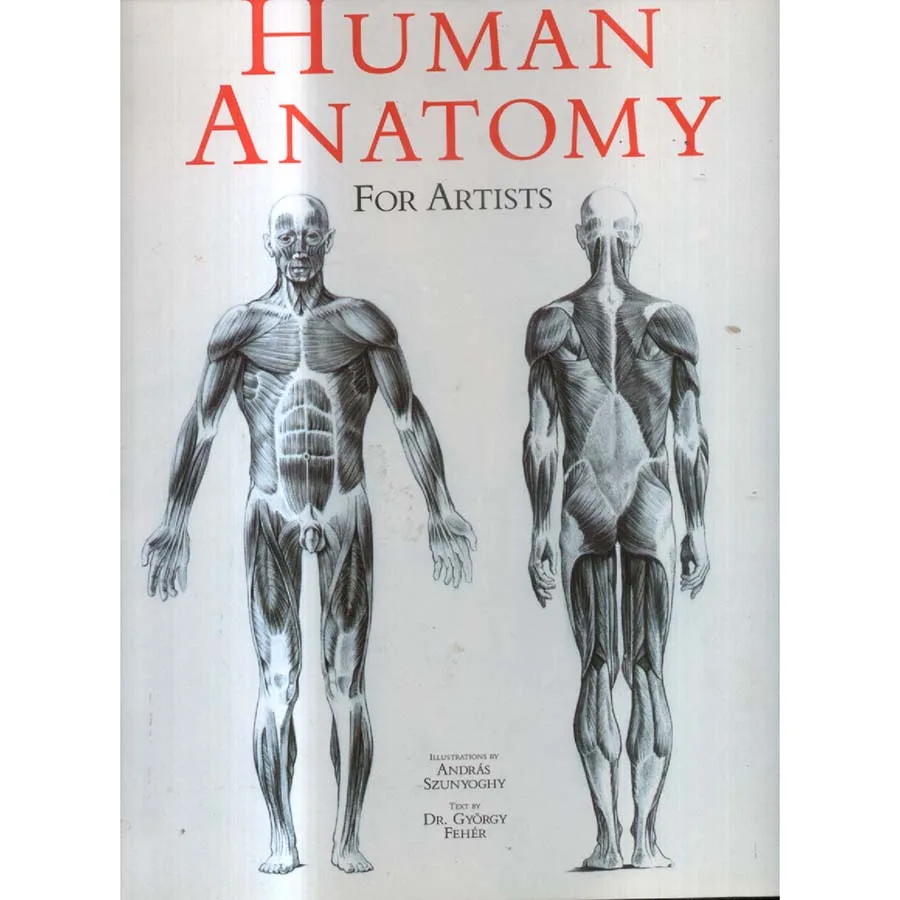
Publisher: Konemann
Format: Hardback
ISBN: 9783829005739
Human Anatomy for Artists (2000) – András Szunyoghy and György Fehér
Könemann | ISBN: 9783829005739
Condition: Very Good | Sold by Crappy Old Books
The human body. A magnificent feat of biological engineering, consisting of approximately 206 bones, hundreds of muscles and an extraordinarily complicated arrangement of joints, tendons and ligaments, all somehow cooperating to keep us upright, moving and occasionally falling over in public. It is also one of the most difficult subjects an artist can attempt to draw, particularly when the model insists upon possessing elbows, knees and fingers that refuse to behave according to the artist’s expectations.
Welcome to Human Anatomy for Artists, András Szunyoghy and György Fehér’s impressive exploration of the extraordinary machinery beneath the human skin, created for artists who have discovered that drawing a convincing person involves considerably more than attaching four limbs and a head to something vaguely resembling a torso.
For centuries, artists have struggled with the complexities of human anatomy. Leonardo da Vinci famously investigated the body through meticulous anatomical studies, while generations of painters and sculptors subsequently devoted themselves to understanding the relationships between muscles, bones, movement and proportion.
Unfortunately, the human skeleton is not quite as straightforward as it first appears. The shoulder is a remarkably elaborate arrangement, the spine contains enough individual components to make an engineer nervous, and the human hand possesses an almost vindictive determination to look wrong whenever somebody attempts to draw one.
This substantial anatomical reference brings together detailed illustrations and systematic explanations of the body’s underlying structures, helping artists understand how the skeleton supports movement, how muscles influence surface appearance and why the human figure changes shape so dramatically depending upon its position.
Szunyoghy’s accomplished anatomical drawings, combined with Fehér’s anatomical expertise, provide a valuable bridge between scientific knowledge and artistic practice. Rather than merely encouraging readers to copy the outline of a model, the book explores the structures responsible for producing those outlines in the first place.
The result is a fascinating journey through the human form, from skeletal construction to musculature and the intricate mechanisms responsible for posture, movement and expression.
Naturally, understanding anatomy does not automatically transform somebody into Michelangelo. One can memorise every major muscle in the human body and still produce a portrait resembling a disappointed potato. Nevertheless, the knowledge certainly improves one’s chances.
The book is particularly useful for life drawing, painting, sculpture and illustration, offering the kind of detailed reference material that serious artists return to repeatedly throughout their careers.
There is something wonderfully ironic about the fact that human beings spend their entire lives inhabiting bodies whose construction they barely understand. We manage to walk, run, dance and occasionally perform elaborate gymnastic manoeuvres without knowing precisely which muscles are responsible, yet ask somebody to draw a realistic knee and the entire arrangement becomes an anatomical mystery.
This 2000 Könemann edition, offered in Very Good condition by Crappy Old Books, is an excellent acquisition for artists, illustrators, sculptors, art students and anyone fascinated by the remarkable engineering of the human body.
A beautifully conceived reference work demonstrating that artistic talent and anatomical knowledge make particularly effective companions.
Because drawing the human figure convincingly requires more than imagination, observation and a decent pencil.
Sometimes you really do need to know where all the bones go.
Especially when your portrait has somehow acquired three elbows.
Keep browsing: See more Art books Other books by Andras Szunyoghy and Gyorgy Feher
