


Lotus - The Creative Edge
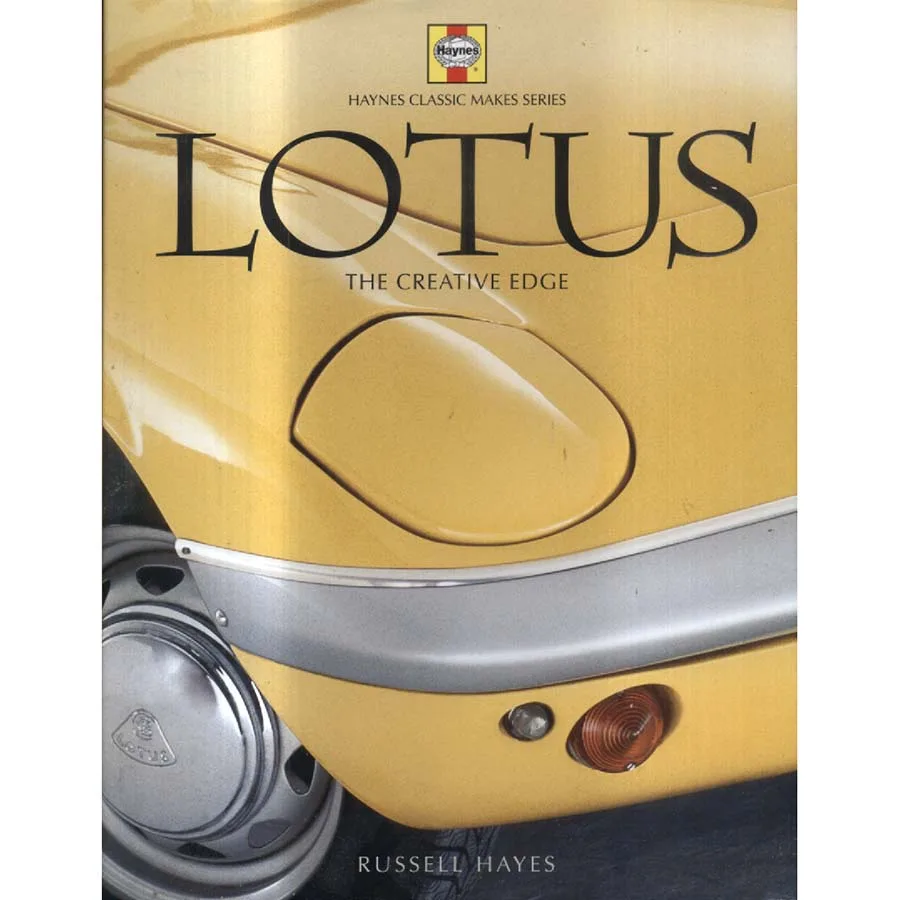
Publisher: Haynes
Format: Hardback
ISBN: 9781844252497
Lotus: The Creative Edge (2007) – Russell Hayes
Haynes Publishing | ISBN: 9781844252497
Condition: Very Good | Sold by Crappy Old Books
Lotus. A name that conjures images of sleek sports cars, legendary racing drivers, revolutionary engineering and the thoroughly British conviction that a motor car should contain absolutely nothing unnecessary. Other manufacturers believed the route to success involved bigger engines, heavier bodies and increasingly luxurious interiors. Lotus founder Colin Chapman had a rather different philosophy: remove everything that doesn’t contribute to performance, and then see whether anything else can be taken off.
Welcome to Lotus: The Creative Edge, Russell Hayes’s fascinating celebration of one of Britain’s most innovative automotive manufacturers, a company whose influence on motor racing and sports car design has been considerably greater than its modest size might suggest.
The Lotus story begins with Chapman, an exceptionally inventive engineer whose enthusiasm for lightweight construction and imaginative technical solutions helped transform a small British enterprise into an internationally celebrated marque. His approach was beautifully straightforward. A lighter car accelerates faster, brakes more effectively and corners with greater agility. Why spend a fortune developing an enormous engine when you could simply stop carrying around unnecessary metal?
It was an excellent theory, although occasionally owners might have appreciated a little more metal in certain strategically important places.
From the original Lotus Seven, that gloriously minimalist collection of wheels, engine and just enough bodywork to prevent the driver falling out, to the elegant Elan, sophisticated Elite and dramatic wedge-shaped Esprit, Lotus repeatedly demonstrated that automotive excellence didn’t necessarily require the resources of a vast multinational corporation.
On the racing circuit, the company’s achievements were even more extraordinary. Lotus became one of Formula One’s most influential constructors, introducing groundbreaking developments in chassis design, aerodynamics and ground-effect technology.
Legendary drivers including Jim Clark, Graham Hill, Emerson Fittipaldi and Mario Andretti helped establish the marque’s formidable racing reputation, collecting championships and victories while demonstrating that Chapman’s technical imagination could regularly embarrass manufacturers with considerably larger budgets.
Hayes explores the creativity that made Lotus distinctive, examining the personalities, designs and engineering ideas behind some of Britain’s most memorable performance cars.
There is something wonderfully appealing about the company’s willingness to challenge conventional wisdom. Where other manufacturers sought refinement through complexity, Lotus often pursued excellence through simplicity. Unfortunately, simplicity did not always translate into effortless ownership, and generations of enthusiasts became intimately acquainted with the mechanical peculiarities of their beloved machines.
The famous joke that Lotus stood for Lots Of Trouble, Usually Serious may have been rather unkind, but it demonstrated the affectionate tolerance required when owning a car designed by people whose principal concern was exceptional handling rather than the longevity of the electric windows.
Published in 2007 by Haynes, Lotus: The Creative Edge offers an engaging tribute to British engineering ingenuity, automotive design and the extraordinary achievements of a manufacturer that consistently punched above its weight.
This 2007 edition, offered in Very Good condition by Crappy Old Books, is an attractive acquisition for Lotus enthusiasts, collectors of motoring literature and anyone fascinated by the intersection of mechanical innovation, racing ambition and eccentric British determination.
A splendid celebration of a company that proved ingenuity could be more valuable than horsepower, and that extraordinary performance could emerge from remarkably modest beginnings.
Because while most manufacturers spent decades asking what more they could put into their cars, Colin Chapman asked what else he could take out.
And if the resulting vehicle was spectacularly fast, handled beautifully and occasionally required roadside attention, well, that was all part of the ownership experience.
At least the breakdown truck had plenty of room to carry it.
Keep browsing: See more Transport books Other books by Russell Hayes
