


King Edward II - His Life His Reign And Its Aftermath 1284-1330
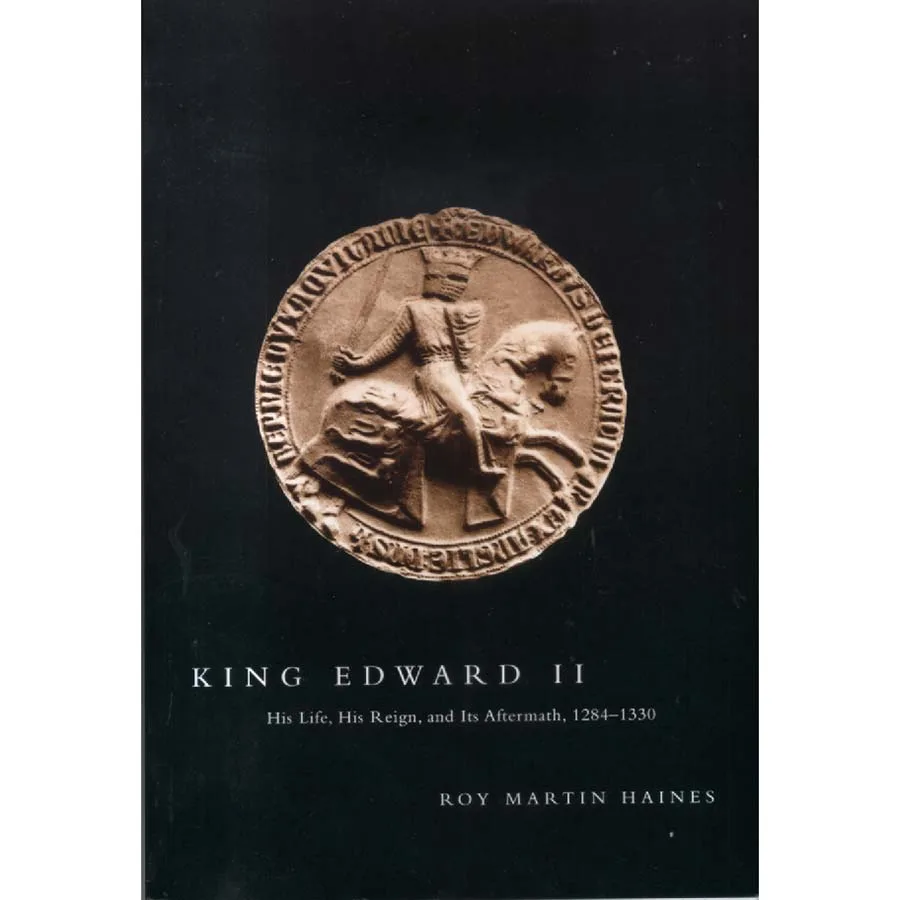
Publisher: McGill-Queens University Press
Format: Paperback
ISBN: 9780773531574
King Edward II: His Life, His Reign, and Its Aftermath, 1284–1330 (2006) – Roy Martin Haines
McGill-Queen’s University Press | ISBN: 9780773531574
Condition: Very Good | Sold by Crappy Old Books
Edward II. King of England, husband of a formidable queen, enthusiast for unsuitable favourites and a man who demonstrated, with considerable dedication, that inheriting a throne is not necessarily the same thing as knowing what to do with it. In medieval England, being king was already a dangerous occupation. Being a king who irritated virtually everybody with influence, money or an armed following was an especially ambitious career choice.
Welcome to King Edward II: His Life, His Reign, and Its Aftermath, 1284–1330, Roy Martin Haines’s substantial scholarly examination of one of England’s most controversial and unfortunate monarchs, whose reign involved military humiliation, political rebellion, personal scandal and a royal deposition that was hardly the retirement package most sovereigns hoped to receive.
Born in 1284, Edward inherited the throne in 1307 from his formidable father, Edward I, a ruler whose military ambitions and authoritarian temperament had established a daunting standard for his successor. Unfortunately, Edward II possessed different priorities, including a remarkable attachment to certain favourites whose rapid advancement caused considerable irritation among the English nobility.
Piers Gaveston became the first great source of controversy, attracting royal affection, prestigious titles and the understandable resentment of aristocrats who believed such privileges should be reserved for people of considerably more respectable ancestry.
The political situation deteriorated further as Edward struggled with rebellious barons, financial pressures and the continuing conflict with Scotland. His catastrophic defeat by Robert the Bruce at Bannockburn in 1314 did little to improve his reputation, particularly among those who already suspected that the king might be rather more interested in personal relationships than effective government.
Later, the influence of Hugh Despenser the Younger and his family contributed to another period of bitter political conflict, culminating in rebellion and the collapse of Edward’s authority.
Then came Isabella of France, Edward’s queen, whose partnership with Roger Mortimer helped bring about one of the most extraordinary reversals of royal fortune in medieval English history. In 1327, Edward was deposed in favour of his young son, Edward III, before dying in captivity under circumstances that have generated centuries of historical argument.
Haines approaches this turbulent reign with the careful attention of a serious historian, examining the documentary evidence, political institutions, personalities and competing interpretations surrounding Edward’s life and downfall.
Importantly, the book extends beyond the familiar dramatic conclusion of 1327, exploring the aftermath of Edward’s deposition and the political consequences that continued into 1330. The result is a fuller investigation of a reign too often reduced to scandalous anecdotes and lurid stories about the king’s supposed murder.
Published in 2006 by McGill-Queen’s University Press, this authoritative study offers a valuable contribution to medieval English political history, challenging readers to consider Edward within the complicated circumstances of his age rather than simply accepting the traditional portrait of an incompetent monarch surrounded by disastrous companions.
This Very Good-condition copy, offered by Crappy Old Books, is an excellent acquisition for medieval historians, students of the Plantagenets and anyone fascinated by the dangerous intersection of monarchy, personal loyalty and aristocratic ambition.
A rigorous and absorbing examination of kingship, political failure, deposition and the uncomfortable consequences of alienating practically everyone capable of raising an army.
Because in medieval England, being king meant possessing enormous theoretical authority.
Unfortunately for Edward II, theory was one thing.
Persuading the barons to let him keep it was quite another.
Keep browsing: See more Biography books Other books by Roy Martin Haines
