


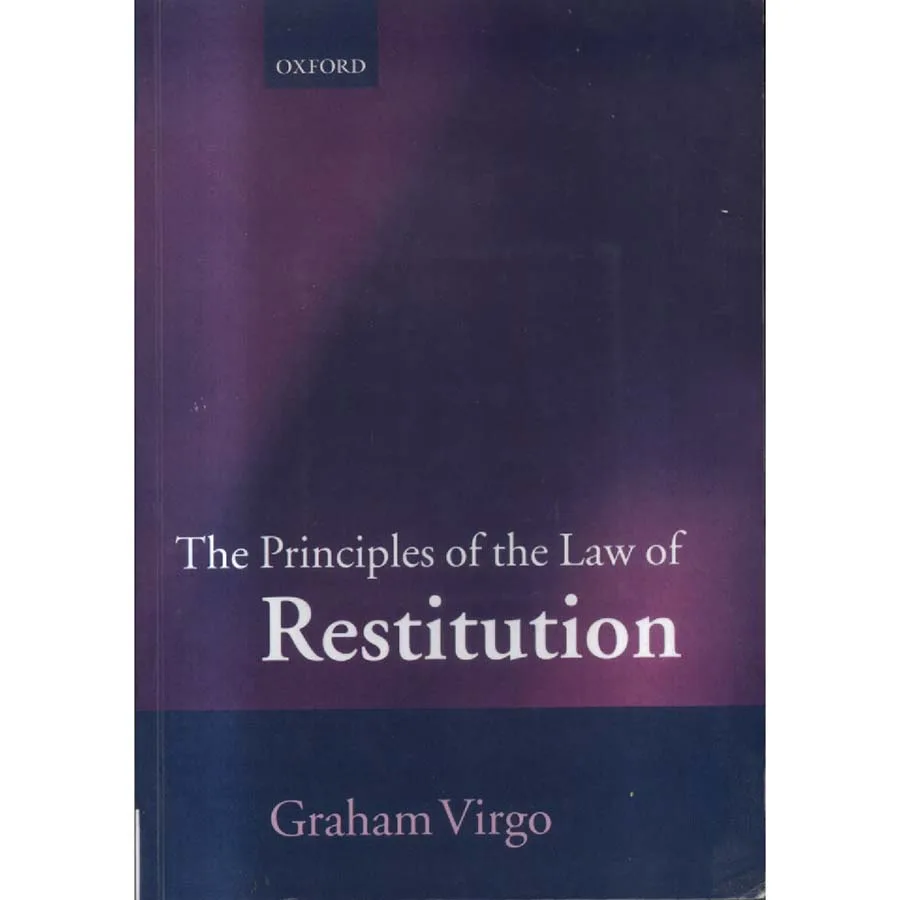
Principles Of The Law Of Restitution
Publisher: Oxford University Press
Format: Paperback
ISBN: 9780198763772
Principles of the Law of Restitution (1999) – Graham Virgo
Oxford University Press | ISBN: 9780198763772
Condition: Good | Sold by Crappy Old Books
Restitution. A wonderfully civilised legal concept based upon the apparently straightforward proposition that if somebody has received something they are not legally entitled to keep, they may have to give it back. An admirable principle, one might imagine, although English lawyers have naturally managed to transform it into an extraordinarily complicated branch of jurisprudence involving unjust enrichment, equitable remedies, mistaken payments and enough Latin terminology to make an ancient Roman magistrate reach for the aspirin.
Welcome to Principles of the Law of Restitution, Graham Virgo’s substantial and authoritative examination of one of the more intellectually demanding areas of English private law, where the apparently simple business of returning money or property can generate arguments complicated enough to occupy several barristers, three judges and a small mountain of expensive paperwork.
The fundamental problem is deceptively ordinary. Suppose somebody accidentally transfers money into your bank account. Can you keep it? What happens if you have already spent it? What if you received a benefit without requesting it? And what if the person demanding repayment was themselves behaving in a manner that would hardly qualify them for a civic award?
These are precisely the sorts of questions that make restitution law so fascinating, particularly to people who enjoy discovering that the obvious answer is rarely the legally correct one.
Virgo explores the principles governing restitutionary claims, examining circumstances in which one party may be required to surrender benefits received at another’s expense. The discussion encompasses unjust enrichment, restitution for wrongdoing, proprietary claims and the complex relationships between common law and equity.
Naturally, English law has developed a remarkable collection of distinctions to explain why apparently similar cases may produce entirely different outcomes. Whether a payment was made by mistake, under duress, following a failure of consideration or in circumstances involving breach of fiduciary duty can have profound consequences for the available remedies.
The legal system, after all, has never been particularly enthusiastic about allowing common sense to proceed without appropriate supervision.
Graham Virgo, a distinguished legal academic, approaches the subject with analytical precision, exploring the underlying structure of restitutionary liability and the sometimes difficult task of reconciling judicial decisions with coherent legal principles.
Published in 1999 by Oxford University Press, this volume reflects an important period in the development of modern English restitution law, when courts and scholars were increasingly examining unjust enrichment as a distinct foundation of private-law liability.
It also provides a valuable historical perspective on the legal doctrines and academic debates of the period, although readers dealing with contemporary cases should naturally consult subsequent developments in legislation and case law.
This 1999 Oxford University Press edition, offered in Good condition by Crappy Old Books, is an excellent acquisition for law students, academics, practising solicitors, barristers and anyone possessing the unusual combination of intellectual curiosity and emotional resilience required to enjoy several hundred pages about the legal consequences of receiving money one perhaps ought not to have received.
A rigorous and intellectually rewarding examination of restitution, legal responsibility and the principles governing the recovery of unjustly obtained benefits.
Because while most people instinctively understand that keeping something which doesn’t belong to them might be wrong, English law prefers to establish precisely why, under what circumstances, subject to which defences and pursuant to which recognised cause of action.
Preferably after several years of litigation.
By which point, the legal fees may comfortably exceed the amount everybody was arguing about in the first place.
Keep browsing: See more Academic books Other books by Graham Virgo
