


Tools Language And Cognition In Human Evolution
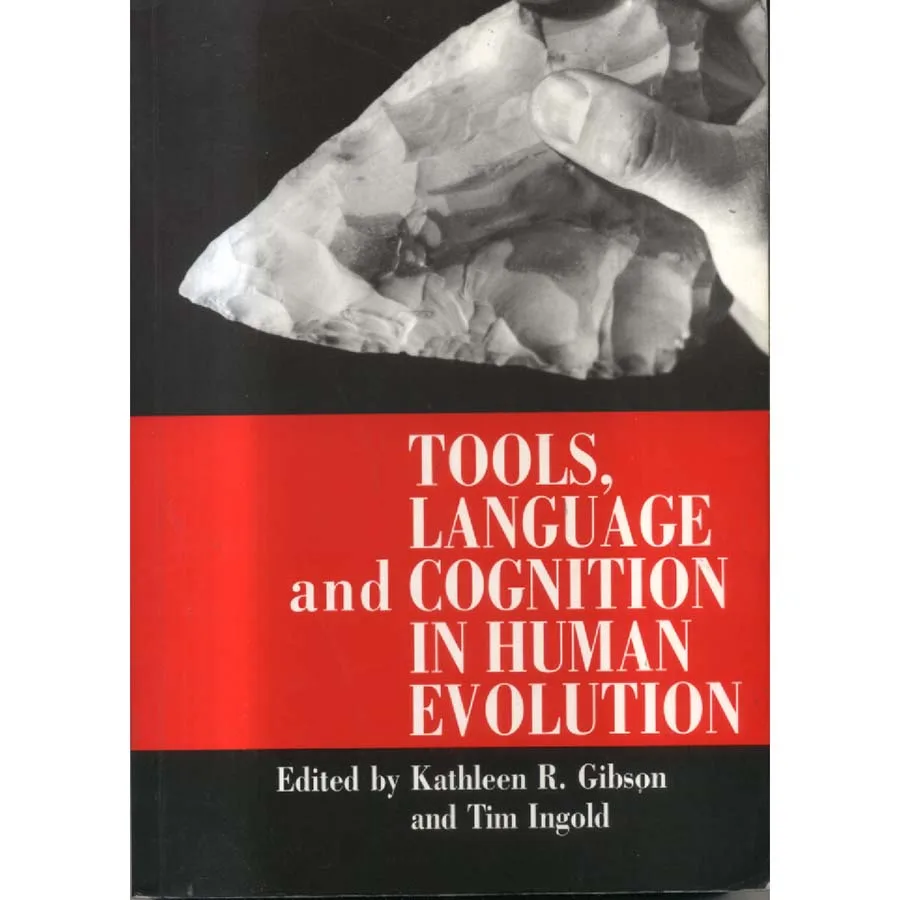
Publisher: Cambridge University Press
Format: Paperback
ISBN: 9780521485418
Tools, Language and Cognition in Human Evolution (1994) – Edited by Kathleen R. Gibson and Tim Ingold
Cambridge University Press | ISBN: 9780521485418
Condition: Good | Sold by Crappy Old Books
Human evolution. That extraordinary journey in which a rather unremarkable collection of African primates gradually developed the ability to make tools, communicate complex ideas, contemplate their own existence and eventually invent reality television. It is a magnificent achievement, although whether the final development represents evolutionary progress remains open to considerable debate.
In Tools, Language and Cognition in Human Evolution, Kathleen R. Gibson and Tim Ingold bring together scholarly investigations into one of the most fascinating questions in human history: how did our ancestors develop the intellectual abilities that distinguish modern humanity from its evolutionary relatives?
And, perhaps more importantly, did thinking lead to toolmaking, did toolmaking encourage thinking, or did the entire process begin when some prehistoric individual became thoroughly fed up with trying to open a nut using his teeth?
This substantial academic volume explores the relationships between technology, communication, intelligence and social behaviour throughout human evolution, drawing upon archaeology, anthropology, psychology, primatology and cognitive science.
The central problem is wonderfully complicated. Archaeologists can recover ancient stone tools, examine their manufacture and estimate their age, but discovering precisely what their makers were thinking presents rather greater difficulties. Unfortunately, prehistoric humans neglected to leave written explanations of their intellectual development, and their occasional artistic efforts are not particularly helpful when attempting to reconstruct the finer details of ancient grammar.
The contributors examine how tool production may relate to planning, learning, manual dexterity and the transmission of knowledge between generations. Making a simple stone implement requires certain cognitive abilities, but manufacturing increasingly sophisticated technologies suggests more elaborate forms of understanding and cooperation.
Language introduces another magnificent puzzle. At what point did our ancestors begin communicating through structured speech? Did language emerge alongside increasingly complex toolmaking, or did the development of social relationships and cooperative behaviour provide the decisive evolutionary advantage?
And how much can comparisons with living primates reveal about abilities that developed hundreds of thousands, or even millions, of years ago?
The book challenges simplistic accounts of human progress, examining the possibility that technology, language and cognition evolved through interacting processes rather than appearing in a convenient sequence of revolutionary breakthroughs.
Published in 1994 by Cambridge University Press, this collection represents an important contribution to interdisciplinary debates about human origins. Some interpretations have inevitably been refined by subsequent discoveries, but its questions remain central to understanding how humanity acquired its remarkable combination of intelligence, creativity and technical ingenuity.
This 1994 Cambridge University Press edition, offered in Good condition by Crappy Old Books, is an excellent acquisition for students of archaeology, anthropology, evolutionary psychology, cognitive science and anyone fascinated by the intellectual development of our species.
A stimulating exploration of the ancient relationship between hands, brains, tools and language, examining how our ancestors developed the abilities that eventually made civilisation possible.
Because somewhere in humanity’s distant past, an individual picked up a stone and discovered that it could be used to accomplish something useful.
Several million years later, we have artificial intelligence, interplanetary spacecraft and electric toothbrushes that connect to mobile telephones.
One suspects our ancestors would be impressed.
Although possibly rather confused about the toothbrush.
Keep browsing: See more History books Other books by Kathleen R Gibson and Tim Ingold
