


The British Industrial Revolution In Global Perspective
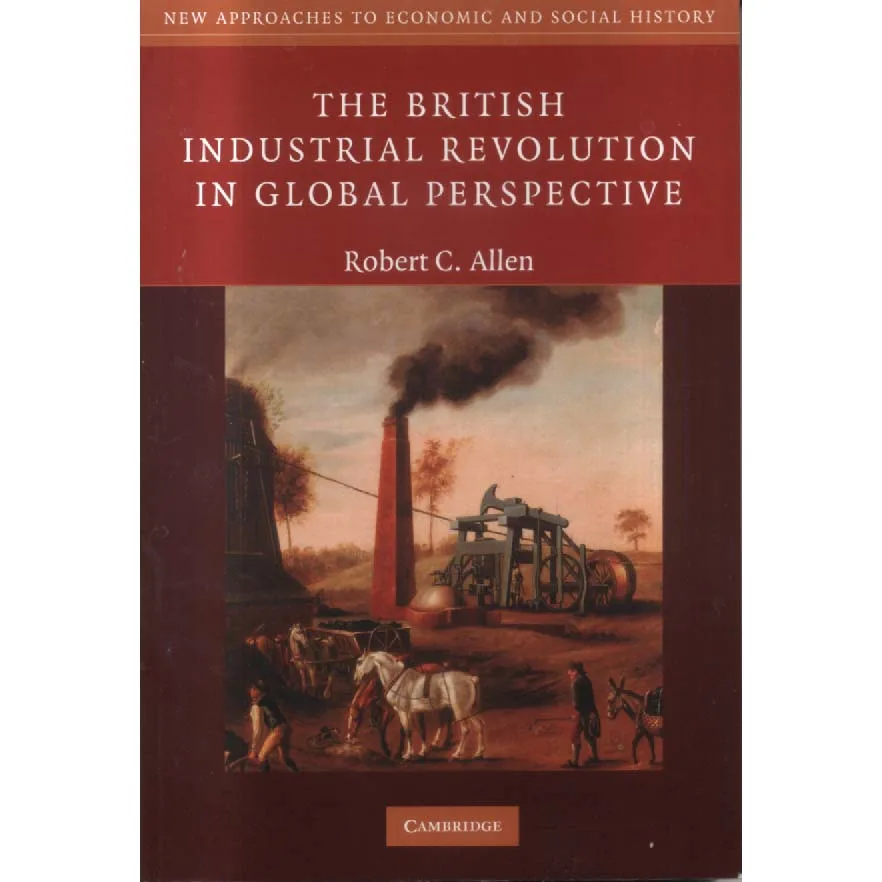
Publisher: Cambridge University Press
Format: Paperback
ISBN: 9780521687850
The British Industrial Revolution in Global Perspective (2009) – Robert C. Allen
Cambridge University Press | ISBN: 9780521687850
Condition: As New | Sold by Crappy Old Books
The Industrial Revolution. That extraordinary period in British history when humanity decided that making things slowly, quietly and by hand was terribly old-fashioned, and that the future clearly belonged to enormous factories, deafening machinery, belching chimneys and twelve-hour working days. It was the moment when Britain transformed itself from a largely agricultural society into the world’s leading industrial power, while simultaneously discovering exciting new ways to make entire cities unpleasant places to breathe.
But why Britain? Why did the Industrial Revolution begin in a damp little island off the coast of Europe rather than in China, India, France or somewhere with better weather and considerably more attractive lunch options?
In The British Industrial Revolution in Global Perspective, distinguished economic historian Robert C. Allen tackles precisely this question, offering a compelling explanation for one of the most consequential transformations in human history.
Allen’s argument centres on a wonderfully practical observation: eighteenth-century Britain combined relatively high wages with comparatively cheap energy, particularly coal. This created powerful economic incentives for employers and inventors to develop machines that could replace expensive human labour with mechanical power. In other words, the Industrial Revolution wasn’t simply the result of British ingenuity, Protestant industriousness or an unusual national enthusiasm for complicated mechanical contraptions. It was also about money.
And coal. Lots and lots of coal.
Why pay a man to perform a task when you can construct an enormous steam-powered machine to do it instead? Particularly when the machine doesn’t demand higher wages, complain about working conditions or disappear to the nearest public house at lunchtime.
Drawing on international comparisons of wages, prices, energy costs and technological development, Allen examines why innovations that made economic sense in Britain were not necessarily attractive elsewhere. His investigation ranges across Europe and Asia, challenging the comfortable notion that industrialisation was simply the inevitable reward for superior institutions or exceptional national cleverness.
The book explores technological change, agricultural productivity, international trade, urbanisation and the economic circumstances that encouraged Britain’s entrepreneurs to invest in increasingly sophisticated machinery. It also examines the extraordinary consequences of industrialisation, which eventually transformed living standards, global production and the economic balance of power.
Naturally, all this progress came with certain inconveniences, including appalling factory conditions, environmental destruction and the emergence of industrial towns that made the traditional rural village seem positively luxurious.
Published by Cambridge University Press in 2009, this is a substantial and influential contribution to economic history, combining detailed research with an argument that makes the Industrial Revolution considerably more intelligible than the familiar procession of heroic inventors and smoking locomotives.
This As New copy, offered by Crappy Old Books, is an excellent acquisition for historians, economists, students and anyone fascinated by why Britain became the workshop of the world.
An illuminating examination of how wages, resources and economic incentives helped transform global history.
Proof that changing the world sometimes requires extraordinary imagination, revolutionary technology and, most importantly, somebody deciding that employing people has become far too expensive.
Keep browsing: See more History books Other books by Robert C Allen
