


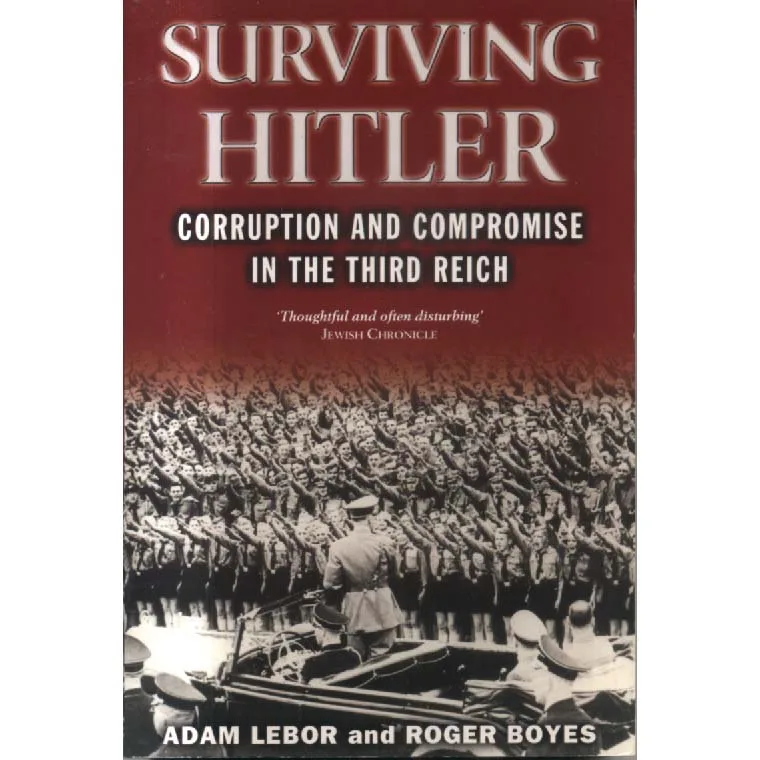
Surviving Hitler - Corruption And Compromise In The Third Reich
Publisher: Pocket Books
Format: Paperback
ISBN: 9780671022631
Surviving Hitler – Corruption and Compromise in the Third Reich (2002) – Adam LeBor and Roger Boyes
Pocket Books | ISBN: 9780671022631 | Condition: As New
Sold by Crappy Old Books – Where Morality Meets Self-Preservation, and Doing Business with the Devil Turns Out to Be a Disturbingly Complicated Arrangement.
There are people who like to imagine that, had they lived in Nazi Germany, they would have immediately joined the resistance, denounced Hitler, hidden persecuted neighbours and generally behaved with the moral courage of a Hollywood hero. Unfortunately, history suggests that when confronted with dictatorship, terror and the possibility of an extremely unpleasant visit from the Gestapo, human behaviour becomes considerably more complicated.
In Surviving Hitler, journalists Adam LeBor and Roger Boyes investigate the uncomfortable world of corruption, collaboration, compromise and survival within the Third Reich, exploring how individuals and institutions navigated one of the most murderous political systems in modern history.
And the results are not especially flattering to the human species.
Nazi Germany was not simply a country populated by fanatical ideologues marching enthusiastically beneath enormous flags. It was also a functioning society in which businessmen conducted transactions, civil servants processed paperwork, industrialists pursued contracts and ordinary people attempted to preserve their careers, possessions and lives.
Some resisted. Some collaborated enthusiastically. Others accommodated the regime through fear, ambition, opportunism or the convenient conviction that somebody else was responsible for whatever unpleasantness happened next.
The distinction between survival and complicity could become disturbingly blurred.
LeBor and Boyes examine the moral ambiguities and material interests that helped sustain Hitler’s dictatorship, revealing a world in which corruption and personal advantage operated alongside terror, ideological fanaticism and bureaucratic obedience.
After all, even the most monstrous political system requires accountants, administrators and people capable of ensuring that the trains run according to schedule.
The fact that those trains might be transporting human beings towards extermination rather than ordinary passengers was a consideration that far too many preferred not to examine.
What makes the subject especially disturbing is the ordinary nature of many of the decisions involved. History often presents evil as something theatrical, complete with uniforms, speeches and dramatic music. In practice, it can also involve signing a document, accepting a promotion, purchasing confiscated property or deciding that asking too many questions might be detrimental to one’s professional advancement.
The paperwork was generally immaculate. The morality was another matter entirely.
The book raises difficult questions about responsibility under dictatorship. How much freedom did individuals possess? Where did coercion end and opportunism begin? Could participation in a corrupt system ever be justified as a means of survival? And how readily can people persuade themselves that they are merely performing their jobs?
These are not comfortable questions, nor are they confined entirely to the history of Nazi Germany.
LeBor and Boyes approach their subject through investigative historical journalism, examining the compromises and relationships that complicate simplistic divisions between villains, victims and bystanders.
It is a reminder that dictatorship depends not only upon its most enthusiastic supporters but also upon the accumulated decisions of people who discover reasons to cooperate.
Condition: As New. This 2002 Pocket Books edition is offered in As New condition, providing an exceptionally tidy copy of a book concerned with an exceptionally untidy chapter of European history.
For readers interested in the Third Reich, political corruption, corporate responsibility, moral compromise and the mechanisms through which authoritarian systems sustain themselves, this is a compelling and thought-provoking work.
Available from Crappy Old Books, where we believe that understanding history requires examining not merely the monsters at the top, but also the uncomfortable arrangements that allowed them to remain there.
A disturbing exploration of ambition, fear, greed and survival under Nazism.
And a reminder that the question is not always what people believed, but what they were prepared to tolerate when their own interests were at stake.
Keep browsing: See more History books Other books by Adam Lebor and Roger Boyes
