


Against Nature And God - The History Of Women With The Jurisdiction Of Bishops
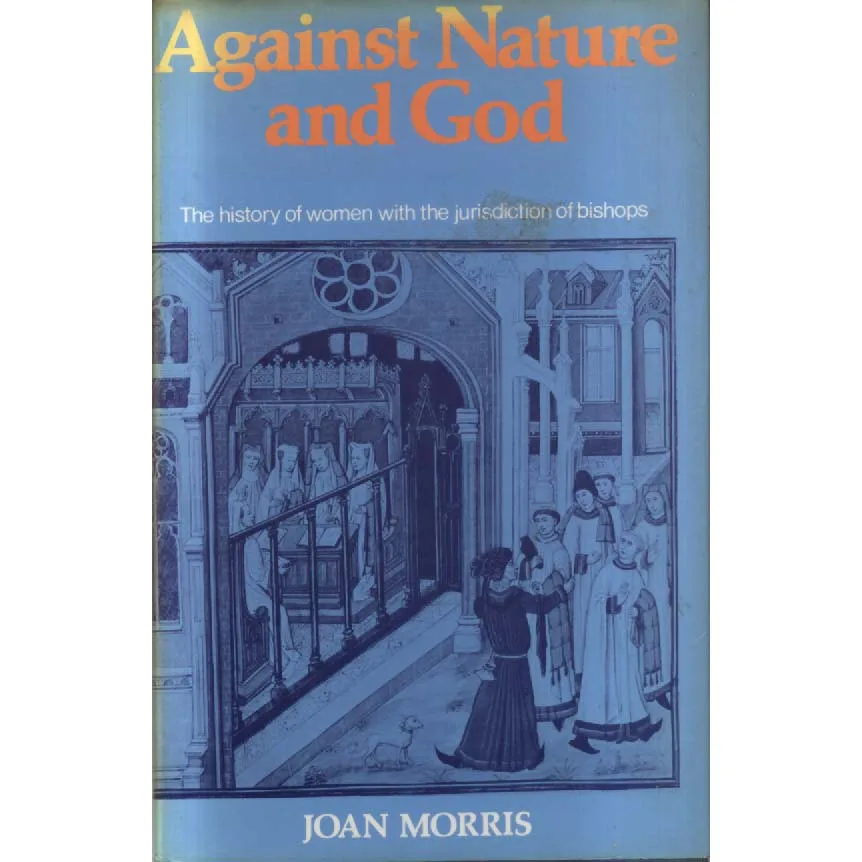
Publisher: Mowbrays
Format: Hardback
ISBN: 0264661486
Mowbrays | ISBN: 0264661486 | Condition: Good
Sold by Crappy Old Books – Where Women Have Been Making History for Centuries, Even When the Men in Charge Would Rather They Hadn’t.
There are few institutions quite as accomplished at producing rules, regulations, committees, hierarchies and beautifully worded explanations of why things must remain exactly as they are as the Christian Church. And among its more enduring preoccupations has been the question of what women should be permitted to do within its walls, beyond cleaning them, filling the pews, raising the children and occasionally providing the money to keep the roof from falling in.
Into this magnificent historical tangle marches Joan Morris with Against Nature and God, a scholarly and provocative examination of women’s place within the jurisdiction of bishops, published by Mowbrays in 1974, at a time when questions of women’s religious authority were becoming particularly difficult for ecclesiastical gentlemen to ignore.
The title alone is splendidly confrontational. Against Nature and God sounds rather like the verdict of a medieval church court delivered upon discovering that a woman had expressed an independent opinion, read a theological manuscript without supervision, or suggested that she might be perfectly capable of running something herself.
But Morris is concerned with something considerably more substantial than clerical disapproval. Her historical investigation challenges comfortable assumptions about the relationship between women, episcopal authority and the institutional development of Christianity.
The central difficulty, as so often happens when somebody starts looking through old documents, is that history stubbornly refuses to behave as neatly as official tradition might suggest.
Women were not merely passive spectators in the development of Christian institutions. Across different periods they exercised religious influence, held positions of responsibility, managed communities and participated in ecclesiastical structures in ways that complicate modern assumptions about an exclusively male religious hierarchy.
This is rather inconvenient if one has spent several centuries explaining that such arrangements were always impossible.
Morris examines the historical evidence surrounding women’s ecclesiastical status and authority, investigating the legal, institutional and theological circumstances that shaped their relationship with bishops. It is a subject involving canon law, religious traditions, changing interpretations of authority and the occasionally remarkable ingenuity with which institutions manage to reinterpret their own past.
After all, there is a considerable difference between establishing that something has always been forbidden and discovering that it gradually became forbidden, particularly when inconvenient historical precedents suggest otherwise.
Such distinctions are unlikely to produce much excitement at the average football match, but they can cause considerable agitation within theological circles.
The book belongs to a period of significant debate about women and Christian ministry. By the 1970s, established assumptions about gender and religious authority were coming under increasing scrutiny, and historical scholarship was becoming an important weapon in arguments that could no longer be settled simply by declaring that matters had always been conducted in a particular fashion.
Morris approaches the subject through history rather than merely contemporary political enthusiasm. This makes her work especially interesting because the evidence she considers reaches beyond the immediate controversies of her own decade.
The question is not simply whether women should exercise religious authority, but what women actually did exercise in earlier centuries, how their positions were understood and what subsequent generations chose to remember, reinterpret or conveniently overlook.
And there is nothing quite so uncomfortable for an ancient institution as discovering that its own archives contain material capable of upsetting its official explanations.
Naturally, ecclesiastical history is not a simple tale of enlightened women battling wicked bishops. Religious institutions developed through complicated combinations of theology, politics, law, custom, social expectations and occasionally the personal ambitions of individuals who happened to possess unusually elaborate hats.
Women themselves occupied different positions within these arrangements, and the distinction between spiritual influence, institutional responsibility and formal ecclesiastical office was not always straightforward.
This complexity is precisely what makes the subject worth investigating.
Morris invites readers to reconsider inherited accounts of Christian history and to question whether modern descriptions of religious authority adequately reflect the varied practices of the past. Her work is particularly relevant to anyone interested in the historical foundations of debates about women’s ordination, the status of female religious communities and the changing boundaries of ecclesiastical power.
It is also a reminder that the past was rarely as orderly as later generations would like to imagine.
For centuries, women could exercise considerable influence in religious life while simultaneously being excluded from particular offices or forms of recognition. Some managed institutions, directed communities and commanded respect, even while the theological and legal frameworks surrounding them imposed substantial limitations.
It is a familiar human arrangement: allowing somebody to do a great deal of the work while maintaining that they cannot possibly possess the authority associated with doing it.
Modern office workers may recognise the principle.
What makes Against Nature and God particularly appealing is its willingness to investigate these historical contradictions without treating tradition as an adequate substitute for evidence. Morris’s scholarship belongs to a broader effort to recover aspects of women’s history that conventional institutional narratives had too often marginalised.
And unlike a modern social-media argument, her investigation requires the considerably less glamorous business of examining historical material, distinguishing between different forms of authority and establishing what can actually be supported.
One imagines this demanded rather more effort than posting an angry message followed by seventeen exclamation marks.
Condition: Good. This is a previously owned copy of the 1974 Mowbrays edition, with the ordinary signs of age and handling consistent with its stated condition. It is a respectable second-hand volume, carrying the sort of historical and theological discussion that tends to become more interesting, rather than less, as subsequent controversies demonstrate just how stubbornly unresolved some questions remain.
For students of church history, feminist theology, Christian ministry, ecclesiastical law and the historical position of women in religious institutions, this is a fascinating and potentially challenging work. It offers an opportunity to examine arguments rooted in historical research rather than relying exclusively upon contemporary assumptions about what Christianity has supposedly always taught or practised.
Available from Crappy Old Books, where we are delighted to offer this 1974 contribution to the history of women and ecclesiastical authority.
A book about women, bishops, power, tradition and the awkward consequences of examining historical evidence.
Proof, perhaps, that asking who was actually in charge can be considerably more dangerous than simply asking who wore the biggest hat.
Keep browsing: See more Religion books Other books by Joan Morris
