


Did Adam And Eve Have Navels
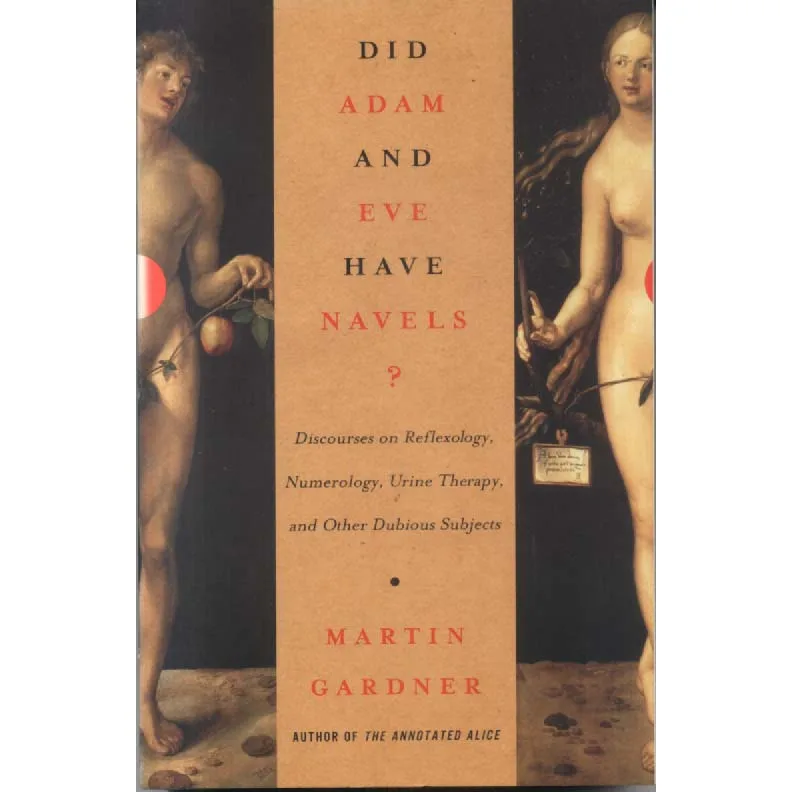
Publisher: Norton
Format: Paperback
ISBN: 0393049639
Did Adam and Eve Have Navels? (2000) – Martin Gardner
W. W. Norton & Company | ISBN: 0393049639 | Condition: Good
Sold by Crappy Old Books – Where the Questions Are Ridiculous, the Answers Are Fascinating, and Somebody Really Ought to Have Asked About the Belly Buttons Sooner.
Did Adam and Eve have navels? It is one of those questions that sounds utterly ridiculous until you think about it for approximately eleven seconds, at which point it becomes surprisingly difficult to dismiss. If Adam was created from dust and Eve from one of his ribs, neither had experienced gestation, neither had possessed an umbilical cord, and therefore neither had any obvious biological requirement for a belly button. On the other hand, if they lacked navels, would they really have looked like ordinary human beings? And what would this mean for several centuries’ worth of religious paintings featuring an anatomically complete Adam lounging about in the Garden of Eden?
Welcome to the wonderfully mischievous intellectual universe of Martin Gardner, a man who spent much of his extraordinarily productive life demonstrating that apparently silly questions can expose remarkably serious problems in science, philosophy, religion and human reasoning.
Did Adam and Eve Have Navels?, published by W. W. Norton in 2000, is a collection of essays drawn from Gardner’s long-standing fascination with the peculiar things people believe, the strange arguments they construct to defend those beliefs, and the entertaining ways in which logic, scepticism and a little intellectual curiosity can dismantle an impressive amount of nonsense.
And what a magnificent quantity of nonsense humanity has produced.
Gardner was one of America’s great popularisers of mathematics, science and rational inquiry. For twenty-five years he wrote the celebrated Mathematical Games column for Scientific American, introducing generations of readers to mathematical puzzles, logical paradoxes and ideas that might otherwise have remained imprisoned within academic journals. He was also a tireless investigator of pseudoscience, dubious claims, paranormal phenomena and the intellectual acrobatics performed by people determined to believe extraordinary things without necessarily producing extraordinary evidence.
He was, in short, the sort of person you would want sitting beside you when someone at a dinner party announced that the pyramids had been built by extraterrestrials using forgotten Atlantean technology.
Although you might not get invited back.
The book takes its title from a genuinely intriguing theological puzzle, but Gardner’s interests extend considerably beyond the abdominal arrangements of humanity’s alleged first couple. His essays explore the uneasy frontier between legitimate inquiry and speculative absurdity, examining the sorts of beliefs and intellectual fashions that flourish wherever human imagination manages to outrun human evidence.
The attraction lies in Gardner’s ability to make scepticism entertaining. He does not merely announce that an argument is mistaken and leave it there. He is interested in how the argument developed, why intelligent people might have found it convincing, what hidden assumptions lie beneath it, and how apparently persuasive reasoning can collapse when examined from a different angle.
This makes his work particularly enjoyable because the reader is encouraged to participate in the detective work. Rather than simply being told what to think, one is invited to discover why certain claims do not survive inspection.
Which is generally more satisfying than being shouted at by someone on the internet who has just completed forty-seven minutes of personal research.
Gardner’s intellectual approach is especially refreshing in a world where confidence is frequently mistaken for competence. The loudest person in the room is not necessarily the best informed, the most elaborate explanation is not necessarily the correct one, and the existence of a complicated theory does not automatically mean that the theory describes anything resembling reality.
These distinctions ought to be obvious. Unfortunately, much of human history suggests otherwise.
One of the pleasures of Gardner’s writing is that he appreciates the entertainment value of human gullibility without entirely losing sight of its consequences. Some strange beliefs are harmless eccentricities, the intellectual equivalent of collecting ornamental teaspoons. Others can mislead, exploit or encourage people to abandon sound reasoning in favour of comforting fantasies.
And then there are those beliefs that are simply too peculiar not to investigate.
The question of Adam and Eve’s navels illustrates the sort of intellectual territory Gardner enjoys exploring. It raises issues concerning creation, apparent age, historical interpretation and the relationship between theological claims and physical evidence. Beneath the superficial absurdity lurks a genuine philosophical difficulty: if a fully formed world were created with the appearance of a previous history, how could anyone distinguish that world from one that actually possessed such a history?
It is a question with implications considerably larger than the average belly button.
Naturally, the reader need not agree with Gardner on every subject to enjoy the book. Indeed, part of the pleasure is encountering an author who is prepared to argue, question, challenge and occasionally irritate. Intellectual life would be remarkably dull if every book consisted of an agreeable gentleman confirming everything we already believed.
Gardner’s lively prose, wide-ranging curiosity and appetite for exposing muddled thinking make him an excellent companion for anyone interested in the stranger corners of human knowledge. He brings the instincts of a mathematician, the enthusiasm of a puzzle enthusiast and the persistence of a sceptic to subjects that might otherwise be dismissed as too obscure, too controversial or simply too silly to deserve attention.
And he does so without requiring the reader to possess a doctorate, a laboratory or a particularly expensive calculator.
This is a book for people who enjoy having their assumptions prodded. It is for readers who find amusement in logical contradictions, pleasure in unexpected historical details and satisfaction in watching a grandiose claim meet the unfortunate obstacle of elementary reasoning. It will appeal to enthusiasts of popular science, philosophy, scepticism, religious controversy and intellectual oddities, as well as anyone who has ever wondered why otherwise sensible people sometimes believe things that make absolutely no sense whatsoever.
Of course, readers seeking a definitive answer to every mystery of existence may find themselves disappointed. Gardner’s greater contribution is to demonstrate how questions should be examined, how arguments should be evaluated and why the ability to distinguish between knowing something and merely believing it remains one of civilisation’s more useful achievements.
It has not, admittedly, prevented civilisation from inventing reality television, celebrity conspiracy theories or the motivational business seminar.
But one cannot reasonably expect a single author to solve everything.
Condition: Good. This is a previously owned copy of the 2000 Norton edition, showing the ordinary signs of handling and age appropriate to its stated condition. It is not being advertised as an untouched museum specimen, but as a perfectly respectable second-hand book containing far more intellectual entertainment than its modest physical circumstances might suggest.
And unlike some of the more extravagant theories Gardner examines, the book itself unquestionably exists. We have it. We can see it. It has pages. This is already a rather promising evidential foundation.
Ultimately, Did Adam and Eve Have Navels? celebrates something that never goes out of intellectual fashion, even if it occasionally falls out of social favour: the willingness to ask awkward questions.
Gardner reminds us that curiosity need not be solemn, scepticism need not be joyless, and an apparently absurd question can sometimes reveal a fundamental problem that generations of distinguished thinkers have managed to overlook.
Available from Crappy Old Books, where we warmly recommend this entertaining excursion into the oddities of belief, the pleasures of rational inquiry and the magnificent human capacity for getting things spectacularly wrong.
As for whether Adam and Eve possessed navels, you may have to make up your own mind.
But spare a thought for the poor Renaissance painters. They had enough trouble with perspective, anatomy and ecclesiastical patronage without somebody demanding theological justification for every belly button.
Keep browsing: See more Religion books Other books by Martin Gardner
