


Bored Of The Rings - A Parody Of JRR Tolkiens Lord Of The Rings
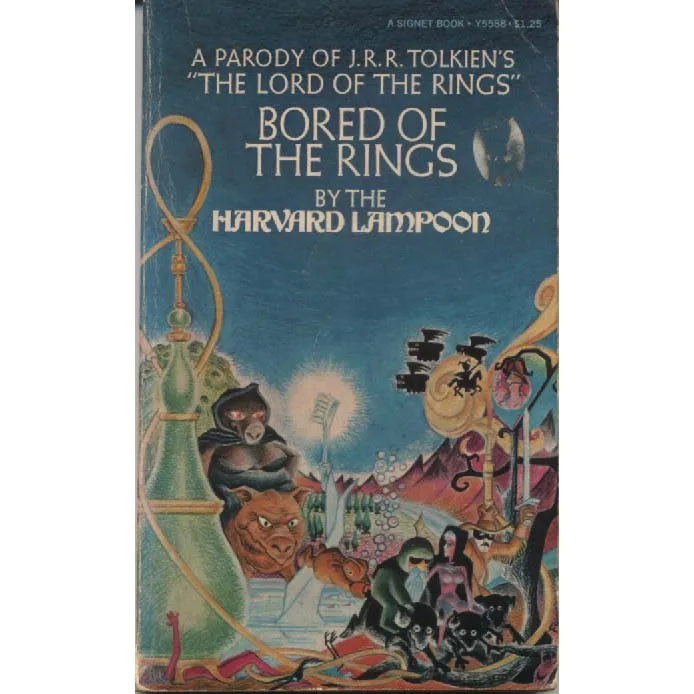
Publisher: Signet
Format: Paperback
ISBN: none
Publisher: Signet
Year: 1969
ISBN: None
Condition: Good
Sold by: Crappy Old Books
One Ring to Rule Them All, Several Idiots to Lose It, and an Entire Fantasy Epic Reduced to Complete Nonsense
There are few achievements in twentieth-century literature quite as impressive as J.R.R. Tolkien’s The Lord of the Rings. An immense work of imaginative fiction, it created an elaborate mythology complete with ancient languages, heroic genealogies, forgotten kingdoms, noble warriors and approximately seventeen thousand opportunities for somebody to break into song.
Naturally, somebody had to make fun of it.
Enter The Harvard Lampoon, America’s celebrated institution of undergraduate literary mischief, whose contributors apparently decided that Tolkien’s monumental fantasy epic contained far too much dignity, heroism and solemn discussion of destiny.
The result was Bored of the Rings, first published in 1969, a gloriously irreverent parody that takes Middle-earth, shakes it vigorously, removes whatever dignity survives and replaces its inhabitants with a collection of incompetent adventurers, dubious personalities and individuals whose principal qualification for saving civilisation appears to be that nobody else was available.
It is Tolkien as interpreted by people who have consumed too much coffee, developed an unhealthy suspicion of literary seriousness and concluded that the fate of the world should probably be entrusted to someone called Frito.
Welcome to Lower Middle Earth, Where Standards Have Slipped Considerably
Forget Frodo Baggins, the brave little hobbit entrusted with an almost impossible mission.
Meet Frito Bugger, whose adventures are considerably less noble and whose personal qualities leave much to be desired.
Forget Gandalf, the wise and mysterious wizard whose knowledge guides the Fellowship through mortal danger.
Meet Goodgulf, a wizard whose relationship with wisdom is rather more casual.
Then there is Spam, a considerably less inspiring version of Samwise Gamgee, alongside a supporting cast of characters whose names alone demonstrate that the authors approached Tolkien’s mythology with absolutely no intention of behaving themselves.
The noble figures of Middle-earth are transformed into ridiculous caricatures. The heroic struggle between good and evil becomes a procession of comic misunderstandings, absurd encounters and spectacularly undignified behaviour.
Even the grand geographical landscape receives an unfortunate makeover.
The result is Lower Middle Earth, a place where the ancient traditions of epic fantasy collide with American popular culture, undergraduate humour and the occasional joke that would probably have been considered dreadful even in 1969.
Fortunately, dreadful jokes are rather the point.
The Fellowship of the Ring Becomes a Gathering of Questionable Characters
Tolkien’s original novel concerns friendship, courage, sacrifice and the struggle against overwhelming evil.
Bored of the Rings concerns many of the same things, although generally by accident.
The heroic quest remains recognisable, but its participants possess little of the grandeur associated with their literary originals.
Characters bicker, misunderstand situations, behave selfishly and demonstrate an impressive ability to transform momentous events into opportunities for personal embarrassment.
The authors follow the broad structure of Tolkien’s epic while relentlessly puncturing its solemnity.
Magnificent descriptions become ridiculous exaggerations. Noble declarations are undermined by absurd dialogue. Ancient traditions are converted into jokes, while characters expected to embody courage and wisdom frequently display qualities more commonly associated with incompetent local government officials.
It is a thoroughly disrespectful enterprise.
And that is precisely why it works.
Anyone familiar with Tolkien will recognise the source material, making the parody particularly entertaining for readers who have struggled through the original trilogy’s mountains, forests, battles and extended discussions about the historical significance of a particular sword.
Here, the journey is considerably shorter.
Not necessarily more sensible, but certainly shorter.
A Product of 1969, When Nothing Was Sacred and Everybody Needed a Haircut
There is something wonderfully appropriate about Bored of the Rings appearing in 1969.
This was the age of counterculture, student rebellion, psychedelic experimentation and widespread suspicion towards established authority.
Tolkien’s novels had become enormously popular among young readers, particularly in American universities, where hobbits, wizards and the struggle against dark powers fitted rather conveniently into the cultural atmosphere.
The Harvard Lampoon responded by doing what satirists have always done when confronted with something enormously successful.
They ridiculed it.
The humour is unmistakably of its period, filled with irreverence, pop-cultural references, sexual innuendo, deliberately ridiculous names and an enthusiasm for bad taste that occasionally exceeds the requirements of the story.
Not every joke has aged gracefully.
Some have aged rather like a forgotten sandwich discovered behind a radiator.
Nevertheless, the book remains an entertaining example of late-1960s American satire and the wonderfully anarchic tradition of literary parody.
It also offers a reminder that irreverence existed long before the internet, and that university students were making terrible jokes about important cultural achievements decades before anyone could post them on social media.
Tolkien Fans: You Have Been Warned
The enjoyment of Bored of the Rings depends partly upon one’s relationship with the original novels.
Readers who regard Tolkien’s mythology as sacred literature may find the proceedings distressing.
Here, beloved characters are humiliated, magnificent landscapes are made ridiculous, and the entire moral architecture of Middle-earth is subjected to the literary equivalent of somebody drawing a moustache on the Mona Lisa.
But readers who appreciate affectionate mockery and absurdist humour will find plenty to enjoy.
The parody works because Tolkien’s world is so familiar and so meticulously constructed. Its seriousness provides the perfect target for writers determined to undermine practically every convention of heroic fantasy.
It is also remarkably liberating.
After thousands of pages concerning ancient prophecies, royal bloodlines, mysterious rings and the eternal struggle against darkness, there is something refreshing about a fantasy adventure that refuses to take anything seriously.
Especially itself.
About This Copy
This is the 1969 Signet edition of Bored of the Rings: A Parody of J.R.R. Tolkien’s Lord of the Rings by The Harvard Lampoon.
ISBN: None recorded for this copy.
Condition: Good. A previously owned vintage paperback showing ordinary signs of age, reading and handling consistent with its condition grading. A respectable survivor from the late 1960s, when books were made of paper, humour was considerably less restrained, and people could apparently spend entire afternoons laughing at the names of imaginary wizards.
Available from Crappy Old Books, where we believe that great literature deserves respect, but also that occasionally it deserves to be dragged through a hedge backwards by a group of irresponsible American undergraduates.
A gloriously silly, irreverent and deliberately ridiculous parody of Tolkien’s masterpiece, recommended for fantasy enthusiasts, collectors of vintage humorous paperbacks and anyone who has ever wondered whether the Fellowship might have benefited from a competent adult.
It will not deepen your understanding of Elvish mythology, improve your knowledge of ancient Middle-earth history or provide profound insights into the nature of good and evil.
But it might make you laugh.
And unlike Tolkien’s original trilogy, you can probably finish it without forgetting what year it is.
One Ring to rule them all.
One book to ridicule the whole business.
And absolutely no refunds if you were expecting The Silmarillion.
Keep browsing: See more Humour books Other books by Harvard Lampoon
