


Infinite Dreams
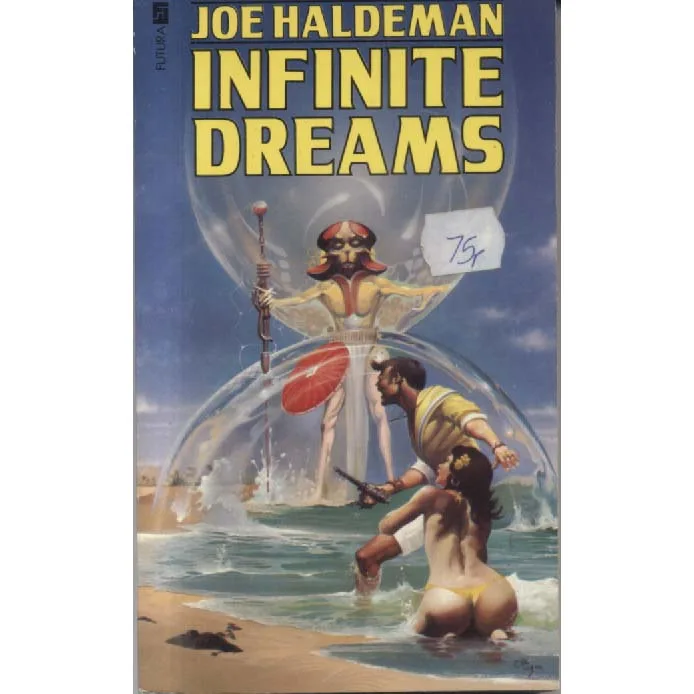
Publisher: Furura
Format: Paperback
ISBN: 0708880568
Infinite Dreams (1981) – Joe Haldeman
Publisher: Futura / Orbit Books
ISBN: 0708880568
Condition: Good
Sold by: Crappy Old Books
Thirteen Trips Into the Future, Where Everything Is Possible Except Humanity Behaving Sensibly
There was once a time when science fiction writers imagined that by the twenty-first century humanity would have conquered the stars, established colonies throughout the solar system, developed extraordinary artificial intelligences and perhaps even achieved something resembling a peaceful and rational civilisation. Instead, we have invented smartphones, automated customer service systems and refrigerators that require software updates, while continuing to argue about essentially the same things that troubled the ancient Romans.
Joe Haldeman, fortunately, never suffered from excessive confidence in human progress.
A Vietnam War veteran, physicist by training and one of the most thoughtful writers to emerge from the science fiction revolution of the 1970s, Haldeman understood that technological advancement and human wisdom were not necessarily travelling in the same direction. Indeed, they frequently appeared to be moving apart at considerable speed, occasionally accompanied by explosions.
In Infinite Dreams, originally published in 1978 and presented here in the 1981 British Futura edition, Haldeman assembles thirteen short stories exploring the stranger possibilities of science, technology, warfare, human psychology and the future of civilisation.
The collection ranges from distant cosmic mysteries to intimate psychological dilemmas, from artificial intelligence and biological transformation to political manipulation and the familiar human habit of producing elaborate technological solutions to problems that might have been avoided by exercising a little common sense.
It is a wonderfully varied collection, demonstrating Haldeman’s ability to move between serious speculation, dark humour and the occasional thoroughly absurd situation without losing his interest in the people caught up in the machinery.
And, in Haldeman’s universe, people have a distressing tendency to discover that the machinery is not particularly interested in their welfare.
The Future Is Here, and Somebody Has Mislaid the Instructions
One of the great pleasures of Haldeman’s fiction is his refusal to assume that technological progress automatically improves the human condition.
His imagined futures contain astonishing inventions, sophisticated computers, advanced medical techniques and extraordinary methods of manipulating matter and consciousness.
Yet the people inhabiting these futures remain recognisably human.
They are ambitious, frightened, inventive, selfish, courageous, confused and occasionally spectacularly foolish.
The machines may be different, but the psychological equipment remains depressingly familiar.
This gives Haldeman’s stories an appealingly grounded quality. Even when the underlying scientific speculation becomes wildly ambitious, the consequences are usually explored through the experiences of individuals rather than enormous lectures about the glorious destiny of mankind.
The reader encounters people attempting to survive, understand or exploit circumstances that have developed far beyond their original expectations.
Sometimes they succeed through ingenuity.
Sometimes they discover that ingenuity has made everything considerably worse.
And occasionally they encounter a situation so ridiculous that the only sensible response is to accept that the universe has developed a rather unpleasant sense of humour.
The Private War of Private Jacob – The Military Discovers an Improved Way to Use Human Beings
War has always presented military authorities with a fundamental difficulty.
Soldiers are human beings.
They become frightened, exhausted, confused and occasionally reluctant to follow orders that seem likely to result in their immediate destruction.
For centuries, armies have attempted to overcome these problems through discipline, training, propaganda and the careful cultivation of unquestioning obedience.
In The Private War of Private Jacob, Haldeman explores the disturbing possibilities of technological intervention in military behaviour.
The story examines the relationship between individual consciousness and the demands of organised warfare, raising uncomfortable questions about autonomy, identity and the extent to which institutions might manipulate those under their control.
It is a particularly appropriate subject for Haldeman, whose experiences of military service profoundly influenced his writing.
He understood that warfare was not simply a matter of impressive weapons and carefully drawn arrows on strategic maps.
It involved actual people, with memories, emotions and a disconcerting tendency to object to being killed.
The story reflects his recurring concern with the mechanisation of human behaviour and the danger of treating individuals as interchangeable components in an enormous institutional machine.
The military, of course, has always been enthusiastic about efficiency.
Whether the individual soldier benefits from that efficiency is another matter entirely.
The Mazel Tov Revolution – Capitalism, Revolution and Some Rather Unfortunate Business Decisions
Science fiction has frequently imagined the expansion of human commerce into space.
After all, once humanity has established colonies on distant planets, somebody will inevitably decide that the most important requirement is a suitable financial structure, preferably involving shareholders who have never visited the place.
In The Mazel Tov Revolution, Haldeman combines political speculation, satire and the possibilities of an expanded human civilisation.
The story concerns a remarkably unconventional challenge to established economic power, demonstrating how ingenuity and an understanding of human institutions can sometimes prove more disruptive than overwhelming physical force.
It is a story in which commerce, authority and revolutionary thinking become entangled, producing consequences that are both entertaining and thought-provoking.
Haldeman’s interest lies partly in the peculiar structures human beings create to organise their societies.
These arrangements may appear permanent, rational and entirely necessary to those who benefit from them.
Yet a sufficiently imaginative outsider can sometimes expose their weaknesses.
This is a dangerous proposition, particularly for large organisations accustomed to assuming that their existing procedures represent the natural and inevitable order of the universe.
One suspects that the inhabitants of Haldeman’s commercial future would have been extremely enthusiastic about quarterly financial reports.
Unfortunately, even an interplanetary business empire cannot guarantee protection against somebody having a better idea.
A Mind of His Own – Your Personality Is Now Available for Modification
Human beings are complicated creatures.
We possess memories, preferences, fears, habits and deeply ingrained psychological characteristics that collectively produce what we rather grandly describe as our personalities.
Some of these qualities are admirable.
Others are less attractive.
Most people would happily eliminate a few inconvenient memories, improve their confidence or remove some particularly irritating personality defect, preferably without having to endure several years of expensive therapy.
But what happens when technology offers the possibility of fundamentally altering the mind?
In A Mind of His Own, Haldeman explores psychological reconstruction and the unsettling consequences of attempting to manipulate individual identity.
The story raises questions concerning consciousness, personal autonomy and the relationship between mental processes and the sense of self.
If memories and psychological characteristics can be modified, what remains of the original individual?
Can a personality be repaired like a defective mechanical component?
And who gets to decide which aspects of somebody’s mind require improvement?
These are questions that have become increasingly relevant as neuroscience, psychology and artificial intelligence continue to develop.
Haldeman approached them during an era when such technological possibilities belonged largely to speculative fiction.
The results are disturbing, not least because the desire to improve the human mind can become difficult to distinguish from the desire to make people easier to control.
Which, one suspects, would appeal enormously to certain employers.
Juryrigged – A Human Being Becomes an Unfortunate Computer Accessory
In Juryrigged, Haldeman explores one of the more alarming possibilities of advanced computing: the integration of human consciousness into a technological system.
The story involves an ordinary individual caught up in the peculiar workings of a computerised society, where human beings may become components in systems they neither fully understand nor particularly wish to join.
It is a wonderfully uncomfortable premise.
Computers are supposed to serve humanity.
At least, that was the original sales pitch.
Unfortunately, technological systems have an established tendency to become increasingly elaborate until the people operating them are no longer entirely certain who is serving whom.
Modern readers may find this disturbingly familiar.
We already spend substantial portions of our lives entering information into databases, negotiating automated telephone menus and demonstrating our humanity to computer systems that appear deeply suspicious of the proposition.
Haldeman’s story takes the relationship between humans and machines into considerably stranger territory.
The resulting satire exposes the absurdity of allowing technological arrangements to acquire authority over the individuals they were supposedly designed to assist.
A particularly troubling idea, especially when one considers how many modern organisations now regard a computer refusing to perform a task as conclusive evidence that the task cannot be performed.
Armaja Das – Science Fiction Meets Something It Cannot Quite Explain
Although Haldeman is strongly associated with scientifically grounded speculative fiction, he was never afraid to wander into more mysterious territory.
Armaja Das introduces elements of the supernatural, combining an unusual curse with the unsettling possibilities of modern technology.
The result is a story that demonstrates how comfortably Haldeman can move between different traditions of fantastic literature.
Science fiction typically concerns itself with explanations, mechanisms and the consequences of scientific discoveries.
Supernatural fiction, by contrast, frequently begins with the uncomfortable suggestion that the universe is not obliged to explain itself.
Combining these approaches produces a particularly entertaining difficulty.
What happens when rational, technologically sophisticated people encounter something that refuses to behave according to their understanding of reality?
The answer, naturally, is that they attempt to investigate it.
This may or may not be wise.
The story’s mixture of wit, mystery and technological speculation provides an entertaining contrast to the more conventional science fiction scenarios elsewhere in the collection.
It also raises the possibility that some of humanity’s oldest superstitions might prove unexpectedly troublesome in an advanced technological civilisation.
Progress, apparently, does not guarantee immunity from ancient inconveniences.
Tricentennial – Three Hundred Years of American Progress, and Still Plenty to Worry About
Among the collection’s most celebrated stories is Tricentennial, winner of the Hugo Award for Best Short Story.
Set against the background of America’s three-hundredth anniversary, the story explores an ambitious space expedition involving a remarkable astronomical discovery and the possibility of obtaining antimatter.
Antimatter is one of those scientific concepts that sounds wonderfully useful until somebody explains the consequences of bringing it into contact with ordinary matter.
The resulting energy release is impressive.
So impressive, in fact, that the practical difficulties of transporting and storing the material become rather more important than the average shipping company would appreciate.
Haldeman uses this extraordinary scientific premise to develop a story concerned with exploration, technological ambition and the unpredictable consequences of scientific discovery.
There is a genuine sense of cosmic scale, combined with the author’s characteristic awareness that human beings remain fallible regardless of how impressive their equipment becomes.
The story illustrates one of science fiction’s greatest strengths: the ability to take a real scientific concept and explore possibilities far beyond current technological achievement.
It also demonstrates that the universe contains plenty of extraordinary opportunities for discovery, many of which are accompanied by equally extraordinary opportunities for catastrophe.
Humanity, naturally, remains enthusiastic about both.
Thirteen Stories and an Impressive Variety of Ways to Get Into Trouble
The full collection contains thirteen stories:
-
Counterpoint
-
Anniversary Project
-
The Mazel Tov Revolution
-
To Howard Hughes: A Modest Proposal
-
A Mind of His Own
-
All the Universe in a Mason Jar
-
The Private War of Private Jacob
-
A Time to Live
-
Juryrigged
-
Summer’s Lease (also published as Truth to Tell)
-
26 Days, on Earth
-
Armaja Das
-
Tricentennial
Together, they demonstrate Haldeman’s remarkable versatility as a short-story writer.
Some are concerned with large-scale scientific possibilities, while others concentrate on intensely personal experiences. Some are dark and unsettling. Others display a mischievous sense of humour, revealing the absurdities that can arise when human institutions encounter unfamiliar circumstances.
The collection also includes Haldeman’s own introductory notes on his stories, providing insights into their origins and the circumstances of their creation.
This is an especially attractive feature for readers interested in the writing process and the development of science fiction during the 1970s.
Rather than simply presenting the finished stories without explanation, Haldeman offers glimpses into the ideas and experiences that helped produce them.
It is rather like being allowed to look inside the workshop of a particularly imaginative engineer, except that instead of discovering spare bolts and half-finished machinery, one encounters nuclear blackmail, artificial intelligence, psychological experimentation and the occasional cosmic mystery.
Joe Haldeman – The Man Who Returned From War With Some Serious Questions
Joe Haldeman occupies a distinctive position in modern science fiction.
His celebrated novel The Forever War transformed military science fiction by combining interstellar conflict with the psychological consequences of warfare, technological change and the alienation experienced by soldiers returning to a society they no longer recognise.
The novel was informed by Haldeman’s service during the Vietnam War, an experience that left an unmistakable influence upon his fiction.
Unlike some earlier science fiction writers who portrayed warfare as an exhilarating demonstration of technological achievement, Haldeman understood that military service could be confusing, terrifying and profoundly destructive.
His fictional soldiers were not merely heroic figures operating impressive weapons.
They were individuals whose lives could be transformed or ruined by forces beyond their control.
This sensitivity extends into his shorter fiction, where scientific advances and political arrangements frequently carry unexpected personal consequences.
Haldeman’s writing is also notable for its clarity.
He can introduce complicated scientific concepts without transforming every story into a physics lecture, and his speculative ideas generally emerge through narrative rather than lengthy explanations.
His characters inhabit futures that feel intellectually convincing even when the premises become fantastic.
There is also a welcome absence of unquestioning technological optimism.
For Haldeman, the future offers extraordinary possibilities, but humanity must still contend with its own weaknesses.
We may eventually travel between stars, manipulate consciousness and control energies beyond anything presently imaginable.
Unfortunately, we shall probably still encounter incompetent managers, dubious political leaders and people who refuse to read the instructions.
The 1970s: When Science Fiction Became Rather Less Cheerful
Infinite Dreams belongs to an especially interesting period in the development of science fiction.
The technological optimism of the early space age had been complicated by the Vietnam War, environmental concerns, political upheaval and growing doubts about the consequences of scientific progress.
The future no longer appeared quite so straightforward.
Writers increasingly explored the social and psychological costs of advanced technology, questioning whether scientific achievement necessarily produced better societies.
Haldeman was an important part of this changing literary landscape.
His stories reflect a world in which technological sophistication can coexist with exploitation, violence, prejudice and institutional absurdity.
Yet they are not uniformly pessimistic.
Human intelligence, adaptability and imagination remain sources of hope, even when circumstances become extraordinarily difficult.
What emerges is a more complicated picture of the future than the familiar spectacle of handsome astronauts solving every problem through courage and conveniently available nuclear-powered machinery.
Haldeman’s universe is populated by individuals who must confront situations for which there may be no simple answer.
Sometimes the technology works perfectly.
It is the people who present the problem.
A Proper Old Futura Paperback From the Days When Science Fiction Had Ideas
This 1981 Futura edition offers more than a convenient collection of entertaining stories.
It is also a surviving example of the British paperback science fiction publishing tradition, when publishers such as Futura, New English Library, Panther and others brought important American speculative writing to readers through affordable mass-market editions.
These books occupied the shelves of railway station bookshops, libraries, second-hand shops and countless private collections.
They introduced generations of readers to strange planets, unfamiliar civilisations, dangerous technologies and philosophical questions that were rarely discussed with quite the same enthusiasm in ordinary everyday conversation.
There is something satisfying about encountering this material in its original paperback form.
No digital subscription is required. No electronic device needs charging. There are no advertisements interrupting the narrative, and no algorithm attempts to persuade you that because you enjoyed a story about interstellar antimatter, you might also be interested in purchasing a novelty kitchen utensil.
It is simply a book.
A modest collection of printed pages containing enough speculation, imagination and intellectual mischief to occupy several entertaining evenings.
For collectors of vintage science fiction, the edition also possesses the attraction of its period presentation and its association with one of the genre’s most respected writers.
And unlike much of the technology that appeared revolutionary in 1981, the basic operating system remains fully functional.
Open the cover. Read the words. Think about them.
An elegant arrangement that modern technology has spent decades attempting to improve, with decidedly mixed results.
About This Copy
This is the 1981 Futura / Orbit Books edition of Infinite Dreams by Joe Haldeman, ISBN 0708880568.
Condition: Good. A previously owned copy showing normal signs of reading, handling and age consistent with its condition grading. A respectable vintage science fiction paperback that has survived more than four decades without being absorbed into a municipal computer system or exposed to an unfortunate quantity of antimatter.
Available from Crappy Old Books, where we appreciate classic science fiction, imaginative speculation and the simple pleasure of owning a physical book that cannot be remotely deactivated by an overenthusiastic software company.
An excellent collection of thirteen inventive, thought-provoking and occasionally darkly humorous stories from one of science fiction’s most accomplished writers, exploring warfare, psychology, artificial intelligence, political power and the extraordinary possibilities of the universe.
Particularly recommended for Joe Haldeman enthusiasts, admirers of The Forever War, collectors of vintage Futura paperbacks and readers who enjoy science fiction that combines big ideas with recognisably human concerns.
It is a reminder that the future has always offered extraordinary possibilities, provided humanity can survive long enough to take advantage of them.
Haldeman imagined a civilisation capable of manipulating consciousness, exploiting exotic forms of energy and travelling across immense interstellar distances.
We have not quite managed all of that yet.
But we have developed computers capable of answering almost any question, pocket-sized devices containing entire libraries and machines that can generate convincing images of things that have never existed.
And what do we mostly use these astonishing inventions for?
Arguing, advertising and watching videos of animals behaving strangely.
Perhaps Joe Haldeman was right.
The universe may contain infinite dreams.
Unfortunately, humanity seems determined to spend most of its time pressing the snooze button.
Keep browsing: See more Science-Fiction books Other books by Joe Haldeman
