


Assignment In Eternity
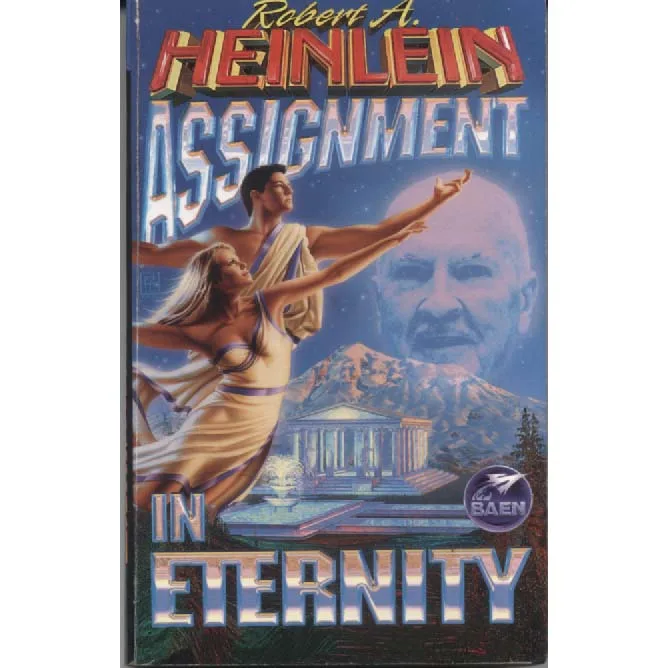
Publisher: BAEN
Format: Paperback
ISBN: 076714006997
Assignment in Eternity (2000) – Robert A. Heinlein
Publisher: Baen Books
ISBN / Product Code: 076714006997
Condition: Good
Sold by: Crappy Old Books
Four Adventures in Human Evolution, Parallel Universes and the Disturbing Possibility That the Monkey Might Be Smarter Than You
Humanity has always been rather pleased with itself. We have developed language, mastered electricity, explored the solar system and invented machines capable of producing seventeen different varieties of coffee, none of which tastes quite like the coffee we actually wanted. We consider ourselves intelligent, civilised and unquestionably superior to the rest of the animal kingdom, although a brief examination of human history suggests that the evidence for these claims is not entirely conclusive.
Robert A. Heinlein, one of science fiction’s most celebrated troublemakers, was never particularly inclined to accept humanity’s flattering assessment of itself. What if ordinary human intelligence represented merely an intermediate evolutionary stage? What if our minds possessed extraordinary abilities we had simply forgotten how to use? What if reality consisted of countless alternative worlds? And, perhaps most awkwardly, what if a genetically engineered animal displayed more humanity than the people legally entitled to call themselves human?
Welcome to Assignment in Eternity, a collection of four classic Heinlein stories originally published in science fiction magazines during the 1940s and subsequently brought together in book form in 1953. This 2000 Baen Books edition preserves a particularly entertaining selection of the author’s early speculative adventures, combining espionage, extraordinary mental powers, alternative realities and an unexpectedly serious examination of civil rights.
It is vintage Heinlein, which means the characters tend to be extraordinarily competent, the dialogue frequently resembles an intellectual fencing competition, and somebody is usually prepared to explain the fundamental nature of existence while simultaneously escaping from an impossibly dangerous situation.
There are four stories here, each exploring a different aspect of what humanity is, what it might become, and whether we should really be trusted with the capabilities we already possess.
Gulf – The Secret Agent Who Discovers That Ordinary People Are Rather Disappointing
In Gulf, Heinlein introduces a world of secret agents, dangerous conspiracies and individuals whose mental abilities make the average human being look rather like a confused goldfish attempting to complete a crossword puzzle.
The story begins as an espionage adventure involving intelligence operations and a potentially catastrophic threat. But beneath the intrigue lies a considerably more unsettling proposition: certain individuals may represent a new stage in human evolution, possessing intellectual capacities far beyond those of ordinary society.
These exceptional people have developed extraordinary methods of thinking and communicating, including a remarkably efficient form of speech known as Speedtalk. It is an intriguing concept, particularly when one considers how much time modern humanity wastes saying things that could have been communicated perfectly adequately by remaining silent.
As the protagonist encounters this hidden world of superior intelligence, the adventure develops into an examination of evolutionary difference, human potential and the relationship between those who possess exceptional abilities and those who do not.
Naturally, there are also sinister plots, dangerous missions and enough Cold War atmosphere to make everyone suspicious of everyone else.
Heinlein clearly enjoyed the idea of unusually capable individuals operating outside conventional institutions, particularly when those institutions were populated by officials who had apparently mistaken bureaucracy for intelligence.
It is a recurring theme in his work: the competent individual confronting a world organised largely by people who would struggle to find their own backsides with a diagram.
And if the extraordinary minds of Gulf seem rather pleased with themselves, the reader can hardly blame them. After all, they have discovered an evolutionary advantage considerably more useful than the ability to operate a smartphone while walking into a lamppost.
Elsewhen – When One Universe Simply Isn’t Enough
Most people find one reality quite sufficient.
There are bills to pay, appointments to remember, irritating neighbours to avoid and a constant procession of minor inconveniences suggesting that the universe was designed by somebody with a deeply questionable sense of humour.
But what if this reality were merely one possibility among countless others?
In Elsewhen, Heinlein explores the fascinating notion that the mind might be capable of travelling beyond conventional limitations of time and space, opening pathways into alternative worlds and different versions of existence.
A professor and his students become involved in experiments that challenge familiar assumptions about consciousness, identity and the nature of reality. Their discoveries lead them into possibilities far beyond the reassuringly ordinary world of lectures, academic discussions and university administration.
The story is particularly interesting because it anticipates themes Heinlein would return to in his later fiction, especially the idea of multiple realities existing beyond the one we happen to inhabit.
Here, the human mind becomes something far more remarkable than a biological machine for remembering shopping lists and worrying about the future. It may be capable of exploring entirely different paths through existence.
This raises several philosophical questions.
If countless alternative realities exist, are there countless alternative versions of ourselves? Could our lives have unfolded differently? Is there a universe somewhere in which politicians answer questions directly, trains arrive on time and every household appliance works exactly as advertised?
Science fiction offers no definitive reassurance.
Nevertheless, Elsewhen provides a wonderfully imaginative journey into the possibilities of consciousness and the unsettling suggestion that the universe might be considerably larger, stranger and less conveniently organised than we suppose.
Lost Legacy – Apparently, We’ve Mislaid Most of Our Brain’s Operating Instructions
One of the more disappointing aspects of human existence is the gap between what we imagine our brains ought to be capable of and what they actually achieve.
We can remember a humiliating incident from twenty-seven years ago with astonishing clarity, yet forget where we placed our spectacles thirty seconds earlier. We possess extraordinary powers of imagination, but routinely use them to invent elaborate explanations for why we have not completed the washing-up.
In Lost Legacy, Heinlein suggests that humanity may possess dormant mental abilities far beyond those generally recognised.
Telepathy, extraordinary perception and other seemingly impossible capacities become part of a speculative exploration of the human mind’s hidden potential.
The story follows characters who discover that ordinary consciousness may represent only a fraction of what human beings are capable of achieving. Through unusual experiences and encounters with hidden knowledge, they begin exploring possibilities that conventional science and society have largely overlooked.
Naturally, discovering that the human mind contains extraordinary capabilities does not make life simpler.
There are secrets to uncover, dangers to confront and the uncomfortable possibility that certain individuals understand considerably more about human nature than the rest of us.
The result is an adventure mixing speculative psychology, ancient mysteries and the intoxicating idea that humanity has somehow forgotten its own greatest inheritance.
This notion was particularly attractive to mid-twentieth-century science fiction writers, who frequently imagined that human evolution might eventually produce telepathy, heightened intelligence and powers beyond ordinary comprehension.
In retrospect, the results have been somewhat disappointing.
Decades of technological progress have provided humanity with computers, satellites and instant global communication, but there remains remarkably little evidence that anyone can reliably read another person’s mind.
Although married couples occasionally claim otherwise.
Jerry Was a Man – An Ape Walks Into Court and Makes Humanity Look Ridiculous
Of the four stories, Jerry Was a Man perhaps offers the most direct and deliciously uncomfortable challenge to humanity’s assumptions about itself.
Jerry is a genetically engineered anthropoid, one of a class of artificially produced beings whose existence raises awkward questions concerning intelligence, individuality and legal rights.
The central issue is deceptively simple: what exactly makes someone human?
Is humanity merely a matter of biological ancestry? Does intelligence matter? What about emotion, consciousness, individuality and the capacity to suffer? And if a manufactured creature demonstrates recognisably human characteristics, can society simply classify it as property and carry on with its business?
Heinlein develops these questions through a story involving legal arguments and the contested status of an engineered being.
It is a remarkable subject for science fiction written in the 1940s, anticipating ethical controversies surrounding genetic engineering, artificial intelligence, animal rights and the legal recognition of non-human intelligence.
The irony is magnificent.
Human beings, a species responsible for war, slavery, exploitation and an almost inexhaustible catalogue of unpleasantness, find themselves deciding whether another creature is sufficiently sophisticated to deserve recognition as a person.
One suspects Jerry might reasonably request an independent tribunal.
The story demonstrates Heinlein’s ability to wrap serious philosophical questions inside entertaining speculative fiction. Beneath the unusual premise lies an examination of prejudice, legal definitions and the tendency of powerful groups to decide who qualifies for protection.
And, as the title rather pointedly suggests, being a man may have considerably less to do with one’s biological classification than society would prefer to admit.
Four Stories, One Uncomfortable Question: What Makes Us So Special?
Although the four stories differ in setting, tone and narrative approach, they share a fascination with human identity and potential.
Gulf asks whether superior intelligence might produce a new kind of human being. Elsewhen challenges our assumptions about the boundaries of consciousness and reality. Lost Legacy imagines extraordinary abilities concealed within the human mind. Jerry Was a Man questions whether the definition of humanity should depend upon biological origins at all.
Together, they offer a splendidly speculative examination of what it means to be human.
The collection also reveals several of the ideas that would become characteristic of Heinlein’s later work: individual freedom, unconventional intelligence, social arrangements, personal responsibility and a persistent suspicion that established authority might not be quite as clever as it thinks.
His protagonists are frequently capable, independent-minded and reluctant to accept conventional explanations merely because those explanations have been approved by the appropriate committee.
This can be enormously entertaining, although one occasionally suspects that Heinlein’s ideal society would consist entirely of highly trained engineers, brilliant mathematicians, adventurous women and individuals capable of repairing a spacecraft using a pocketknife and three minutes of philosophical discussion.
There would presumably be very little room for management consultants.
Science Fiction From an Age When the Future Still Looked Interesting
One of the pleasures of reading classic Heinlein is encountering the future as imagined by a writer working before humanity actually arrived in it.
These stories emerged during the extraordinary scientific and technological ferment of the 1940s, when atomic energy, advanced aviation, electronics and developments in physics were transforming perceptions of what might become possible.
Science fiction writers looked towards a future of extraordinary machines, ambitious space exploration and fundamental changes in human society.
Some of their predictions were remarkably perceptive. Others were cheerfully extravagant.
And some now possess a delightful period charm, reflecting an era when advanced civilisations might reasonably be expected to possess astonishing spacecraft while retaining the social attitudes, clothing preferences and conversational habits of mid-century Americans.
Yet this is part of their appeal.
Heinlein was not merely predicting gadgets. He was examining how technological and biological possibilities might challenge familiar assumptions about humanity.
The stories are therefore interesting both as adventures and as historical examples of speculative thinking.
They reveal how an influential science fiction writer approached questions that continue to concern us, even if the vocabulary and scientific expectations have changed.
Artificial intelligence, genetic engineering, neurological enhancement, alternative realities and the ethical status of intelligent non-human beings all remain fascinating subjects.
The fact that we have not yet developed reliable telepathy should not discourage us unduly.
After all, we have invented social media, which allows everyone to know what everyone else is thinking, whether they wish to or not.
Robert A. Heinlein – The Man Who Rarely Left an Assumption Unchallenged
Robert A. Heinlein was one of the defining figures of twentieth-century science fiction, helping transform the genre from sensational adventure stories into a field capable of exploring complex political, scientific and philosophical ideas.
His influence extends across generations of writers and readers, and his fiction remains notable for its combination of energetic storytelling, technical speculation and provocative attitudes towards conventional society.
Heinlein was rarely content simply to introduce an extraordinary invention and describe what happened when somebody switched it on.
He wanted to know what that invention might do to human relationships, social institutions and established ideas about morality and identity.
This occasionally resulted in characters delivering opinions with the confidence of people who had never experienced the inconvenience of being wrong.
But it also produced fiction that encourages readers to question familiar beliefs and consider possibilities far beyond everyday experience.
Assignment in Eternity is particularly interesting because it brings together early explorations of several ideas that would reappear in his more ambitious later novels.
For established enthusiasts, it provides an opportunity to revisit the intellectual foundations of Heinlein’s fictional universe. For newcomers, it offers four substantial examples of his imagination at work without requiring commitment to one of his more imposing novels.
And for anyone who enjoys science fiction in which something actually happens between the philosophical arguments, there is adventure, danger and considerable entertainment.
About This Copy
This is the 2000 Baen Books edition of Assignment in Eternity by Robert A. Heinlein, product code 076714006997.
Condition: Good. A previously owned and read copy in good second-hand condition, showing the ordinary signs of handling and age consistent with its grading. It has survived into the twenty-first century without requiring the assistance of telepathy, superhuman intelligence or travel through alternative dimensions, which is more than can be said for some of Heinlein’s characters.
Available from Crappy Old Books, where we specialise in giving old books another opportunity to fulfil their literary destiny, preferably without involving a catastrophic interplanetary conspiracy.
An entertaining and thought-provoking collection of four classic science fiction adventures exploring extraordinary intelligence, hidden mental abilities, alternative realities and the surprisingly difficult question of what it actually means to be human.
Recommended for Heinlein enthusiasts, collectors of vintage science fiction, readers interested in the Golden Age of the genre and anyone who suspects that the human race might not represent the ultimate achievement of evolution.
After all, millions of years of natural selection have produced a species capable of understanding quantum physics, sending spacecraft beyond the solar system and contemplating the existence of parallel universes.
Unfortunately, the same species also invented automated customer service telephone systems.
Perhaps evolution still has some work to do.
Keep browsing: See more Science-Fiction books Other books by Robert A Heinlein
