


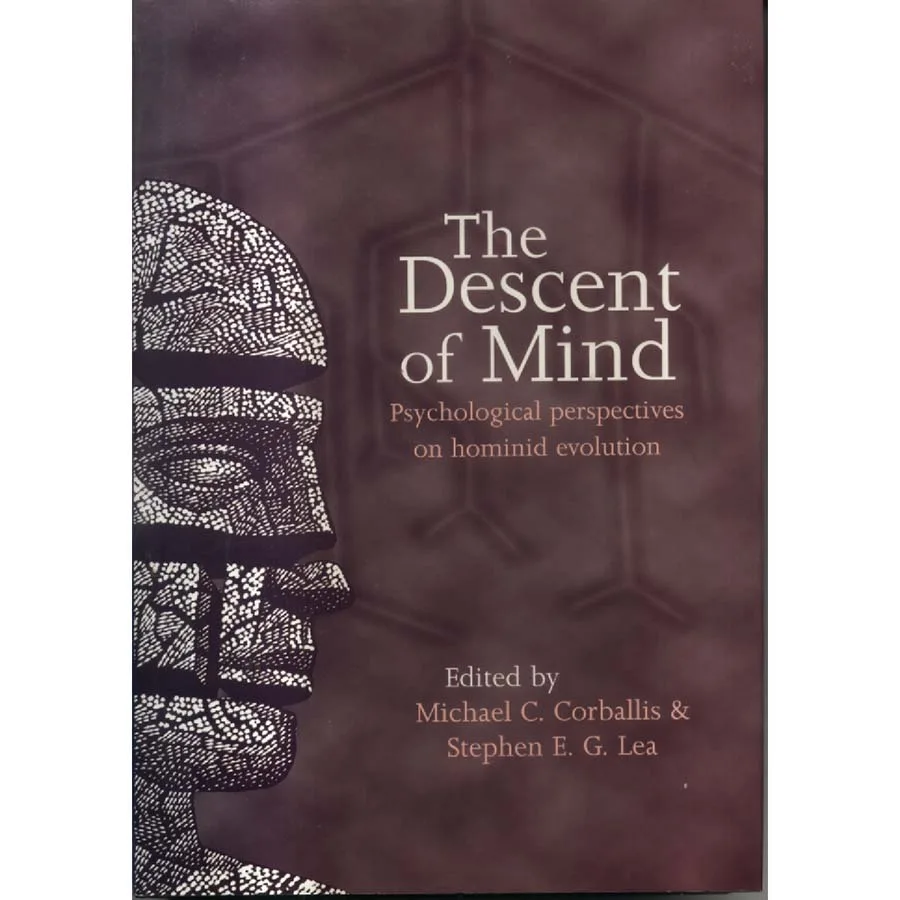
The Descent Of Mind - Psychological Perspectives On Hominid Evolution
Publisher: Oxford University Press
Format: Hardback
ISBN: 9780198524199
The Descent of Mind: Psychological Perspectives on Hominid Evolution (1999) – Michael C. Corballis and Stephen E. G. Lea
Publisher: Oxford University Press
ISBN: 9780198524199
Condition: Very Good
Sold by: Crappy Old Books
How a Bunch of Apes Developed Brains, Invented Civilisation and Eventually Created Reality Television
Somewhere in the distant African past, millions of years before smartphones, income tax, motorway service stations and the invention of management consultancy, something quite extraordinary began happening inside the heads of our ancestors. Their brains were changing. Their behaviour was becoming more complicated. They were developing new ways of understanding the world, manipulating objects, communicating with one another and generally making themselves rather more troublesome than the average mammal.
Eventually, this process produced human beings: creatures capable of composing symphonies, developing quantum mechanics, exploring outer space and spending forty-five minutes trying to remember why they walked into the kitchen.
How did this happen? Why did the human mind evolve in the particular way that it did? What separates human intelligence from that of other animals? And at what point did our ancestors stop behaving like ordinary apes and begin developing the psychological peculiarities that would eventually lead to philosophy, organised religion, international warfare and people arguing with strangers on the internet?
These are some of the enormous questions explored in The Descent of Mind: Psychological Perspectives on Hominid Evolution, edited by Michael C. Corballis and Stephen E. G. Lea and published by Oxford University Press.
Bringing together research and perspectives on the evolution of human cognition, this scholarly collection examines one of the most remarkable developments in natural history: the emergence of the human mind from the evolutionary processes that shaped our ancestors.
It is a subject of considerable scientific importance, not least because the human brain is responsible for practically everything we are proud of, along with a truly astonishing proportion of everything we should probably be embarrassed about.
Evolution’s Most Complicated Piece of Grey Porridge
Charles Darwin famously demonstrated that humanity was not exempt from the evolutionary processes governing the rest of the natural world. This was an unsettling proposition for Victorian society, which had spent centuries regarding human beings as rather special and was not especially delighted to discover that the family tree included creatures with unusually hairy relatives.
Yet explaining the evolution of the human body is only part of the story.
The development of the mind presents an even more complicated challenge. Bones and teeth fossilise. Stone tools survive. Ancient footprints can remain preserved for millions of years. Unfortunately, thoughts, memories, intentions and embarrassing personal fantasies do not leave much of an archaeological record.
Nobody has yet excavated a prehistoric opinion.
Consequently, scientists investigating the evolution of human psychology must draw upon evidence from several different disciplines, including evolutionary biology, comparative psychology, primatology, anthropology, neuroscience and the study of human behaviour.
The Descent of Mind approaches this challenge through psychological perspectives on hominid evolution, examining how cognitive capacities may have developed and how the behaviour of our evolutionary relatives can help illuminate the origins of our own mental abilities.
The resulting questions are fascinating. How did our ancestors acquire increasingly sophisticated mental representations of their surroundings? What evolutionary pressures favoured enhanced learning, memory and problem-solving? How did social relationships influence intelligence? And why did one lineage of primates eventually develop the capacity to contemplate its own existence, while others remained apparently content to concentrate on food, reproduction and avoiding predators?
Although, given the modern human condition, the latter arrangement arguably has certain advantages.
Before Language, There Was Probably a Great Deal of Pointing
One of the most intriguing aspects of human evolution concerns the development of communication and language.
Human beings possess an extraordinary ability to communicate complex ideas, describe imaginary events, discuss the distant past and make elaborate promises concerning things they have absolutely no intention of doing.
But language did not simply arrive one afternoon, fully formed, complete with grammar, irregular verbs and the English spelling system.
Its evolutionary origins remain a subject of scientific investigation and debate.
The psychological study of hominid evolution asks how increasingly sophisticated communication might have developed from the cognitive and social abilities of earlier ancestors. Understanding the relationship between language, memory, symbolic thought and social behaviour is central to understanding what makes human cognition distinctive.
Our nearest living relatives are capable of remarkably sophisticated behaviour, including communication, social learning and problem-solving. Yet human language permits an extraordinary flexibility of expression, allowing knowledge to accumulate and circulate between individuals and across generations.
It also permits the production of sentences such as ’Your call is important to us’, which demonstrates that evolutionary advancement is not necessarily accompanied by sincerity.
The emergence of sophisticated communication was potentially transformative. Information could be exchanged, relationships negotiated, activities coordinated and experience transmitted beyond the immediate circumstances in which it was acquired.
At some stage, our ancestors became capable of doing rather more than responding to the world directly. They could increasingly think about things that were absent, anticipate events and perhaps share information about situations that others had not witnessed.
Eventually, of course, this developed into the ability to tell somebody that the fish which escaped was considerably larger than it actually was.
The Social Brain: Because Other People Have Always Been Difficult
Living in groups presents obvious evolutionary advantages. There is safety in numbers, cooperation can improve access to resources, and social relationships provide opportunities that solitary existence does not.
Unfortunately, groups also contain other individuals.
These individuals may be allies, competitors, relatives, rivals or potential mates. They may share food, steal food, offer assistance, cause trouble or develop complicated social arrangements that must be remembered and negotiated.
The cognitive demands of social life provide an important perspective on the evolution of intelligence.
Comparative psychology allows researchers to investigate how animals recognise individuals, understand relationships, learn from one another and respond to changing social circumstances. Such abilities offer clues to the evolutionary foundations of human social cognition.
Human beings have taken these capacities to extraordinary lengths, developing families, communities, alliances, governments, multinational corporations and increasingly elaborate systems for determining who is responsible when something goes wrong.
Yet many of the psychological foundations of social existence may have deep evolutionary roots.
The ability to recognise another individual’s intentions, remember previous interactions, anticipate behaviour and adjust one’s own actions accordingly can be advantageous in a complex social environment.
It can also be exhausting.
Indeed, one might argue that a substantial proportion of modern human mental activity continues to revolve around the same fundamental concerns that troubled our distant ancestors: Who can be trusted? Who has the food? Who is in charge? And why is that individual behaving like such an idiot?
The surroundings have changed, but the questions remain remarkably familiar.
Clever Monkeys, Stone Tools and the Invention of Having a Plan
Another major puzzle concerns the relationship between intelligence, physical behaviour and technological development.
The archaeological record reveals that early hominins developed increasingly sophisticated ways of manipulating their environments. Stone tools provide evidence of practical skills, planning and interaction with materials, although the precise cognitive abilities involved remain matters for scientific interpretation.
Making a useful tool requires more than simply possessing an object. It can involve recognising suitable materials, anticipating the consequences of actions and coordinating movements towards a desired result.
Such activities raise fundamental questions about the evolution of problem-solving and mental representation.
At what point did our ancestors begin planning beyond their immediate needs? How did learning and imitation contribute to technological development? To what extent did practical manipulation of the environment influence the evolution of cognition?
These questions are particularly interesting because humans are not the only animals capable of using tools or solving complicated problems.
The evolutionary story is therefore not simply one of stupid animals becoming clever humans. It involves the development and modification of capacities that may have been present, in different forms, among earlier ancestors and other species.
Human intelligence emerged from an evolutionary history, rather than appearing out of nowhere as a spectacular neurological upgrade.
And while our ancestors eventually developed increasingly sophisticated technologies, it is worth remembering that much of modern life still depends upon the ancient technique of hitting something until it works.
The tools have improved, but the underlying philosophy remains surprisingly durable.
Consciousness, Cognition and the Unreasonable Complexity of Being Human
The evolution of mind is especially difficult to investigate because the mind itself is not a single, easily defined object.
It encompasses perception, memory, learning, attention, reasoning, communication, social understanding and numerous other capacities that interact in complicated ways.
Some of these abilities have clear parallels elsewhere in the animal kingdom. Others appear to have developed to exceptional degrees in humans.
The challenge is to understand how these different capacities evolved, how they influenced one another and which evolutionary pressures may have contributed to their development.
The Descent of Mind takes the subject seriously, drawing upon psychological research rather than treating human intelligence as an inevitable destination towards which evolution had been patiently working.
Evolution, after all, has no obligation to produce philosophers, mathematicians or university professors.
Natural selection favours characteristics in relation to the circumstances in which organisms live and reproduce. It does not maintain a master plan for the eventual invention of universities, parliamentary democracy or the self-service supermarket checkout.
Human cognitive abilities must therefore be understood within the evolutionary circumstances that shaped them.
This perspective can be rather humbling.
We like to imagine ourselves as exceptionally rational creatures, yet our psychological equipment evolved in environments profoundly different from those we now inhabit. The same mind capable of scientific discovery can also produce superstition, prejudice, irrational fears and the conviction that a particular football team is uniquely favoured by destiny.
The evolutionary origins of intelligence do not guarantee that intelligence will always be used intelligently.
Which, considering the historical evidence, is probably just as well.
The Missing Fossils Inside Our Heads
Perhaps the greatest challenge facing researchers into hominid psychology is that much of the evidence must be indirect.
A fossil skull may provide information about anatomy. Archaeological remains may reveal patterns of behaviour. Comparisons with living primates can illuminate the abilities of evolutionary relatives.
But none of these sources offers a complete account of what an ancient individual was thinking.
Researchers must construct explanations that connect physical evidence, observed behaviour and psychological theory, while recognising that several interpretations may sometimes be possible.
This makes the study of cognitive evolution both difficult and intellectually rewarding.
It requires cooperation between disciplines that do not always use the same methods, terminology or assumptions. Evolutionary biologists, psychologists, archaeologists and anthropologists may approach similar questions from very different directions.
Putting them together can be extraordinarily productive, although one suspects it occasionally resembles assembling a committee of academics and asking them to agree upon the definition of a thought.
Nevertheless, interdisciplinary research is essential if we are to understand how the human mind developed.
No single fossil, experiment or psychological theory can explain the entire evolutionary history of human cognition.
The story must be reconstructed from many pieces of evidence, some robust, others incomplete, and almost all open to further investigation.
An Academic Book for People Who Occasionally Wonder Why They Think at All
Published in 1999, The Descent of Mind belongs to an important period in the development of evolutionary approaches to psychology and cognition.
It is an academic collection rather than a lightweight popular-science introduction, making it particularly suitable for readers already interested in evolutionary psychology, comparative cognition, anthropology and the biological origins of human behaviour.
Readers should expect serious discussion and theoretical investigation rather than a cheerful chronological account in which a succession of increasingly upright apes gradually learns to operate a washing machine.
The subject is considerably more complicated, and considerably more rewarding.
Corballis and Lea bring together psychological perspectives that encourage readers to question familiar assumptions about human uniqueness and the nature of intelligence.
The collection is valuable not because it provides one final, definitive explanation of the human mind, but because it explores the problems involved in constructing such an explanation.
Even decades after publication, the historical development of these ideas remains interesting. Scientific understanding has continued to advance, particularly through genetics, neuroscience and new archaeological discoveries, but many fundamental questions concerning the evolution of cognition remain subjects of active debate.
How did human language emerge? What shaped our capacity for abstract reasoning? Why did social intelligence become so important? What distinguishes human cognition from that of our closest living relatives?
And perhaps most perplexing of all, how did a species capable of extraordinary intellectual achievements come to spend so much of its existence watching other members of the same species cook dinner on television?
The answers may not all be found here, but the questions are well worth exploring.
About This Copy
This is the 1999 Oxford University Press edition of The Descent of Mind: Psychological Perspectives on Hominid Evolution, edited by Michael C. Corballis and Stephen E. G. Lea, ISBN 9780198524199.
Condition: Very Good. A previously owned copy in very good second-hand condition, with only the modest signs of age and handling consistent with its grading. A respectable academic volume that has evidently survived its own evolutionary journey through the book trade without suffering any particularly serious setbacks.
Available from Crappy Old Books, where we take a keen interest in the survival of old books, the evolution of human intelligence and the curious fact that a species clever enough to develop written language now frequently communicates through pictures of cats.
An intellectually stimulating collection for psychologists, anthropologists, evolutionary biologists, students of human origins and anyone fascinated by the extraordinary development of the human mind.
It offers a scholarly examination of the evolutionary processes and psychological capacities that helped transform our distant ancestors into the peculiar, inventive, argumentative and occasionally brilliant creatures we are today.
After millions of years of evolution, humanity has developed the ability to contemplate its own origins, investigate the structure of the universe and ask profound questions about consciousness and existence.
Unfortunately, we have also developed the ability to read online comments.
Whether this represents evolutionary progress remains an open question.
Keep browsing: See more History books Other books by Michael C Corballis and Stephen EG Lea
