


Darwinism Comes To America
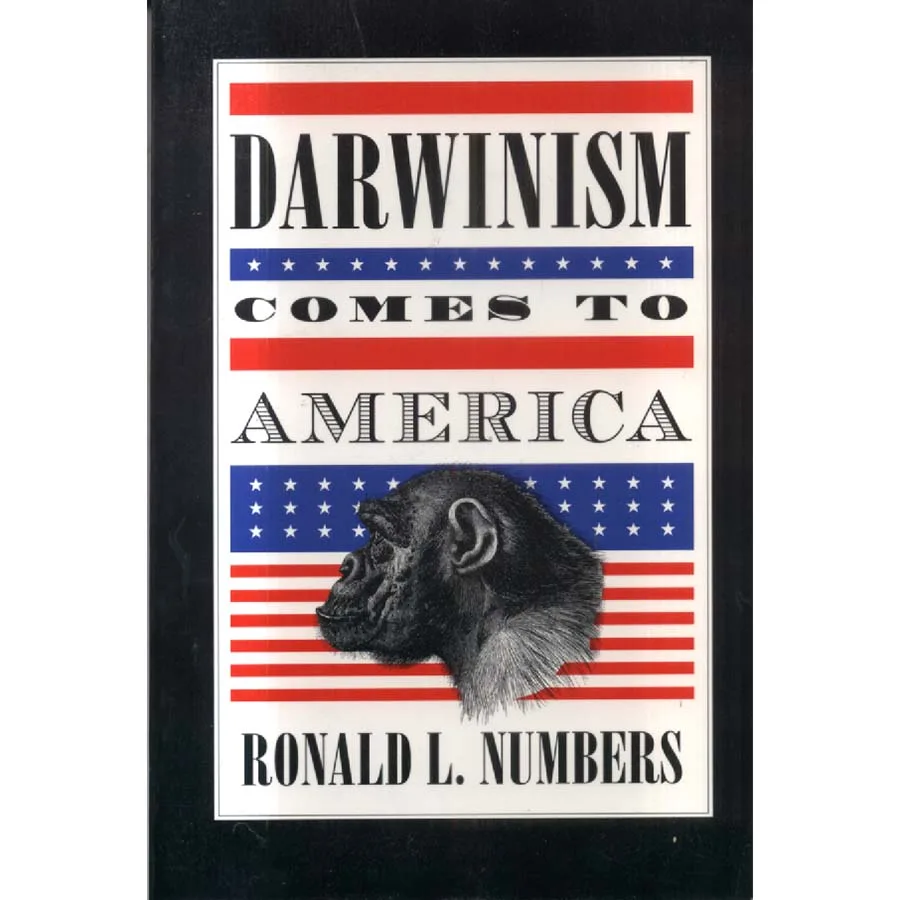
Publisher: Harvard University Press
Format: Paperback
ISBN: 9780674193123
Darwinism Comes to America (1998) – Ronald L. Numbers
Publisher: Harvard University Press
ISBN: 9780674193123
Condition: Good
Sold by: Crappy Old Books
Charles Darwin Crosses the Atlantic, and America Immediately Starts Arguing
In 1859, Charles Darwin published On the Origin of Species, a book that suggested life on Earth had developed through natural processes over immense periods of time rather than appearing fully assembled, individually labelled and ready for immediate use. This was an interesting scientific proposition, particularly for a society accustomed to believing that the natural world had been created according to a rather more direct and purposeful arrangement.
It was also a spectacular way to start an argument.
When Darwin’s ideas crossed the Atlantic, they arrived in a country already well practised in theological disagreement, political controversy and the deeply American conviction that everybody else was probably wrong. The United States had churches, universities, scientists, preachers, philosophers and an apparently inexhaustible enthusiasm for public disputation. Into this lively environment came evolutionary theory, carrying the unwelcome suggestion that humanity might not occupy quite the privileged position in nature that it had previously imagined.
In Darwinism Comes to America, distinguished historian of science Ronald L. Numbers examines how Americans responded to evolutionary thinking and how the resulting arguments developed across the scientific, religious and intellectual landscape. Published by Harvard University Press, this is a carefully researched account of one of the great cultural controversies of modern history, and one which has demonstrated a remarkable ability to survive long after most nineteenth-century disagreements have become the exclusive concern of historians.
Indeed, while the average Victorian argument about railway timetables, agricultural tariffs or the correct arrangement of a gentleman’s whiskers has largely disappeared, the argument over Darwin remains enthusiastically alive.
Evolution Arrives Without an Appointment
The popular version of this story is wonderfully straightforward. Darwin proposed evolution, scientists recognised that he was right, religious Americans became furious, and everybody spent the next century shouting at one another.
Unfortunately, history has a disagreeable habit of being more complicated than the people who enjoy shouting about it.
Numbers challenges simplistic accounts of Darwinism’s American reception, showing that the relationship between science and religion was neither uniformly hostile nor easily divided into enlightened evolutionists on one side and stubborn fundamentalists on the other.
Some religious thinkers found ways to accommodate evolutionary ideas. Some scientists had reservations about Darwin’s particular mechanisms. Others accepted aspects of evolution while rejecting natural selection as an adequate explanation. The theological and scientific arguments overlapped, diverged and changed over time, often producing positions that would thoroughly confuse anyone attempting to organise the participants into two convenient teams.
This is one of the book’s central attractions. Rather than presenting the controversy as a melodrama in which rationality defeats superstition, or faith heroically resists godless modernity, Numbers examines what people actually believed, why they believed it and how those beliefs changed.
It turns out that nineteenth-century Americans were capable of holding complicated opinions.
An alarming discovery, particularly by the standards of modern political discussion.
Scientists, Preachers and the Unfortunate Question of the Monkey
Darwinism presented Americans with several uncomfortable questions. If species evolved, what did that mean for the biblical account of creation? If humans shared ancestors with other animals, where did that leave human uniqueness? Could evolutionary theory be reconciled with divine purpose? And, perhaps most importantly to a society deeply concerned with respectability, was somebody seriously suggesting that respectable citizens were related to monkeys?
The last question proved particularly troublesome.
Numbers explores the reactions of American scientists, intellectuals and religious figures, including the complicated positions adopted by those who attempted to reconcile evolutionary science with their existing convictions.
The American scientific community was itself far from unanimous. Acceptance of evolution did not necessarily imply wholehearted enthusiasm for Darwinian natural selection, while opposition to particular scientific interpretations did not automatically amount to rejection of every evolutionary idea.
Nor was religious reaction uniform. Some theologians and Christian intellectuals regarded evolution as compatible with divine creation, while others perceived it as a threat to the foundations of religious authority and morality.
The resulting arguments were conducted through lectures, publications, academic institutions, churches and public controversies, creating an intellectual battlefield on which the combatants occasionally appeared to disagree about what the opposing side actually believed.
In other words, the foundations of a distinctly modern American tradition were already firmly established.
Creationism: A Surprisingly Complicated Family History
One of the most revealing aspects of Darwinism Comes to America is its examination of the historical development of anti-evolutionary thought, particularly the emergence of modern creationist movements.
It is tempting to imagine creationism as an ancient, unchanged body of belief that has existed in substantially the same form since the first chapter of Genesis. Numbers demonstrates that the reality is considerably more interesting.
American creationist positions developed through particular religious movements, intellectual influences and historical circumstances. The arguments advanced by opponents of evolution were not always identical, and the familiar contemporary divisions between evolutionists and creationists obscure a much more varied history.
Ideas that later appeared to be permanent and immovable religious principles often possessed surprisingly recent origins.
This is an awkward discovery for movements that pride themselves on defending eternal truths, although it is hardly unprecedented. Human beings have an impressive talent for taking relatively new ideas, dressing them in respectable historical clothing and announcing that things have always been done this way.
Numbers examines these developments with the attention of a historian rather than the enthusiasm of a participant in a theological street fight. His concern is to establish where ideas originated, how they spread and why particular interpretations became influential.
Consequently, the reader encounters not simply a history of Darwinism, but a history of the American reactions that helped shape its public reputation.
The Scopes Trial and the Great American Spectacle
No account of America’s evolutionary controversies can entirely escape the shadow of the famous 1925 Scopes trial in Tennessee, when a schoolteacher was prosecuted for teaching human evolution in violation of state law.
The trial became one of the most celebrated confrontations between science and religion in American history, featuring national publicity, prominent legal personalities and the irresistible spectacle of grown men arguing over humanity’s ancestry in a courtroom.
For many people, it remains the defining image of the American evolution controversy.
Yet Numbers places such events within a broader historical framework, demonstrating that public spectacles are rarely sufficient explanations for intellectual movements. The disputes surrounding Darwinism had been developing for decades before Scopes entered a courtroom, and they continued long afterwards.
The history is not merely a succession of famous confrontations. It involves scientific institutions, religious denominations, educational systems, publishing networks and changing public attitudes towards scientific authority.
The courtroom may have supplied the entertainment, but the underlying disagreements were considerably older and more deeply rooted.
And, rather inconveniently for those who thought the matter had been settled, they showed little inclination to disappear.
America: Where Even Biology Becomes a Cultural War
Perhaps the most striking feature of the story is how evolutionary theory became entangled with questions extending far beyond biology.
Darwin’s ideas were scientific propositions concerning the development and diversification of living organisms. Yet their reception was shaped by theology, philosophy, education and competing understandings of human nature.
The controversy became as much about who possessed the authority to explain the world as about the actual mechanisms of evolutionary change.
Scientists increasingly claimed authority in matters of natural explanation. Religious thinkers defended or revised their interpretations of creation. Educational institutions became arenas in which these competing claims were negotiated, contested and occasionally transformed into public entertainment.
Numbers demonstrates that the American experience of Darwinism cannot be reduced to a simple march of scientific progress against religious resistance.
Instead, it is a story of cultural adaptation, shifting alliances, intellectual uncertainty and the extraordinary ability of human beings to turn complicated questions into matters of personal and collective identity.
The irony is considerable. Evolutionary theory concerns the capacity of living organisms to change over time, yet arguments about evolution have frequently been conducted by people determined to demonstrate that their own opinions are incapable of doing anything of the sort.
A History of Ideas That Refuse to Become Extinct
What distinguishes Ronald L. Numbers’ treatment is its historical precision and willingness to challenge comfortable assumptions.
Readers expecting a straightforward celebration of scientific enlightenment may discover that the early reception of Darwinism was considerably more nuanced. Those expecting a history of consistent religious opposition may be surprised by the variety of theological responses.
The book reveals the intellectual complexity behind familiar slogans and demonstrates how modern controversies acquire their apparently fixed identities through historical processes.
It is an especially rewarding read for anyone interested in the history of science, American religion, evolutionary biology, intellectual history or the broader relationship between scientific discovery and cultural belief.
Although published in 1998, its subject has lost little of its relevance. America continues to debate evolution, religious authority and the teaching of science with an enthusiasm that would probably astonish Darwin, although perhaps not quite as much as the sight of millions of people carrying small electronic devices capable of accessing virtually all human knowledge while using them primarily to exchange insults.
For all the developments in genetics, molecular biology and evolutionary research, the cultural argument remains remarkably persistent.
Natural selection, it seems, has not yet eliminated the public appetite for controversy.
About This Copy
This is the 1998 Harvard University Press edition of Darwinism Comes to America by Ronald L. Numbers, ISBN 9780674193123.
Condition: Good. A previously owned copy showing the normal signs of handling, reading and age appropriate to its condition. It is a respectable second-hand academic title rather than an immaculate museum specimen, and it offers the considerable advantage of being available without the need to persuade a university library to lend it to you.
Available from Crappy Old Books, where we regard the survival of interesting second-hand books as an encouraging example of cultural selection. Less interesting books may also survive, of course, but nobody has yet established a convincing evolutionary mechanism for eliminating celebrity autobiographies.
An absorbing, intelligent and occasionally surprising history of how Darwin’s revolutionary ideas entered American intellectual life, challenged established assumptions and inspired arguments that have continued for well over a century.
Recommended for historians, scientists, theologians, sceptics, believers, students of American culture and anyone who has ever wondered why a nineteenth-century naturalist studying finches and other organisms managed to upset so many people who had never met him.
After all, Darwin proposed that life changes over time.
America responded by demonstrating that some arguments apparently don’t.
Keep browsing: See more History books Other books by Ronald L Numbers
