


Making Silent Stones Speak
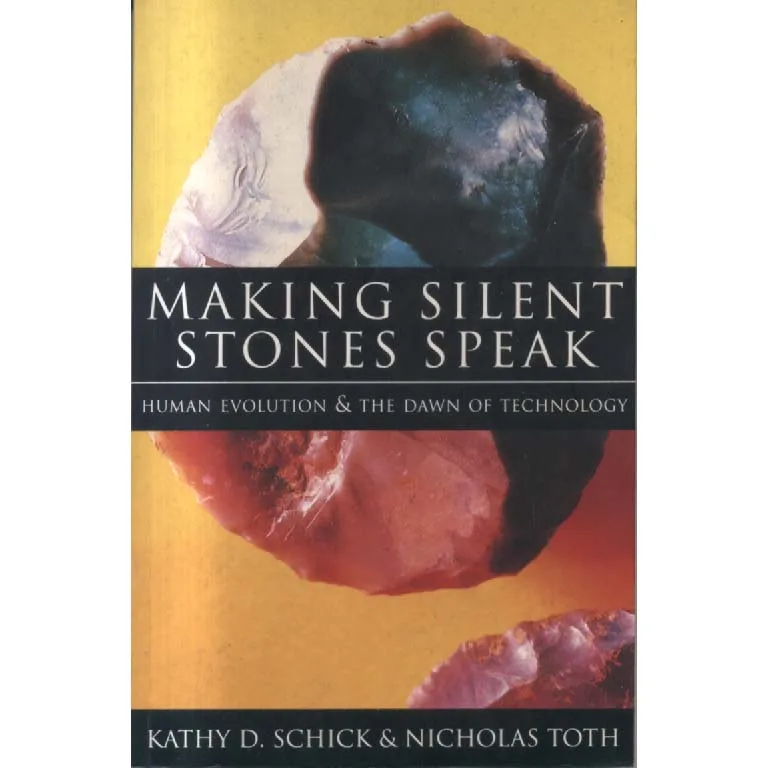
Publisher: Phoenix
Format: Paperback
ISBN: 9781857992427
Publisher: Phoenix
ISBN: 9781857992427
Condition: Good
Sold by: Crappy Old Books
Several Million Years of Human Achievement, Beginning with a Rock and a Surprisingly Good Idea
There was a time, long before smartphones, traffic wardens, mortgage applications and the invention of the customer satisfaction survey, when mankind’s greatest technological achievement consisted of picking up a stone and hitting another stone with it. Admittedly, this may not sound particularly impressive by modern standards, but it was the beginning of something extraordinary. From those first deliberately fractured rocks came knives, axes, spears, civilisation, nuclear weapons, electric toothbrushes and eventually the peculiar modern conviction that a refrigerator ought to be connected to the internet.
In Making Silent Stones Speak, archaeologists Kathy D. Schick and Nicholas Toth take us back to the very beginning of humanity’s technological adventure, when our ancestors were discovering that a sharp edge could be extremely useful, particularly when dinner had four legs, an unfortunate tendency to run away, and no intention whatsoever of becoming dinner.
This is the fascinating story of how scientists reconstruct the lives of our earliest ancestors from the objects they left behind, principally stones, bones and the occasional tantalising indication that somebody, somewhere, was thinking rather more seriously about lunch than their contemporaries.
The Stone Age: Before Everything Became Unnecessarily Complicated
The earliest stone tools are deceptively simple objects. To the untrained eye, many resemble the sort of things one might find in a garden and subsequently throw into a skip. To an archaeologist, however, a chipped flint can represent an extraordinary technological breakthrough, evidence of intelligence, planning, dexterity and perhaps even the first faint glimmerings of what would eventually become human culture.
Schick and Toth are particularly well qualified to explain this because they have done something rather more practical than merely sitting around discussing prehistoric stones. They have actually made them.
Through experimental archaeology, the authors reproduce ancient stone-tool manufacturing techniques, investigate how those tools were used, and examine the physical evidence left behind. By striking stones together, cutting materials, examining wear patterns and studying prehistoric archaeological sites, they demonstrate how seemingly insignificant fragments of rock can reveal remarkable details about vanished lives.
It turns out that making an effective stone tool is not necessarily as straightforward as it looks. There is a technique involved, an understanding of materials and a degree of coordination that many modern humans might struggle to demonstrate while attempting to open a particularly stubborn packet of biscuits.
And yet our distant ancestors were doing it millions of years ago, without instruction manuals, online tutorials or somebody on YouTube explaining that you have been holding your rock incorrectly all this time.
A Detective Story in Which the Suspects Have Been Dead for Millions of Years
One of the great attractions of prehistoric archaeology is that almost everybody involved has been dead for an exceptionally long time, most witnesses are unavailable, and the crime scene has generally been interfered with by geological processes.
Nevertheless, the evidence remains.
The authors explore how archaeologists interpret the archaeological record, particularly the stone tools and animal remains associated with early hominins. What can a pattern of fractured rocks tell us about intelligence? How can cut marks on bones reveal ancient feeding behaviour? Were our ancestors hunters, scavengers or opportunists who simply made the best of whatever happened to be lying around?
These are not trivial questions. Understanding how early humans obtained food, manufactured tools and interacted with their surroundings helps illuminate the development of our species and the extraordinary evolutionary journey that followed.
The book brings together archaeological discoveries, experiments, evolutionary research and observations of the physical world to show how the apparently mute remains of prehistory can be made to tell their stories.
Of course, stones do not actually speak, which is probably fortunate. Given the number of them scattered across the planet, the resulting conversation would be intolerable.
Meet Your Ancestors. They Had Rocks. You Have Problems.
There is something wonderfully humbling about studying the origins of human technology.
We tend to think of ourselves as astonishingly advanced creatures, capable of splitting atoms, exploring distant planets and manufacturing kitchen appliances that break down three months after their warranties expire. Yet the foundations of all these achievements were laid by creatures whose technological possessions could probably have been accommodated in a modest trouser pocket, assuming anyone had yet invented trousers.
Schick and Toth demonstrate that early toolmaking was part of a much larger evolutionary development involving behaviour, adaptation, learning and increasingly sophisticated relationships with the environment.
Their account takes readers into the world of early human ancestors and the scientific investigations that have transformed our understanding of them. It is a world without cities, governments, supermarkets or estate agents, although there were undoubtedly plenty of disputes over desirable locations and access to resources.
What makes the book particularly engaging is its emphasis on practical experimentation. Rather than treating the Stone Age as a remote collection of museum exhibits, the authors investigate what prehistoric technology actually involved and what its surviving traces can tell us.
The results are often surprising, occasionally ingenious and a useful reminder that intelligence did not suddenly materialise when somebody invented the personal computer.
Millions of Years Later, We Still Hit Things When They Don’t Work
Making Silent Stones Speak is an accessible and thought-provoking exploration of archaeology, human evolution and the origins of technology. It is particularly appealing to readers interested in prehistory, palaeoanthropology, experimental archaeology and the remarkable scientific detective work involved in reconstructing a world that disappeared long before anyone thought to write anything down.
There is also a certain irony in the subject. Our ancestors spent an extraordinary amount of time learning how to manufacture reliable cutting edges from stone. Modern civilisation has subsequently devoted enormous resources to producing disposable plastic objects that struggle to perform the same basic tasks.
Progress, apparently, is not always straightforward.
The book encourages readers to look differently at objects that might otherwise appear entirely ordinary. A fractured pebble, a scatter of stone flakes or a marked animal bone can become evidence of an ancient decision, a moment of ingenuity or a behaviour that helped shape the course of human evolution.
And unlike much of the technological rubbish manufactured in the last fifty years, these early products have demonstrated exceptional durability. Some have survived for millions of years, a record that modern consumer electronics manufacturers are unlikely to challenge.
About This Copy
This is the 1995 Phoenix edition of Making Silent Stones Speak by Kathy D. Schick and Nicholas Toth, ISBN 9781857992427.
Condition: Good. A previously owned and read copy showing the ordinary signs of use and age consistent with its condition grading. It is not being presented as a pristine collector’s specimen, but as a perfectly respectable second-hand book with plenty of intellectual life remaining.
Available from Crappy Old Books, where we appreciate books that have already survived a few decades, particularly when their subject matter concerns objects that have survived a few million years.
An excellent choice for anyone fascinated by human origins, ancient technology and the remarkable discovery that civilisation began not with a grand philosophical declaration, but quite possibly with someone looking at a rock and thinking, "I wonder what happens if I hit that?"
And the rest, as they say, is prehistory.
Keep browsing: See more History books Other books by Kathy D Schick and Nicholas Toth
