


The Day After Tomorrow
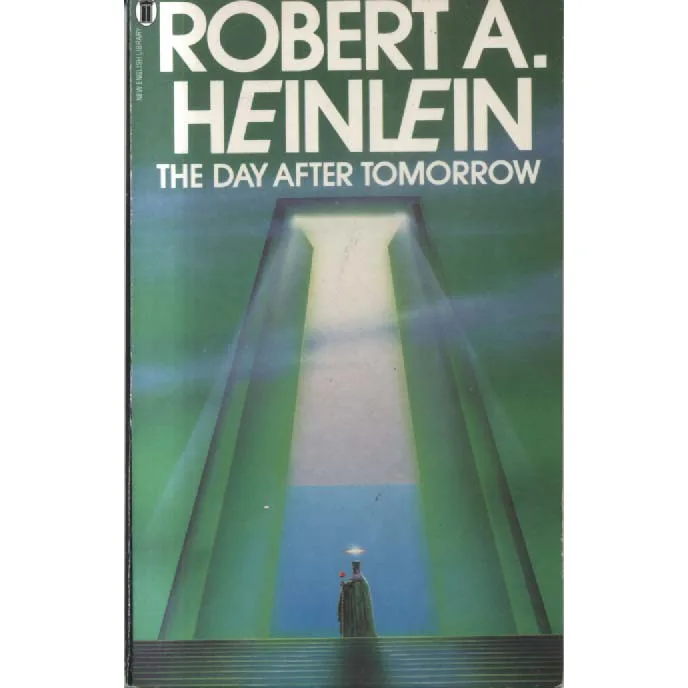
Publisher: New English Library
Format: Paperback
ISBN: 9780450010859
The Day After Tomorrow (1985) by Robert A. Heinlein
New English Library | ISBN: 9780450010859 | Condition: Good
There are military disasters, there are catastrophic military disasters, and then there is the rather unfortunate situation in which an entire country discovers that it has been conquered by a foreign empire and that the only people left capable of doing anything about it are a handful of scientists hiding inside a mountain. In The Day After Tomorrow, Robert A. Heinlein presents a splendidly audacious tale of invasion, resistance, secret weapons and the remarkable human ability to improvise a solution when conventional military planning has proved spectacularly inadequate. It is a story in which the United States finds itself occupied by a ruthless enemy, its armed forces defeated, its government destroyed and its surviving citizens faced with the deeply unwelcome prospect of discovering what life is like when somebody else has acquired control of the country.
Originally serialised in 1941 under the title Sixth Column, and first published in book form in 1949, The Day After Tomorrow belongs to the pioneering period of Heinlein’s science-fiction career, when the author was developing the combination of technological speculation, political argument and determinedly resourceful protagonists that would eventually make him one of the most influential writers in the genre.
The premise is straightforward enough, although the consequences are anything but agreeable. America has been overwhelmed by the forces of a powerful Pan-Asian empire, whose military superiority has enabled it to conquer the country with devastating efficiency. The invaders establish a brutal occupation, suppress resistance and impose their authority upon a population that has suddenly discovered that the freedoms it previously took for granted are no longer available.
This is, naturally, a thoroughly embarrassing development for a nation accustomed to regarding itself as the world’s foremost defender of liberty, democracy and the right to pursue happiness without excessive interference from foreign governments.
But all is not quite lost.
Hidden within a secret research installation in the mountains of Colorado, a small group of Americans survives the national catastrophe. The laboratory contains advanced scientific equipment and the results of experiments involving extraordinary new forms of energy, technology that may provide the foundations of a weapon capable of challenging the apparently invincible occupying forces.
Unfortunately, the scientific breakthrough has been achieved at considerable cost. A disastrous experiment has killed most of the laboratory’s personnel, leaving only a handful of survivors and a technological discovery that is not yet fully understood.
It is hardly an ideal foundation upon which to organise the liberation of an occupied continent.
Into this extraordinary situation comes Major Thomas Ardmore, an intelligence officer whose civilian background includes advertising, a qualification that might initially appear of limited practical value when confronting a vast military empire. After all, the ability to devise a successful commercial campaign does not generally feature prominently among the skills required to defeat an occupying army.
Heinlein, however, has other ideas.
Ardmore recognises that a small resistance movement cannot simply confront the enemy through conventional military means. The invaders possess overwhelming advantages in manpower, equipment and organisation, while the Americans have little more than a secret laboratory, some astonishing experimental technology and an increasingly urgent need to devise a strategy before somebody discovers where they are hiding.
The solution requires imagination, deception and a rather unconventional understanding of how human beings respond to authority.
Instead of building a conventional resistance army, Ardmore and his companions develop an elaborate organisation disguised as a religious movement. Their advanced scientific devices can produce effects that appear miraculous to those unfamiliar with the technology, allowing the resistance to operate under the protection of an apparently harmless spiritual institution.
It is a magnificently Heinleinian proposition: when military force proves inadequate, combine advanced physics, psychological manipulation, religious theatre and a thoroughly professional publicity campaign.
The result is an extraordinary struggle in which scientific ingenuity and an understanding of human behaviour become more important than tanks, aircraft and conventional military superiority.
There is something wonderfully ironic about the idea that a country conquered through overwhelming force might be liberated by people pretending to perform miracles. The occupation authorities understand military threats, armed resistance and conventional political opposition, but the emergence of a mysterious religious organisation presents a rather different administrative difficulty.
After all, it is one thing to arrest a suspected insurgent and quite another to explain why a supposedly harmless religious ceremony appears capable of producing effects that the finest military technology cannot reproduce.
Heinlein’s treatment of science is characteristically enthusiastic. His protagonists approach extraordinary discoveries with the practical determination of engineers who believe that every problem possesses a technical solution, provided sufficient effort is devoted to understanding it.
The novel reflects the extraordinary scientific optimism of the early twentieth century, when developments in atomic physics, electronics and other emerging disciplines encouraged speculation about technologies capable of transforming civilisation almost overnight.
In Heinlein’s fictional world, the discovery of a new physical principle becomes the key to an entirely different form of warfare, challenging the assumption that military power necessarily depends upon possessing the largest armies and the most expensive conventional weapons.
Of course, the book also demonstrates one of science fiction’s more entertaining habits: introducing an extraordinary technological breakthrough and then allowing the characters to develop applications for it with a speed that would leave a modern research laboratory’s funding committee suffering from acute professional embarrassment.
Where contemporary scientific projects may require years of testing, regulatory approval, peer review and interminable discussions concerning budgets, Heinlein’s resourceful Americans tend to recognise an opportunity, examine the available equipment and begin investigating whether they can use it to overthrow an empire before lunch.
This enthusiasm for practical problem-solving is central to the novel’s appeal.
Ardmore is not a conventional action hero whose principal qualification is the ability to shoot large numbers of enemies while remaining attractively dishevelled. His strength lies in organisation, strategy and the recognition that winning a conflict may require understanding the opponent’s beliefs and assumptions rather than merely attempting to defeat his armies.
There is also a decidedly uncomfortable historical dimension to the book. Written before the United States entered the Second World War, the story reflects contemporary anxieties about Asian military expansion, dictatorship and the possibility of national conquest.
Its portrayal of the Pan-Asian enemy and its reliance upon racial distinctions, particularly in relation to the fictional weapons, contain ideas that modern readers are likely to find troubling. These elements reflect both the prejudices and political fears present in the story’s original period, and they deserve to be recognised rather than quietly ignored.
Indeed, this makes The Day After Tomorrow especially interesting as a historical example of early science fiction. The novel reveals not only the imaginative ambitions of its author but also the assumptions, anxieties and limitations of the world in which it was written.
The fictional enemy is presented as ruthlessly authoritarian, with the occupying regime exercising brutal control over the conquered population. Heinlein uses this setting to explore questions of resistance, political freedom and the moral responsibilities of individuals confronted with overwhelming tyranny.
But the story also raises the awkward question of how far those fighting oppression may legitimately go in developing and deploying extraordinary new weapons.
A resistance movement that acquires technological power beyond anything possessed by the established authorities must eventually confront the problem of what should happen once the immediate struggle is over. Defeating a dictatorship is one thing; ensuring that the victors do not simply establish another form of unaccountable power is quite another.
This concern would recur throughout Heinlein’s later fiction, in which individual liberty, political authority and the dangers of concentrated power frequently become central themes.
There is also the practical problem of secrecy. The surviving Americans cannot afford to reveal the true nature of their discoveries, yet their strategy requires them to operate among the population, establish contacts and gradually undermine the occupying regime.
The entire enterprise becomes an elaborate exercise in controlled deception, depending upon the ability of a tiny group to sustain a convincing public identity while secretly organising a struggle against one of the most powerful military organisations imaginable.
One suspects that the administrative arrangements would have been formidable, particularly given that their organisation combines the functions of a scientific establishment, intelligence service, military resistance movement and religious institution.
Even ordinary businesses occasionally struggle to coordinate the responsibilities of their different departments. Attempting to liberate an occupied country while maintaining the appearance of a respectable spiritual organisation would undoubtedly create some exceptionally complicated staff meetings.
The book’s original title, Sixth Column, is particularly appropriate. The familiar expression ’fifth column’ refers to secret supporters of an enemy operating within a country, while Heinlein’s title suggests a new and unconventional force working against the occupiers from within their supposedly secure conquest.
Under the alternative title The Day After Tomorrow, the novel takes on a broader suggestion of an imagined and potentially alarming future, a world in which today’s familiar political arrangements have disappeared and entirely new struggles are being fought.
There is something suitably ominous about the title. Tomorrow may be expected to arrive more or less normally, but the day after tomorrow apparently involves foreign occupation, revolutionary physics and the urgent necessity of establishing a new religion.
One might reasonably prefer to remain in bed.
For readers familiar with Heinlein’s later novels, The Day After Tomorrow offers a fascinating opportunity to encounter the author during an earlier phase of his development. The writing is direct, the pace brisk and the emphasis firmly upon ingenuity, technological possibilities and the determination of competent individuals to overcome enormous obstacles.
This is not the sprawling philosophical Heinlein of Time Enough for Love or I Will Fear No Evil, where characters can spend considerable portions of a novel discussing human behaviour, sexuality and political theory while the plot waits patiently for them to finish.
Instead, the action proceeds with the urgency of a wartime adventure, albeit one whose central military strategy involves enough speculative science to leave the average defence procurement official reaching for a strong drink.
The novel also reflects the pulp science-fiction tradition from which Heinlein emerged. Originally appearing in Astounding Science-Fiction, it belongs to an era when magazines provided a home for ambitious stories involving scientific discoveries, future societies and dramatic conflicts between technological civilisation and the threats confronting it.
These publications helped establish many of the conventions that would define science fiction for generations, while providing talented writers with opportunities to explore ideas that mainstream literary publishing might have regarded as rather peculiar.
There is something wonderfully appealing about the directness of early science fiction. The author presents an extraordinary problem, assembles a group of intelligent protagonists and invites the reader to discover how ingenuity and determination might overcome apparently impossible circumstances.
The scientific explanations may not always withstand rigorous modern examination, and the political assumptions can belong unmistakably to their historical moment, but the imaginative energy remains considerable.
And, naturally, the Americans possess an admirable ability to discover that the solution to their difficulties involves something that nobody else has quite managed to understand.
The book’s depiction of advertising as a useful skill in the organisation of resistance is also especially entertaining. In most military adventures, the heroes possess backgrounds in special forces, intelligence operations or advanced weapons development. Heinlein recognises that the ability to influence public opinion, construct convincing appearances and manipulate expectations may prove equally valuable.
This is, perhaps, one of the more unsettling observations in the novel.
If the techniques employed to persuade people to purchase household products can also be adapted to undermine an occupying empire, one begins to wonder whether the advertising industry possesses rather more political potential than is generally acknowledged.
The distinction between propaganda, persuasion and ordinary commercial publicity becomes particularly interesting when the survival of an entire resistance movement depends upon convincing people that scientific technology is actually evidence of supernatural intervention.
Modern readers familiar with political misinformation, carefully managed public images and sophisticated campaigns designed to influence opinion may find some of these ideas unexpectedly recognisable.
The technologies have changed, but humanity’s willingness to believe extraordinary claims when they are presented with sufficient confidence remains impressively consistent.
Published in this 1985 New English Library edition, The Day After Tomorrow offers an enjoyable glimpse into the formative period of one of science fiction’s most influential authors.
It is also a fascinating period piece, both in its portrayal of an imagined future and in the political attitudes it preserves from the tense years immediately preceding America’s entry into the Second World War.
For collectors of Heinlein, the novel occupies a distinctive position within his bibliography, combining wartime anxieties, technological optimism and the recurring conviction that a small group of resourceful individuals can accomplish extraordinary things when freed from the limitations of conventional thinking.
The story is particularly suitable for readers who enjoy science fiction built around resistance movements, secret scientific discoveries and conflicts in which intelligence and deception prove more effective than sheer military strength.
It also offers a reminder that the appeal of science fiction does not depend upon the author’s predictions coming true. Indeed, the imaginative futures of earlier generations are frequently most interesting precisely because they reveal what people feared, hoped for and believed possible at the time.
This 1985 New English Library edition is offered in Good condition by Crappy Old Books, a bookseller that appreciates the resourcefulness of small organisations operating against overwhelming odds, particularly when the opposition consists of powerful institutions, complicated administrative systems and people who appear determined to make ordinary life unnecessarily difficult.
Unlike the resistance fighters in Heinlein’s novel, this particular enterprise does not possess an underground scientific laboratory, a revolutionary energy weapon or a secret network of religious operatives. Its activities are presently confined to rescuing elderly books and attempting to persuade the public that purchasing them represents a worthwhile contribution to civilisation.
It is a considerably less ambitious undertaking, although the administrative complications can occasionally be surprisingly similar.
An excellent addition to any collection of classic science fiction, Robert A. Heinlein paperbacks, alternative-history adventures or literature reflecting the political anxieties of the Second World War era, The Day After Tomorrow offers an entertaining mixture of imaginative technology, political resistance and unconventional military strategy.
A fast-moving and provocative early Heinlein adventure, exploring the struggle against tyranny through scientific ingenuity, psychological warfare and the astonishing proposition that a handful of determined individuals might succeed where an entire national army has failed.
And perhaps the greatest irony of the entire story is that humanity’s salvation depends not simply upon possessing advanced scientific knowledge, but upon discovering how to market it convincingly to an unsuspecting public.
Apparently, even the liberation of an occupied nation requires a successful advertising campaign.
Crappy Old Books: supplying classic science fiction without the need for a secret underground laboratory, an invented religion or a revolutionary military weapon disguised as a miracle.
And should somebody ask whether the novel’s scientific discoveries are entirely plausible, simply remind them that this is science fiction, a literary genre in which the impossible is routinely achieved by a small collection of brilliant people working in a laboratory with insufficient funding.
The genuinely unrealistic aspect is probably the assumption that the government would allow them to proceed without first establishing a committee to investigate the potential regulatory implications.
Keep browsing: See more Science-Fiction books Other books by Robert A Heinlein
