


Double Star
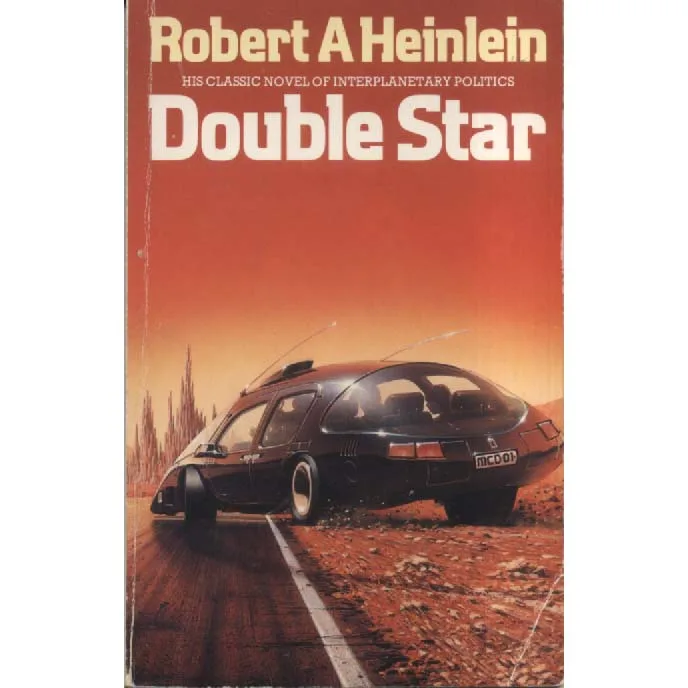
Publisher: Grafton Books
Format: Paperback
ISBN: 9780586025024
Double Star (1986) by Robert A. Heinlein
Grafton Books | ISBN: 9780586025024 | Condition: Good
There are actors, there are politicians, and then there are actors pretending to be politicians, a distinction that has occasionally proved rather difficult to establish even without the assistance of science fiction. In Double Star, Robert A. Heinlein explores what happens when an unsuccessful theatrical performer is hired to impersonate one of the most important political figures in the Solar System, only to discover that the role requires rather more than remembering his lines and accepting enthusiastic applause. It is a magnificent tale of deception, political intrigue, interplanetary diplomacy and the unsettling possibility that a professional actor might actually make a better statesman than the person he has been employed to imitate.
Originally published in 1956 and winner of the Hugo Award for Best Novel, Double Star is one of Heinlein’s most entertaining and tightly constructed works, combining the excitement of a political thriller with the imaginative possibilities of a future in which humanity has expanded across the Solar System. It also possesses a wonderfully mischievous central premise: if politics is largely a matter of public performance, why bother with an actual politician when somebody professionally trained in pretending to be other people might do the job considerably more convincingly?
Our unlikely hero is Lawrence Smith, better known by his theatrical name of Lorenzo Smythe, an actor whose opinion of his own abilities is matched only by the unfortunate reluctance of the entertainment industry to provide him with employment worthy of his extraordinary talents. Lorenzo regards himself as a distinguished performer, a master of disguise and characterisation, and a gentleman destined for greatness, even if the available evidence suggests that greatness has been experiencing considerable difficulty locating his current address.
Like many theatrical personalities, Lorenzo possesses an ego of impressive dimensions and an income rather less substantial than he would prefer. He is a man capable of discussing the noblest traditions of dramatic art while worrying about where his next meal is coming from, a combination that has sustained generations of actors and provided considerable entertainment to landlords attempting to collect overdue rent.
His circumstances change dramatically when he is approached with an unusual proposition. A prominent political leader, John Joseph Bonforte, has been kidnapped, and his associates desperately need somebody capable of impersonating him during an important public appearance. The assignment is politically sensitive, potentially dangerous and entirely unsuitable for an ordinary amateur.
Naturally, they turn to a professional actor.
Lorenzo is initially less than enthusiastic. He possesses strong prejudices concerning Martians and has little sympathy for Bonforte’s political ideals, particularly the statesman’s commitment to extending rights and recognition to the non-human inhabitants of the Solar System. The very prospect of participating in the complicated ceremonies associated with Martian society fills him with a mixture of distaste and theatrical indignation.
Unfortunately, financial necessity has a remarkable ability to overcome deeply held principles, particularly when those principles are being defended by a gentleman whose professional engagements have become distressingly infrequent.
The role proves considerably more demanding than Lorenzo anticipates. Bonforte is not merely a politician with a recognisable face and a collection of familiar speeches. He is an accomplished statesman whose public behaviour, personal mannerisms, political knowledge and relationships have been observed closely by colleagues, supporters and enemies alike.
To impersonate such a figure convincingly requires an extraordinary degree of preparation. Lorenzo must study Bonforte’s appearance, gestures, speech patterns and personality, while acquiring sufficient understanding of his political commitments to survive encounters with people who know the original man intimately.
A lesser actor might have been content to wear suitable clothing, practise a few characteristic expressions and hope that nobody asked a difficult question. Lorenzo, however, approaches the assignment with the professional seriousness of a performer who understands that a convincing portrayal depends upon inhabiting the character rather than simply imitating his appearance.
This proves fortunate, since the consequences of failure extend somewhat beyond receiving an unfavourable theatrical review.
Bonforte’s political career is central to a struggle concerning the future of humanity’s relations with other intelligent species. His commitment to cooperation and equal treatment has made him a figure of enormous importance, but also attracted determined opposition from individuals and political groups who regard the extension of rights beyond humanity as an intolerable threat.
The resulting intrigue involves questions of prejudice, citizenship, political legitimacy and the difficulties of governing a society that has expanded far beyond the familiar boundaries of Earth.
Heinlein was particularly interested in examining how human institutions might adapt to the discovery of intelligent extraterrestrial life. Science fiction frequently imagines alien species as enemies to be defeated, monsters to be avoided or convenient providers of advanced technology. In Double Star, however, the presence of other intelligent beings creates political and moral problems remarkably similar to those that have troubled human societies throughout history.
Who deserves political representation? What constitutes membership of a community? Can people overcome inherited prejudice? And how far should a government extend rights to those whom its citizens regard as fundamentally different?
These are serious questions, although Heinlein has the considerable good sense to explore them through a lively adventure rather than requiring his readers to attend a three-day symposium on interplanetary constitutional arrangements.
The Martians themselves are particularly important to the story. Their customs, social organisation and cultural expectations differ considerably from those familiar to humanity, creating circumstances in which political diplomacy requires more than a reassuring handshake and a carefully prepared speech.
Lorenzo must learn not merely to resemble Bonforte but to understand the significance of his relationships with the Martians, an experience that gradually challenges some of his own assumptions.
There is something wonderfully ironic about the transformation. A man hired to impersonate a politician whose principles he initially dislikes begins to discover that understanding another person’s convictions may require him to reconsider his own.
Acting, in this case, becomes an unexpected education in moral responsibility.
Heinlein handles this development with considerable skill. Lorenzo begins as a rather vain, self-important and occasionally objectionable individual, but his professional commitment gradually leads him towards a deeper appreciation of the man he is portraying.
The distinction between performance and identity becomes increasingly uncertain. At what point does pretending to possess another person’s convictions become genuinely accepting them? Can a man change his character simply by behaving consistently as though he were somebody better? And if an actor performs the duties of a statesman with sufficient skill and sincerity, does it matter that he originally accepted the role for money?
These questions give the novel a philosophical depth that extends well beyond its ingenious central premise.
The story also provides an entertaining examination of political leadership. Bonforte’s importance rests not simply upon his public speeches or personal popularity, but upon his ability to inspire loyalty, negotiate difficult relationships and maintain a principled political position despite considerable opposition.
Lorenzo discovers that effective statesmanship requires extraordinary discipline and an understanding of human behaviour that bears a surprisingly close resemblance to the skills developed by a serious theatrical performer.
Both actors and politicians must understand their audiences, communicate convincingly, anticipate reactions and maintain composure under pressure. Both can be judged as much by their public presentation as by their actual abilities. And both are vulnerable to the unfortunate discovery that one badly delivered performance can produce consequences lasting considerably longer than the performance itself.
Of course, the comparison is not entirely flattering to the political profession.
A professional actor is at least generally honest about pretending to be somebody else. Politicians, by contrast, may devote considerable effort to persuading the public that the character they present is entirely authentic, even when the performance has been carefully developed by speechwriters, advisers, image consultants and people whose principal responsibility is to ensure that the candidate does not accidentally reveal what they really think.
Lorenzo’s predicament therefore possesses a rather timeless quality. The technology may belong to an imagined future, but the relationship between public image, political authority and personal identity remains recognisably contemporary.
The novel’s political background is also fascinating. Heinlein imagines a future constitutional system involving parliamentary government, a monarchy and institutions that reflect aspects of British political tradition. This gives the story an unusual character among American science-fiction novels, replacing the familiar presidency with a political environment of parties, ministers, constitutional conventions and complicated questions concerning who is entitled to exercise authority.
The resulting society feels both futuristic and oddly traditional. Humanity may have developed interplanetary travel and established itself across the Solar System, but political life still involves parties, rivalries, public appearances, parliamentary manoeuvres and the occasional spectacular example of human dishonesty.
Technological progress, it appears, has once again failed to eliminate the need for politicians.
The kidnapping of Bonforte and the desperate efforts to maintain the appearance of political continuity create a compelling thriller, with Lorenzo increasingly drawn into circumstances whose consequences he barely understands at the outset.
His theatrical skills become essential to the survival of an important political movement, and the stakes rise as the deception becomes more difficult to maintain.
One of Heinlein’s great achievements in Double Star is the efficiency with which he develops this premise. The novel is relatively compact compared with some of his later works, moving briskly through its political intrigue while allowing the central character sufficient space to undergo a convincing transformation.
Readers familiar with the sprawling philosophical conversations of Stranger in a Strange Land, Time Enough for Love or I Will Fear No Evil may be surprised by the comparatively disciplined structure. There are ideas to consider, certainly, but they emerge naturally through the unfolding adventure rather than demanding that everyone stop what they are doing for an extended lecture on the organisation of human society.
This is Heinlein at his most accessible, combining imaginative speculation with strong characterisation, humour and a plot that keeps the reader turning the pages.
Lorenzo himself is one of the author’s most entertaining creations. His theatrical vanity, professional pride and occasional bursts of indignation provide much of the novel’s comedy, particularly as he confronts circumstances that require him to subordinate his own personality to the demands of the role.
He is not a conventional science-fiction hero. He possesses no extraordinary physical powers, commands no magnificent spaceship and begins the story without any particular desire to save civilisation.
His principal talent is pretending to be somebody else, a skill that initially seems rather less impressive than the ability to pilot an interplanetary vessel or defeat an alien invasion.
Yet Heinlein demonstrates that intelligence, discipline, observation and empathy can be every bit as important as technological expertise or physical courage.
There is also a particularly satisfying irony in the fact that Lorenzo’s greatest professional achievement may never receive the public recognition ordinarily expected by an actor. The success of his performance depends upon nobody realising that a performance is taking place.
For a man whose natural inclination is to seek applause, this presents a considerable philosophical difficulty.
Imagine delivering the performance of a lifetime, influencing the future of interplanetary politics and demonstrating acting skills beyond anything attempted in the conventional theatre, only to discover that revealing one’s achievement would undermine the entire enterprise.
Most actors would find this arrangement intolerable.
Lorenzo, however, gradually discovers that some accomplishments matter more than public recognition, a conclusion that represents quite an achievement for somebody who began the story with such an elevated opinion of his own professional importance.
The novel also explores the relationship between identity and duty. Lorenzo must repeatedly decide whether his obligations extend only to the terms of his original employment or whether he has acquired responsibilities that transcend the financial arrangement.
This becomes especially important as he learns more about Bonforte and the political movement he represents.
The transformation is not simply a matter of acquiring new opinions. Lorenzo gradually develops the habits, judgement and moral commitments associated with the man he has been portraying, raising the intriguing possibility that character itself may be shaped through repeated acts of conscious choice.
A person becomes what they consistently do, even when the process begins as an act of imitation.
This is a wonderfully optimistic idea, particularly for readers who have occasionally considered improving their own character but found the undertaking rather less appealing than watching television or purchasing another book.
Heinlein suggests that the performance of virtue may eventually become genuine virtue, although the practical application of this principle to everyday life might require rather more determination than most people can conveniently summon before breakfast.
The political themes also give Double Star an enduring relevance. The manipulation of public appearances, the role of personal charisma in democratic politics and the conflict between prejudice and inclusive citizenship remain central concerns in modern societies.
One does not need to travel to Mars to encounter political figures whose public image differs substantially from their private character, nor to discover that groups of people can become remarkably hostile towards those they regard as outsiders.
The novel’s imaginative setting allows Heinlein to examine these difficulties at a useful distance, presenting familiar human failings through the unfamiliar circumstances of an interplanetary civilisation.
Its treatment of theatrical impersonation is also particularly entertaining in the modern age of artificial intelligence, synthetic media and increasingly sophisticated techniques for reproducing voices and appearances.
When Heinlein wrote the novel, convincing impersonation depended upon human skill, careful observation and elaborate preparation. Today, technology can imitate aspects of a person’s appearance and speech with astonishing accuracy, creating new difficulties in determining whether the figure addressing an audience is quite who they claim to be.
Lorenzo’s professional expertise therefore belongs to an earlier conception of deception, when successfully impersonating a political leader required rather more than access to suitable software and a reasonably convincing digital image.
Yet his deeper challenge remains unchanged. Reproducing somebody’s face is one thing; understanding their judgement, principles and personal relationships is quite another.
That distinction lies at the heart of the novel.
Originally appearing during the golden age of American science fiction, Double Star reflects a period when writers were exploring the political and social implications of humanity’s imagined expansion into space. The Solar System was still largely unexplored, and the possibility of inhabited planets offered enormous scope for speculation.
Heinlein’s Mars belongs to that wonderfully imaginative tradition in which the planet possesses intelligent inhabitants and a developed society, rather than the rather more disappointing landscape of rocks, dust and occasionally intriguing geological formations revealed by modern exploration.
One suspects that the discovery of actual Martians would have made the business of interplanetary diplomacy considerably more exciting, although the administrative costs of establishing an embassy would undoubtedly have been alarming.
The book’s 1956 Hugo Award recognised its standing among contemporary science-fiction readers, and the novel has remained one of Heinlein’s best-regarded shorter works.
It is an excellent example of his ability to take an apparently improbable premise and develop it into a story that raises genuine questions about politics, character and human behaviour.
The central conceit is simple enough to explain in a sentence: an actor is hired to impersonate a kidnapped political leader.
What makes the novel memorable is everything that follows from that arrangement.
The tension between appearance and reality, the transformation of the protagonist, the political struggles surrounding Bonforte and the examination of prejudice and responsibility combine to produce a novel that is considerably more substantial than a straightforward adventure about mistaken identity.
Published in this 1986 Grafton Books edition, Double Star is also a pleasing survivor from the era of affordable science-fiction paperbacks, when imaginative stories could be purchased for modest sums and transported conveniently in a coat pocket.
The 1980s were an interesting period for Heinlein’s reputation, with his earlier novels continuing to attract new readers alongside his increasingly expansive later works. This edition provides an opportunity to encounter a classic example of his mid-century storytelling, when concise plotting and speculative invention combined to particularly satisfying effect.
For collectors of Heinlein, Double Star occupies an appealing position between his youthful adventures and his more overtly philosophical later fiction. It possesses the accessibility and excitement of the former while introducing political and ethical questions that would remain central to much of his subsequent writing.
There is also something wonderfully appropriate about a second-hand copy of a novel concerned with identity and impersonation. This particular book has passed through the decades wearing the same title, preserving the same story and remaining entirely recognisable despite the changing fashions of publishing.
Unlike its protagonist, it has not been required to assume another person’s identity in order to survive.
This 1986 Grafton Books edition is offered in Good condition by Crappy Old Books, a bookseller that appreciates political intrigue, theatrical deception and the enduring attractions of classic science fiction, particularly when the entire enterprise can be enjoyed without becoming personally involved in an interplanetary constitutional crisis.
The volume requires no disguise, theatrical training or knowledge of Martian diplomatic customs. It will remain perfectly content upon a bookshelf and is unlikely to demand a ministerial salary, although it may occasionally inspire the reader to wonder whether the people currently occupying public office are actually the individuals they claim to be.
An excellent addition to any collection of Robert A. Heinlein, golden-age science fiction, political thrillers or novels exploring identity and personal responsibility, Double Star will appeal to readers who appreciate imaginative adventures with intelligence, humour and something meaningful to say about human nature.
It would also make an entertaining gift for an aspiring actor, particularly one who has spent years attempting to secure a leading role and might appreciate the encouraging suggestion that a sufficiently convincing performance could eventually result in control of an entire planetary government.
Naturally, the employment conditions would require careful examination.
A witty, intelligent and thoroughly entertaining science-fiction classic, combining political intrigue, interplanetary adventure and one of Heinlein’s most memorable characters in a story that asks whether pretending to be a great leader might eventually make someone worthy of becoming one.
And perhaps the greatest irony of Double Star is that the fictional politician’s replacement must work extraordinarily hard to understand his responsibilities, master his principles and behave with genuine integrity.
One cannot help wondering whether introducing similar professional requirements for actual politicians might improve the quality of government.
Crappy Old Books: supplying classic science fiction, political intrigue and improbable adventures without requiring a theatrical audition, an interplanetary passport or the approval of a parliamentary committee.
And should anybody suggest that actors have no business becoming political leaders, simply remind them that Ronald Reagan went from Hollywood to the White House, and Arnold Schwarzenegger subsequently became Governor of California.
Clearly, Heinlein’s central proposition was not quite as far-fetched as it first appeared.
The only remaining question is whether a good actor makes a good politician, or whether a good politician is simply somebody who has never been caught acting.
That, regrettably, is a question for which even the finest science fiction may struggle to provide a satisfactory answer.
Keep browsing: See more Science-Fiction books Other books by Robert A Heinlein
