


Europe As Empire - The Nature Of The Enlarged European Union
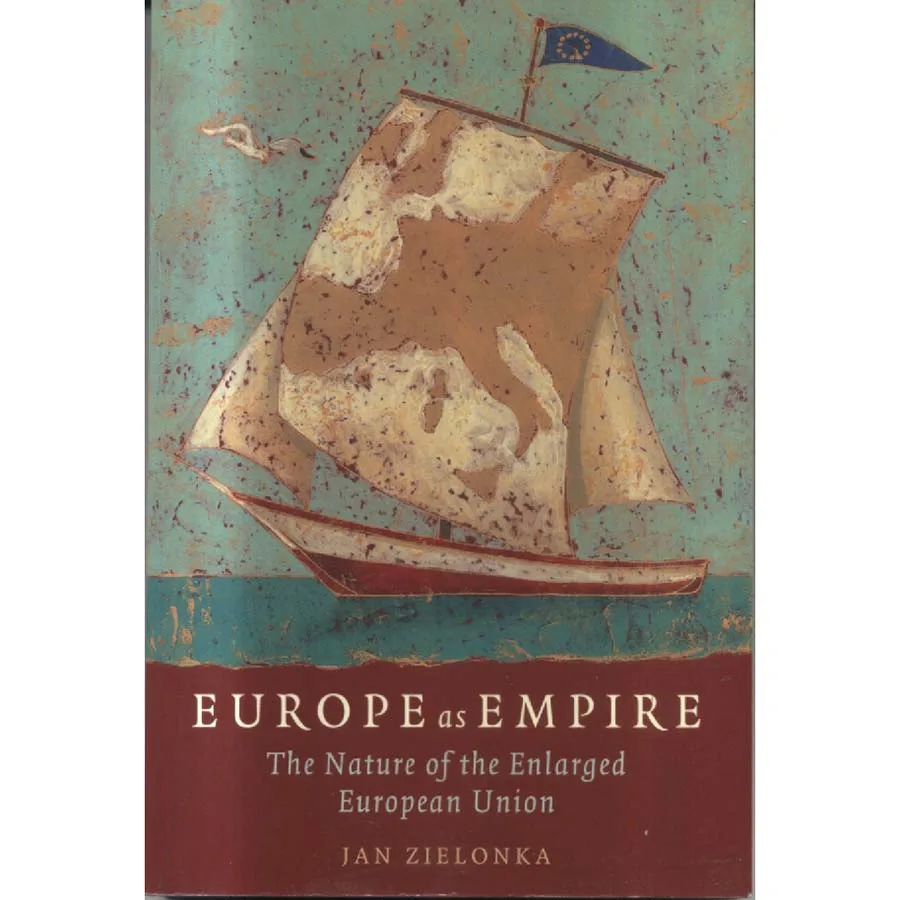
Publisher: Oxford University Press
Format: Paperback
ISBN: 9780199231867
Europe as Empire – The Nature of the Enlarged European Union (2006) by Jan Zielonka
Oxford University Press | ISBN: 9780199231867 | Condition: Good
There are empires, there are bureaucracies, and then there is the European Union, an extraordinary political construction that has managed to unite countries with different languages, histories, economies, culinary traditions and attitudes towards punctuality, while simultaneously creating a system of government so complicated that even the people responsible for operating it occasionally appear uncertain about who is actually in charge. In Europe as Empire – The Nature of the Enlarged European Union, published by Oxford University Press in 2006, political scientist Jan Zielonka asks a magnificently provocative question: what if the European Union is not evolving into a conventional federal state at all, but into something altogether more peculiar, resembling the sprawling, overlapping and frequently untidy empires of Europe’s past?
It is an intriguing proposition, particularly given that the very word empire tends to produce a variety of uncomfortable reactions among Europeans. The British remember theirs with a mixture of nostalgia, embarrassment and arguments about railway construction. The French possess an equally complicated historical inheritance, the Germans have particular reasons for preferring the subject to be approached with caution, and the inhabitants of Eastern Europe have generally experienced enough imperial enthusiasm from their neighbours to regard the whole business with understandable suspicion.
Yet Zielonka is not suggesting that Brussels has secretly acquired a collection of battleships and intends to dispatch an expeditionary force to establish colonies somewhere beyond the Mediterranean. His argument is considerably more subtle. The enlarged European Union, he proposes, may be better understood through the historical example of a neo-medieval empire than through the conventional model of a modern sovereign state.
This is where matters become especially interesting, because the EU has never fitted comfortably into the familiar political categories. It is not simply an international organisation, since its institutions possess powers extending far beyond those of most conventional diplomatic arrangements. Nor is it a traditional nation-state, since it lacks many of the characteristics normally associated with a single sovereign country. It possesses laws, institutions, borders and political ambitions, but its authority is distributed through an elaborate arrangement of national governments, European bodies and overlapping legal responsibilities.
In other words, it is a political entity that can regulate a remarkable range of economic activities while remaining surprisingly difficult to describe in a single sentence.
The great enlargement of 2004, which brought ten additional countries into the European Union, transformed the organisation’s geographical, political and cultural character. States emerging from the experience of communist rule and Soviet domination joined an organisation originally developed around the integration of Western European economies. This was an extraordinary historical development, reuniting much of a continent that had spent decades divided by the Cold War, although the practical arrangements involved rather more meetings, negotiations and technical documentation than the average romantic vision of European unity generally acknowledges.
The enlargement also created enormous challenges. The EU now encompassed countries with very different economic circumstances, administrative traditions, political priorities and historical experiences. The assumption that such a diverse collection of states would gradually develop into something resembling a single conventional country became increasingly difficult to sustain.
Zielonka offers an alternative interpretation. Rather than imagining the European Union as an unfinished superstate awaiting the final pieces of its constitutional machinery, he suggests that its apparent irregularities may be fundamental characteristics of the political order emerging across the continent.
The concept of a neo-medieval empire is particularly provocative. Medieval Europe was not organised into neat, self-contained sovereign states with clearly defined powers and universally recognised borders. Political authority was frequently divided among monarchs, nobles, cities, churches and other institutions, producing a complicated landscape of overlapping jurisdictions and competing loyalties.
A person might owe obligations to a local ruler, a distant monarch and a religious authority, while enjoying privileges granted by an institution whose precise constitutional relationship with the others was best left unexplored unless someone was prepared to fight a war over it.
The modern European Union, Zielonka argues, exhibits certain comparable characteristics. Power is dispersed across different levels of government, borders possess varying degrees of significance, and political authority operates through networks and institutions that do not conform neatly to the conventional model of a sovereign state.
This does not mean that Europe has returned to the Middle Ages, although anyone who has attempted to understand certain administrative procedures might occasionally wonder. Rather, the historical comparison provides a way of understanding a political system that is complex, flexible, decentralised and resistant to tidy constitutional classification.
It is a fascinating challenge to the assumption that political development must inevitably lead towards ever larger, more centralised states. The EU may represent a different kind of political organisation altogether, one that governs through negotiated authority, economic integration, legal cooperation and the gradual extension of influence beyond its formal boundaries.
Those boundaries are themselves a source of considerable interest. Traditional empires often possessed frontiers whose significance varied according to geography, military strength and the interests of neighbouring powers. The European Union likewise developed a complex relationship with surrounding countries, many of which adopted European rules, participated in cooperative arrangements or sought closer integration without necessarily becoming full members.
The result is a political landscape in which membership, influence and authority are not always straightforward matters of being either inside or outside.
For anyone accustomed to thinking of international borders as clearly marked lines separating distinct sovereign territories, this can seem unnecessarily complicated. Yet the practical realities of trade, migration, security, diplomacy and economic cooperation have always possessed a remarkable capacity for ignoring the tidy arrangements favoured by political maps.
Zielonka’s analysis examines the implications of enlargement for governance, democracy, identity, security and Europe’s relationships with its neighbours. The expansion of the Union raises difficult questions about how authority can be exercised across an increasingly diverse continent, and whether the institutions developed for a smaller Western European community remain appropriate for a much larger and more complicated organisation.
There is also the awkward matter of democracy. Conventional democratic systems generally assume some recognisable relationship between citizens, elected representatives and the institutions exercising political power. The European Union complicates this arrangement through its combination of national and supranational institutions, creating situations in which responsibility can become difficult to identify and political accountability harder to establish.
National politicians have occasionally found this arrangement extraordinarily convenient. Popular developments can be presented as the achievements of domestic government, while unpopular regulations may be attributed to distant European institutions whose representatives are not immediately available to defend themselves.
Brussels, in this interpretation, becomes an immensely useful political location: close enough to claim credit for European cooperation, but sufficiently distant to accept responsibility whenever something becomes inconvenient.
Yet Zielonka’s work is not simply an exercise in criticising European bureaucracy. His argument challenges readers to consider whether the Union’s complexity might also provide advantages. A flexible and decentralised political order may accommodate diversity more effectively than a rigid federal structure, particularly across a continent containing numerous languages, national identities and historical traditions.
The central question is whether Europe can achieve meaningful cooperation without demanding complete political uniformity.
That is a particularly important consideration for countries whose histories have encouraged a degree of caution towards grand schemes of continental integration. The experiences of the twentieth century demonstrated that European unity, when pursued through military conquest and authoritarian domination, could produce consequences considerably less agreeable than the promotional literature suggested.
The European Union’s reliance upon treaties, negotiations, institutions and economic incentives therefore represents a profoundly different approach to continental organisation, even if the resulting paperwork occasionally appears sufficient to consume a small forest.
The neo-medieval comparison also offers an unusual perspective on sovereignty. Modern political debate often treats sovereignty as something a country either possesses completely or has surrendered to somebody else, rather like a valuable family heirloom that must be kept safely locked away. Zielonka’s approach suggests a more complicated reality, in which authority can be shared, divided, negotiated and exercised through institutions whose responsibilities overlap.
This is hardly an unfamiliar arrangement in European history. For centuries, rulers governed territories in which legal authority, economic privilege and political allegiance were distributed through systems that would have reduced the average modern constitutional lawyer to despair.
The difference, of course, is that contemporary European institutions generally attempt to settle their disagreements through legal proceedings and prolonged negotiations rather than sending an army to besiege somebody’s castle.
One might reasonably regard this as progress.
The book is particularly valuable because it emerged at a significant moment in European political history. Published in 2006, it examines the EU in the aftermath of the 2004 enlargement, before the global financial crisis, the eurozone debt crisis, Brexit and the many subsequent developments that would further test the assumptions underlying European integration.
Reading it today therefore provides an opportunity to consider how the possibilities and tensions identified at that time have played out over the following two decades.
The debate about whether the EU should become a more centralised political entity, remain a cooperative association of sovereign states or develop into something that fits neither model has certainly not disappeared. If anything, the experience of successive crises has demonstrated how difficult it can be to reconcile the demands of collective action with the political preferences of individual member states.
The eurozone crisis exposed fundamental tensions within economic and monetary integration, while disputes over migration, constitutional authority and national political priorities illustrated the difficulties of governing an organisation whose members do not always share the same understanding of its ultimate purpose.
Brexit introduced another extraordinary chapter, demonstrating that the process of European integration was not necessarily irreversible. The United Kingdom’s departure from the EU in 2020 would have provided a fascinating subject for Zielonka’s model of overlapping political authority, differentiated integration and changing relationships between European institutions and their neighbours.
For British readers, the book possesses a particularly interesting dimension. The United Kingdom’s relationship with European integration has long involved a complicated mixture of practical economic cooperation, political scepticism, historical self-confidence and occasional bewilderment that other European nations do not automatically share the British understanding of how everything ought to be organised.
The British were enthusiastic about European trade, frequently suspicious of European political integration and particularly talented at arguing about the precise meaning of sovereignty. The resulting relationship produced decades of negotiations, disputes, compromises and newspaper headlines, culminating in a referendum that managed to transform constitutional theory into an argument conducted at extraordinary volume in pubs, workplaces and family dining rooms.
Zielonka’s analysis provides a useful framework for understanding why such disagreements are not merely questions of administrative detail. They concern fundamentally different conceptions of political authority, national identity and the desirable future organisation of Europe.
There is also something wonderfully ironic about the idea of Europe returning, in conceptual terms, to a form of medieval political organisation. For centuries, the continent experienced an elaborate collection of competing kingdoms, principalities, bishoprics, duchies, city-states and empires, all enthusiastically defending their particular privileges and frequently engaging in warfare whenever the opportunity presented itself.
Modern European integration was intended, among other things, to overcome the destructive rivalries of this historical inheritance. Yet its evolving institutional structure may possess certain similarities to the overlapping jurisdictions and multiple authorities of the medieval world.
The difference is that instead of rival princes arguing over feudal obligations, contemporary European officials may spend several years negotiating the allocation of regulatory competencies.
The language has improved, the furniture is more comfortable and the catering is probably considerably better, but the underlying complexity remains surprisingly familiar.
One of the great strengths of the book’s central argument is that it invites readers to abandon the assumption that the European Union must eventually become either the United States of Europe or a failed attempt to create one. The possibility of an entirely different political arrangement opens a broader discussion about how authority, legitimacy and cooperation might operate in an increasingly interconnected world.
The nation-state remains an enormously important political institution, but many contemporary problems extend beyond national boundaries. Trade, environmental policy, financial regulation, migration, security and international relations all create pressures for cooperation that cannot easily be contained within the traditional framework of independent governments acting entirely alone.
Equally, the existence of cross-border problems does not automatically mean that every political decision should be transferred to a central European authority. Different societies possess different priorities, democratic traditions and expectations of government, and an effective political order must somehow accommodate these differences without becoming paralysed by them.
This is the sort of challenge that makes political science such an entertaining discipline. The objective is to devise arrangements through which millions of people with different interests can cooperate peacefully, despite possessing entirely incompatible opinions about taxation, immigration, national identity, agricultural subsidies and the appropriate interpretation of a treaty provision written several decades earlier.
It is a remarkable achievement that the system functions at all.
Naturally, the European Union has developed a reputation for administrative complexity that provides abundant opportunities for satire. Its institutional structure includes the European Commission, European Parliament, European Council, Council of the European Union, Court of Justice and numerous other bodies, each possessing particular responsibilities and relationships with the others.
For the uninitiated, distinguishing between the European Council and the Council of the European Union can be an unexpectedly demanding intellectual exercise, particularly when one discovers that the Council of Europe is an entirely separate organisation.
One suspects that medieval Europe, with its competing popes, emperors, kings and ecclesiastical authorities, might actually have been easier to explain after several glasses of wine.
Yet beneath the administrative machinery lie serious questions about the future of political organisation. Zielonka’s work challenges readers to consider whether the familiar assumptions of territorial sovereignty, centralised government and clearly defined political communities remain sufficient to explain the evolving European system.
His neo-medieval empire is therefore not simply a colourful historical analogy, but an attempt to develop a conceptual framework for understanding political change.
For students of European politics, international relations, comparative government and political theory, Europe as Empire offers a substantial and thought-provoking contribution to the study of European integration. It is particularly relevant to debates concerning enlargement, governance, sovereignty, democratic legitimacy and the EU’s relationships with neighbouring states.
It will also appeal to readers interested in the historical development of empires and political institutions, since the comparison between modern European governance and earlier systems of fragmented authority challenges some of the conventional distinctions between the medieval and modern worlds.
Published by Oxford University Press, the volume belongs to the serious academic literature on European politics, rather than the more excitable tradition of political commentary in which every European regulation is either evidence of imminent continental tyranny or another magnificent step towards universal peace, prosperity and properly harmonised consumer packaging.
Zielonka’s argument is considerably more interesting than either extreme. He asks how the enlarged Union actually operates, what kind of political order it represents and whether the conceptual categories commonly used to describe it are adequate to the task.
These are questions with implications extending well beyond the EU itself. As political and economic relationships become increasingly interconnected, other regions may encounter similar problems concerning the distribution of authority, the management of diversity and the relationship between national governments and wider systems of cooperation.
There is a broader lesson here about political institutions. Human beings possess an extraordinary enthusiasm for designing systems that appear logical, efficient and internally consistent, only to discover that those systems must eventually be operated by politicians, civil servants, voters and organisations whose interests do not always correspond with the original theoretical assumptions.
Europe has spent centuries demonstrating this principle, and there seems little reason to suppose that the experiment is nearing completion.
This 2006 Oxford University Press edition is offered in Good condition by Crappy Old Books, a bookseller that has considerable sympathy with complicated institutions, overlapping responsibilities and enterprises whose internal arrangements occasionally appear incomprehensible to outsiders.
Unlike the European Union, this particular volume possesses a clearly defined boundary, a recognisable beginning and end, and a single ISBN number that can be used to identify it without consulting seventeen treaties and a constitutional lawyer.
It also requires no referendum before being removed from the shelf, although the owner is perfectly entitled to hold one if the household contains sufficiently enthusiastic political participants.
An excellent addition to collections of European history, international relations, political science, European Union studies and contemporary political theory, Europe as Empire – The Nature of the Enlarged European Union will appeal to students, academics, policy enthusiasts and readers interested in understanding the unusual political experiment that has developed across the European continent.
It is also a particularly rewarding acquisition for anyone who has ever wondered what the European Union actually is. A country? A confederation? A federation in progress? An international organisation with unusually ambitious administrative habits? Or something entirely different, requiring a political vocabulary that conventional constitutional theory has not yet satisfactorily developed?
Zielonka offers a provocative answer, suggesting that the Union’s apparent contradictions may be central to understanding its nature rather than merely inconvenient obstacles to its eventual transformation.
A fascinating and intellectually challenging examination of the enlarged European Union, proposing that Europe’s future may resemble not a conventional superstate but a new form of empire characterised by overlapping authority, flexible boundaries and political diversity.
And perhaps the greatest irony of European integration is that after centuries of wars, revolutions, dynastic struggles and attempts to establish political order across the continent, Europeans may have created a system that resembles certain aspects of medieval governance, except with better roads, electronic voting and considerably more elaborate regulations concerning agricultural products.
Crappy Old Books: proudly offering serious European political literature without requiring proof of citizenship, agreement on constitutional principles or prior approval from the European Commission.
And should anyone ask whether the European Union is really an empire, you can confidently explain that the answer depends upon the definition of empire, the historical period under consideration, the distribution of political authority and the precise nature of the relationship between sovereignty and supranational governance.
By the time you have finished explaining, your audience will probably have gone home.
Which, as any experienced European diplomat will appreciate, is sometimes the most effective way of bringing a difficult negotiation to a conclusion.
Keep browsing: See more Politics books Other books by Jan Zielonka
