


Rex - The Autobiography Of A Star
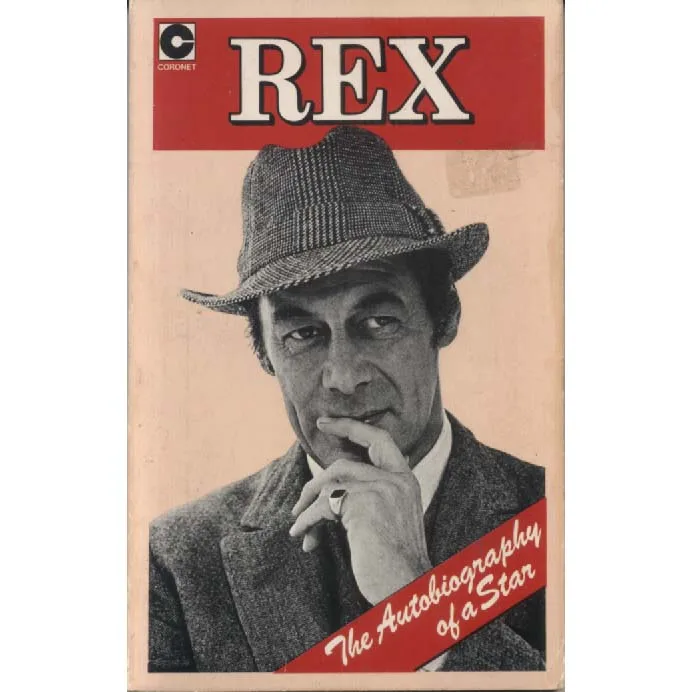
Publisher: Coronet
Format: Paperback
ISBN: 0340206519
Rex – The Autobiography of a Star (1976) by Rex Harrison
Coronet | ISBN: 0340206519 | Condition: Good
There are actors, there are stars, and then there was Rex Harrison, a gentleman who somehow managed to build an extraordinarily successful career out of appearing faintly irritated by the people around him, speaking his songs rather than singing them, and maintaining the unmistakable impression that the entire business of show business would be considerably more agreeable if everyone else would simply behave properly. In Rex – The Autobiography of a Star, published in this Coronet edition in 1976, one of Britain’s most distinguished and gloriously sophisticated theatrical personalities turns his attention to the most fascinating subject in his considerable experience: Rex Harrison himself.
And who better qualified to undertake the task?
Sir Reginald Carey Harrison, better known to the world as Rex, was one of those unmistakably British performers whose combination of elegance, wit, arrogance and immaculate diction seemed ideally suited to portraying men who regarded the rest of humanity as a regrettable but unavoidable inconvenience. Whether delivering withering observations across a drawing room, charming an unsuspecting lady or attempting to impose order upon a collection of less intellectually distinguished individuals, Harrison possessed a screen presence that was both unmistakable and frequently irresistible.
Born in Huyton, Lancashire, in 1908, Harrison began his theatrical career during an era when becoming a successful actor involved rather more than acquiring a social media following and appearing in a television talent competition. The stage demanded discipline, persistence, technical skill and the ability to maintain an audience’s attention without the assistance of computer-generated explosions, elaborate editing or an inspirational soundtrack informing viewers when they were supposed to become emotional.
Harrison’s rise through the British theatre was a remarkable journey, taking him from early professional performances to the heights of the West End, Broadway and Hollywood. Along the way, he developed the distinctive combination of dry humour, impeccable timing and aristocratic bearing that would become his theatrical trademark. Few performers have ever managed to convey so much superiority through the simple act of raising an eyebrow.
His film career included appearances in such memorable productions as Blithe Spirit, The Ghost and Mrs. Muir, Unfaithfully Yours and Cleopatra, demonstrating an ability to move between sophisticated comedy, romance and grand historical spectacle with considerable confidence. Whether appearing opposite glamorous leading ladies or surrounded by the extravagances of a major Hollywood production, Harrison generally succeeded in making it appear that he was the only person in the room who fully understood what was going on.
Of course, his most celebrated role was Professor Henry Higgins in My Fair Lady, the magnificently insufferable phonetics expert who undertakes to transform a Cockney flower seller into a respectable society lady, while demonstrating that an expert in human speech need not possess the slightest understanding of ordinary human feelings.
Harrison originated the role on Broadway in 1956 and later recreated it in the celebrated 1964 film opposite Audrey Hepburn. His portrayal became one of the defining performances of his career, earning him the Academy Award for Best Actor and establishing Professor Higgins as perhaps the ultimate expression of the Harrison personality: brilliant, domineering, articulate, emotionally incompetent and absolutely convinced that every problem in the world could be solved if people would only learn to pronounce their vowels correctly.
There was, naturally, the small matter of the singing.
Harrison was not conventionally equipped for the demands of musical theatre, particularly when compared with performers possessing voices capable of filling enormous auditoriums without appearing to exert themselves. His solution was brilliantly characteristic: rather than attempting to sing in the traditional sense, he developed a distinctive form of rhythmic speech that allowed him to deliver the musical numbers with extraordinary precision, wit and personality.
It was an inspired approach. Generations of aspiring singers had devoted years to developing vocal technique, breath control and musical expression, while Harrison arrived, spoke the words in approximately the correct rhythm and walked away with one of the most famous performances in musical theatre history.
One suspects that professional singing teachers found the entire business profoundly irritating.
Yet Harrison’s success was far from accidental. His ability to command a scene depended upon exceptional timing, an acute understanding of character and the sort of theatrical discipline that can only be developed through years of demanding work. His performances may appear effortless, but effortless acting is frequently the result of enormous preparation, particularly when the character is required to deliver complicated dialogue while conveying the impression that everybody else is a complete fool.
The autobiography offers the opportunity to encounter the personality behind this remarkable career, tracing the experiences of a performer whose professional life extended across some of the most fascinating decades in the history of twentieth-century entertainment. The theatre of his youth was a very different institution from the modern entertainment industry, while Hollywood was still developing the elaborate machinery of glamour, celebrity and publicity that would eventually transform actors into international cultural commodities.
Harrison witnessed those changes from a privileged position, moving among celebrated performers, directors, producers and theatrical personalities at a time when the boundaries between stage and screen were constantly shifting. His professional experiences belonged to a world of opening nights, theatrical rehearsals, demanding directors, celebrated leading ladies and the occasional unfortunate discovery that an actor’s temperament could be almost as impressive as his talent.
And Harrison certainly had temperament.
His reputation for being difficult, demanding and occasionally spectacularly uncooperative became almost as famous as his performances. This was not a man generally associated with humble gratitude, cheerful compliance or a willingness to accept criticism from people whose qualifications he considered inferior to his own. He could be charming, witty and enormously entertaining, but also imperious and thoroughly exasperating, sometimes within the space of a single conversation.
There is something magnificently theatrical about an actor whose real-life personality occasionally seemed indistinguishable from the characters he portrayed. Professor Higgins might have been a fictional creation, but the qualities that made him so convincing were hardly alien to the man playing him. Harrison possessed a natural authority that could be immensely effective on stage and rather less universally appreciated in the dressing room.
His personal life was no less eventful than his professional career. Harrison became known for a succession of marriages and romantic relationships, some passionate, some turbulent and others complicated by the unfortunate discovery that two people may possess considerable affection for one another without necessarily being capable of living together harmoniously.
His marriages included those to actresses Lilli Palmer, Kay Kendall and Rachel Roberts, whose own careers and personalities contributed to a private life that sometimes attracted as much public interest as his theatrical achievements. The combination of fame, ambition, strong personalities and the pressures of show business did not always provide an ideal foundation for domestic tranquillity.
One might reasonably suggest that a man capable of commanding an audience of thousands could occasionally have benefited from applying rather less theatrical authority to the management of his personal relationships.
But celebrity autobiography is rarely at its most entertaining when devoted to an uninterrupted catalogue of good decisions, exemplary conduct and harmonious marriages. Readers generally prefer a little complication, a few spectacular disagreements and the occasional glimpse of famous people behaving in ways that would be considered deeply unreasonable if attempted by somebody working in a building society.
Harrison’s life certainly provided abundant material.
There were professional triumphs, personal disappointments, considerable public attention and the peculiar pressures of occupying a prominent position in an industry where one’s reputation could be transformed by a single performance, an unfortunate headline or an ill-advised romantic entanglement. His career was a reminder that public admiration and private happiness are not necessarily supplied together, even when accompanied by international fame and an impressive collection of theatrical honours.
The golden age of Hollywood also produced a fascinating culture of celebrity, very different from the modern world of instant communication and permanent electronic surveillance. Stars were surrounded by publicists, studio executives and carefully managed reputations, while the newspapers enthusiastically pursued scandals that could attract readers and occasionally destroy careers.
Harrison’s experiences belonged to this complicated environment, where glamour and sophistication frequently concealed rather less elegant realities. Behind the polished publicity photographs and immaculate evening clothes were professional rivalries, emotional difficulties, contractual disputes and the same extraordinary collection of human weaknesses found in any ordinary workplace, although generally accompanied by considerably better tailoring.
The title Rex – The Autobiography of a Star possesses a certain magnificent confidence. There is no unnecessary modesty, no apologetic suggestion that the author is merely an ordinary fellow fortunate enough to have enjoyed an interesting career. The subject is Rex Harrison, the author is Rex Harrison, and the reader is politely invited to appreciate the distinction.
It is difficult to imagine a title better suited to the man.
By 1976, when this Coronet edition appeared, Harrison had already secured an enduring place in theatrical and cinematic history. His achievements included major stage successes, memorable screen performances and an Academy Award, while his distinctive acting style had made him one of the most recognisable British performers of his generation.
The book therefore offers the perspective of an established star reflecting upon decades of professional experience, personal encounters and the extraordinary business of entertaining audiences across the world. It is also a fascinating period piece, belonging to an age when the theatrical autobiography remained an important means by which celebrated performers presented their own version of events.
And, of course, there is something particularly entertaining about an autobiography written by an actor. The profession is built upon the art of presenting convincing versions of reality, often while standing beneath powerful lights and pretending to experience emotions that have been carefully rehearsed over several weeks.
When an actor turns his attention to his own life, the reader is presented with the delightful challenge of deciding where candid recollection ends and theatrical presentation begins.
This is not necessarily a criticism. Indeed, the capacity for dramatic storytelling is precisely what makes the memoirs of great performers so appealing. A perfectly accurate account of every railway journey, hotel reservation and production meeting would doubtless possess historical value, but might prove considerably less entertaining than a collection of well-told anecdotes involving famous personalities and unfortunate incidents.
Harrison’s world was populated by some of the most celebrated figures in British and American entertainment, providing ample opportunity for recollections of theatrical life, professional encounters and the complicated personalities that inhabited the entertainment industry. The memoir belongs to a tradition in which actors could recount their experiences with wit, elegance and a healthy appreciation of their own importance.
There is also something irresistibly nostalgic about the period it represents. This was an age when leading men could become international stars without possessing enormous muscles, elaborate tattoos or the ability to perform their own spectacular stunt sequences. Harrison’s principal weapons were his voice, timing, intelligence and the devastating possibility that he might look at somebody as though they had just committed a serious grammatical offence.
His style of performance was rooted in language, character and theatrical presence. In a world increasingly dominated by visual spectacle, these qualities are worth remembering. Harrison could command an audience through conversation, delivering a line with such precision that an otherwise ordinary observation became memorable.
He also belonged to that distinguished tradition of British actors who appeared effortlessly sophisticated, regardless of whether the circumstances justified such confidence. Even when portraying deeply flawed individuals, Harrison maintained an extraordinary dignity, although it was often the dignity of a man who had just discovered that the entire world was being run by incompetents.
One suspects that he would have found the modern entertainment industry a fascinating and occasionally horrifying development. The prospect of actors promoting themselves through social media, submitting to endless celebrity interviews and discussing their personal lives with millions of strangers might have produced some magnificently cutting observations.
Then again, the opportunity to address an enormous international audience without interference from theatrical managers might have appealed to him enormously.
For admirers of classic Hollywood, British theatre and the great personalities of twentieth-century entertainment, Rex offers an engaging journey into a world where stardom was built upon talent, persistence, personality and occasionally the ability to survive one’s own temperament.
It is also an appealing companion to Harrison’s films, allowing readers to approach familiar performances with a greater appreciation of the man whose distinctive manner and formidable professional presence helped create them. Watching My Fair Lady after reading about Harrison’s life may lend additional interest to Professor Higgins’s confident assertions about human behaviour, particularly when considering the actor’s own complicated adventures in romance.
Of course, one should never confuse the theatrical persona with the private individual, even when the resemblance appears unusually convincing. Actors create characters, and the relationship between performer and performance is often considerably more complicated than audiences imagine. Nevertheless, Harrison’s public image and personal reputation provide a particularly interesting example of the ways in which a star’s personality can become inseparable from the roles that made him famous.
There is something almost reassuring about encountering a celebrity from an age when being difficult could be interpreted as evidence of artistic seriousness rather than immediately resulting in a public apology drafted by a team of professional reputation managers. Harrison’s generation inhabited a world where eccentricity, arrogance and occasional spectacular displays of bad temper were frequently regarded as regrettable but familiar occupational hazards of theatrical genius.
Whether such indulgence was entirely justified is another question, although it certainly contributed to a considerable supply of entertaining memoirs.
This 1976 Coronet edition of Rex – The Autobiography of a Star is offered in Good condition by Crappy Old Books, a bookseller that appreciates the magnificent egos, complicated personal histories and extraordinary professional achievements of the great theatrical personalities.
The book has survived approximately half a century of changing fashions, cinematic revolutions and increasingly elaborate interpretations of celebrity culture. It belongs to a period when performers were still expected to possess something resembling a distinctive personality, rather than merely an expensive publicity strategy and a carefully managed collection of commercial endorsements.
Unlike its famous subject, this copy is unlikely to demand special treatment, complain about the supporting cast or insist upon occupying the most prestigious dressing room. It requires no theatrical agent, chauffeur or personal assistant, and will remain perfectly content upon a bookshelf until summoned for another performance.
An excellent addition to any collection of theatrical autobiography, classic cinema, British acting history or Hollywood memoirs, Rex will particularly appeal to admirers of My Fair Lady, The Ghost and Mrs. Muir, Blithe Spirit and the other celebrated productions that established Harrison’s enduring reputation.
It would also make an entertaining gift for anyone who appreciates old-fashioned theatrical sophistication, impeccable English diction and the particular pleasure of watching an enormously talented actor deliver a devastating insult without raising his voice.
A fascinating journey through the life and career of one of Britain’s most distinctive performers, celebrating the triumphs, personalities, romances and theatrical adventures of a man who made sophistication look effortless and exasperation look positively elegant.
And perhaps Rex Harrison’s greatest achievement was proving that a gentleman could become an international film star, win an Academy Award, charm generations of audiences and achieve immortality in musical theatre without ever having to demonstrate that he could sing in the conventional sense.
That alone deserves a certain amount of admiration.
Crappy Old Books: preserving the memoirs of theatrical legends one second-hand volume at a time, without demanding top billing, a private dressing room or a contractual guarantee that nobody else receives a better review.
And should anyone question the wisdom of reading the autobiography of a man whose personality was sometimes considered rather difficult, simply remind them that perfectly agreeable people rarely make the most entertaining subjects.
After all, nobody ever became a Hollywood legend by being relentlessly reasonable.
At least, not one anybody particularly remembers.
Keep browsing: See more Biography books Other books by Rex Harrison
