


The Tenement - A Way Of Life
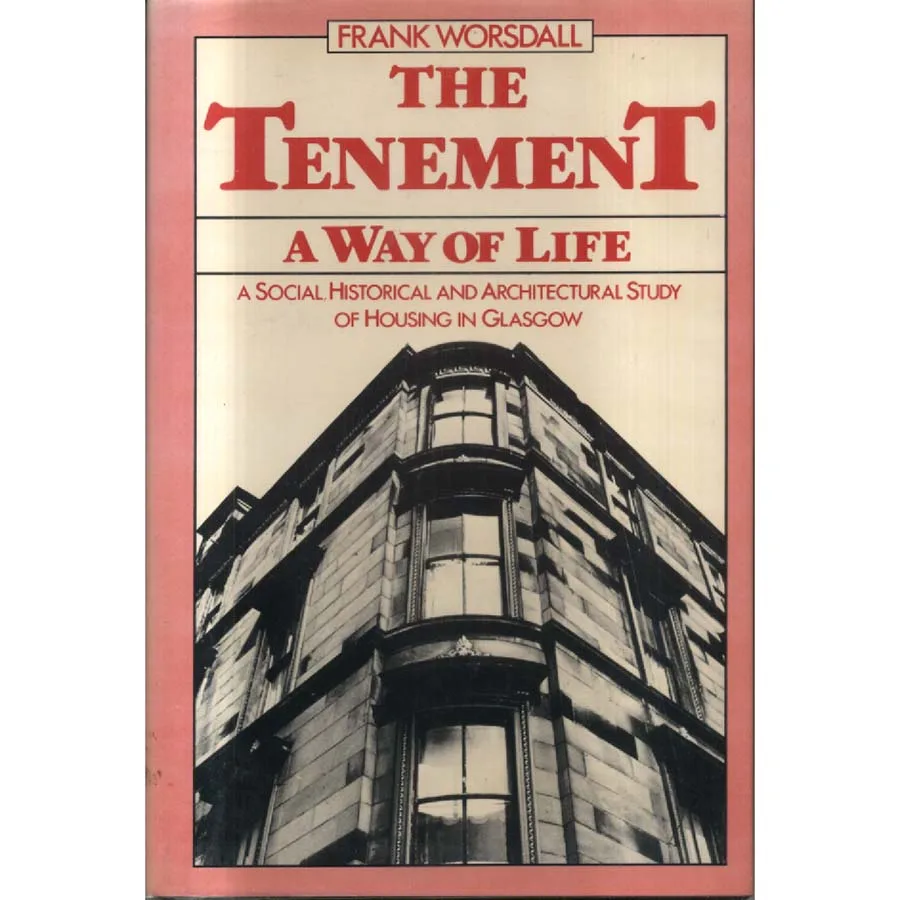
Publisher: Chambers
Format: Hardback
ISBN: 0550203524
The Tenement – A Way of Life (1979) by Frank Worsdall
Chambers | ISBN: 0550203524 | Condition: Very Good
There are houses, there are flats, and then there are Scottish tenements, those magnificent monuments to Victorian urban planning in which several dozen people could share a staircase, a backyard, a collection of domestic inconveniences and an intimate knowledge of everybody else’s private affairs. In The Tenement – A Way of Life, published by Chambers in 1979, Frank Worsdall explores one of the most distinctive features of Scottish urban life, a form of housing that shaped generations of families, created extraordinary communities and demonstrated conclusively that human beings can live remarkably close together without necessarily becoming any more agreeable.
The Scottish tenement was never simply a building. It was an entire social institution, an architectural arrangement that brought together families, neighbours, children, tradesmen, gossip, domestic disputes and the occasional unexplained smell into a densely populated world governed by customs and conventions that were often more powerful than anything officially recorded in the local council’s regulations.
In cities such as Glasgow and Edinburgh, tenements became a defining feature of the urban landscape, their towering sandstone façades, communal staircases and densely occupied flats reflecting the enormous social changes brought about by industrialisation and population growth. They provided accommodation for everyone from relatively prosperous professionals to families enduring severe poverty and overcrowding, demonstrating that the same basic architectural concept could accommodate a remarkable variety of human circumstances, provided nobody became excessively concerned about personal space.
For many residents, tenement life was characterised by an extraordinary degree of communal familiarity. Neighbours knew one another’s habits, children came and went between households, and the arrival of an unfamiliar visitor could generate sufficient speculation to sustain an entire afternoon’s conversation. Privacy was theoretically available behind one’s own front door, although its practical existence depended largely upon the thickness of the walls and the willingness of the people next door to mind their own business.
The close, or communal entrance and staircase, was the great social artery of tenement life. Through it passed generations of residents, deliveries, furniture, coal, washing, children, visitors and occasional individuals who had perhaps spent rather too long in the public house. It was simultaneously an entrance hall, meeting place, playground, observation post and informal communications network, operating with an efficiency that would have astonished the developers of modern social media.
News travelled quickly in a tenement. Births, marriages, deaths, arguments, illnesses and domestic scandals could become common knowledge with astonishing speed, often before the people directly involved had quite understood what was happening themselves. There was little need for a neighbourhood newsletter when Mrs McDonald on the second floor had already acquired a complete account of events, together with several additional details that might not have been strictly accurate.
Children growing up in tenements experienced a world that was both restrictive and remarkably full of adventure. Shared back courts, stairways, neighbouring streets and nearby waste ground became the settings for games, rivalries and friendships, while the constant presence of other families meant that childhood was rarely a solitary occupation. A child might escape the supervision of one parent only to discover that three neighbouring mothers had already been informed of the offence and were preparing to deliver their own opinions upon the matter.
The back court was another essential feature of tenement life, a communal space whose functions extended far beyond the simple business of accommodating washing lines and dustbins. Here, residents encountered one another in the course of daily domestic routines, exchanged information, settled minor disputes and occasionally conducted arguments of such magnificent intensity that the proceedings might reasonably have qualified as public entertainment.
Washday, in particular, could become an elaborate exercise in communal diplomacy. The successful hanging of several families’ washing required cooperation, negotiation and a reasonable understanding of territorial boundaries. An unauthorised occupation of somebody else’s preferred section of washing line might provoke a confrontation whose seriousness was entirely disproportionate to the garments involved, but whose underlying principles of justice and established custom were regarded as beyond dispute.
Of course, the romantic image of tenement community life should not obscure the often harsh conditions endured by many residents. Overcrowding, inadequate sanitation, damp, poor ventilation and poverty were serious features of urban housing, particularly in the older and less prosperous districts. Families sometimes occupied accommodation that modern housing regulations would regard with considerable alarm, while the demands of everyday domestic life involved levels of physical labour largely forgotten in the age of central heating, washing machines and supermarkets offering home delivery.
Heating a tenement flat could be an undertaking in itself. Coal fires required fuel, maintenance and considerable effort, while keeping a room warm during a Scottish winter was not always a straightforward matter. The journey from a freezing bedroom to the relative comfort of the kitchen might require unusual determination, particularly when the weather outside appeared to have been designed specifically to discourage human habitation.
Yet families developed routines, customs and remarkable ingenuity in making the best of their circumstances. Furniture was arranged with care, possessions were maintained, meals were prepared under difficult conditions and homes were often kept with extraordinary pride despite the limitations imposed by their surroundings. The tenement was not simply a place where people endured hardship; it was also a setting for affection, friendship, humour and the everyday achievements through which ordinary lives acquired their meaning.
One of the fascinating aspects of tenement history is the enormous variety concealed behind outwardly similar buildings. A substantial stone tenement in a respectable district might contain spacious, well-appointed flats occupied by comfortable middle-class families, while another, only a short distance away, could house numerous people in cramped and impoverished conditions. The architecture might appear broadly comparable from the street, but the lives unfolding behind the windows could be separated by profound differences in income, opportunity and social position.
Scottish tenements also possessed a distinctive architectural character that has helped ensure their survival as some of the most recognisable buildings in the country’s cities. Solid stone construction, imposing elevations, tall windows and elaborate entrances reflected the tastes and ambitions of successive generations of builders. Even relatively modest examples could possess a sense of permanence and dignity that contrasts rather sharply with some modern housing developments, whose principal architectural ambition appears to be achieving the maximum number of saleable units within the minimum available space.
There is something especially appealing about the survival of these great buildings. Constructed to accommodate the expanding populations of industrial cities, many have outlived the industries, institutions and social arrangements that originally surrounded them. Their interiors have been modernised, bathrooms installed, central heating introduced and flats transformed into desirable urban residences, while the external stonework continues to observe the changing world with a suitably Scottish expression of granite-like disapproval.
The transformation is not without irony. Accommodation once associated with overcrowding, poverty and the difficulties of industrial working-class life has, in many neighbourhoods, become fashionable and expensive. High ceilings, original fireplaces, decorative cornices and substantial wooden doors are now marketed as desirable period features, often commanding impressive premiums from buyers who would probably be considerably less enthusiastic about the original arrangements for sanitation, heating and refuse disposal.
Estate agents have become particularly adept at discovering the commercial possibilities of tenement history. A flat described in earlier times as being up four flights of stairs with no lift might now be advertised as a characterful upper-floor apartment offering traditional proportions and excellent opportunities for cardiovascular exercise. The communal back court becomes a shared outdoor amenity, while the absence of private parking is transformed into an invitation to embrace sustainable urban living.
The residents of earlier generations might have regarded these descriptions with some bewilderment.
But the history of tenement life is also the history of changing communities. As industries declined, populations moved and urban redevelopment transformed Scottish cities, older patterns of neighbourhood life were altered or swept away. Entire streets disappeared under slum-clearance programmes, while families who had lived in close proximity for generations were rehoused in unfamiliar districts, sometimes gaining much-needed modern amenities at the expense of established social networks.
The movement from tenement flats to new housing estates and high-rise developments was frequently presented as an uncomplicated triumph of progress. Indoor bathrooms, modern kitchens and improved living conditions were enormous advantages, but the loss of familiar streets, neighbours and communal traditions could also prove painful. A new house might provide central heating and a private garden, yet it could not automatically reproduce the intricate network of relationships that had developed over decades within a densely populated neighbourhood.
There is a tendency, when looking back at older forms of working-class life, to become excessively sentimental about community spirit. It is easy to imagine an earlier world in which everyone knew their neighbours, doors were left unlocked and children played happily in the streets, conveniently overlooking the poverty, illness, overcrowding and domestic difficulties that often accompanied these arrangements. Equally, it would be a mistake to dismiss the genuine warmth, mutual support and social solidarity that could flourish under circumstances far less comfortable than those enjoyed by many people today.
That tension between hardship and affection is part of what makes the tenement such a compelling subject. It represents a distinctive way of life, shaped by the physical proximity of people whose individual experiences were woven into the larger history of their streets and communities. The buildings themselves were important, but their real significance lay in the generations who occupied them.
Published in 1979, Frank Worsdall’s The Tenement – A Way of Life belongs to a particularly important period in the recording of Scottish urban history. By then, extensive redevelopment and changes in housing policy had already transformed many traditional tenement districts, making the preservation of their history, character and social customs increasingly valuable. The book offers a window into a world that was still within living memory for many readers, yet was rapidly disappearing from the everyday experience of younger generations.
For readers interested in Scottish social history, architecture, urban development and the lives of ordinary people, the subject is exceptionally rewarding. Grand political events and famous historical figures may dominate conventional history books, but the experiences of families living in tenement buildings reveal something equally important about how societies actually functioned. Their stories are found not in royal palaces or parliamentary chambers, but in kitchens, stairwells, shared yards and the countless modest spaces where the ordinary business of living took place.
There is also a special attraction for anyone with family connections to Glasgow, Edinburgh or the other Scottish towns and cities where tenements shaped everyday existence. The very word can evoke memories of childhood, familiar streets, polished stair rails, coal fires, neighbouring families and the distinctive sounds of life echoing through a shared close. For some, these recollections will be affectionate; for others, they may involve the slightly less romantic memory of carrying heavy shopping up several flights of stairs while wondering why the family had not chosen to live somewhere considerably nearer the ground.
Modern apartment living, of course, has not entirely eliminated the peculiar difficulties of sharing a building with other human beings. Neighbours still argue about noise, rubbish, communal maintenance and the mysterious disappearance of parcels left in entrance halls. The difference is that such disputes may now involve management companies, service charges and lengthy email correspondence rather than a direct confrontation on the stairs conducted by two formidable women wearing aprons.
Progress, it seems, has merely provided more elaborate administrative arrangements for disagreements that have existed for centuries.
This 1979 Chambers edition is offered in Very Good condition by Crappy Old Books, a bookseller with a particular affection for volumes documenting the social history, architecture and everyday experiences of earlier generations. Books such as this preserve something that cannot always be recovered through official records or grand historical narratives: the atmosphere, customs and distinctive character of ordinary communities.
Unlike the traditional tenement, this copy requires no communal cleaning rota, contribution towards roof repairs or negotiations concerning the appropriate use of the back court. It occupies comparatively little space, makes no noise and is unlikely to provoke complaints from the neighbours, although leaving it on a shared staircase is probably not advisable.
An excellent addition to any collection of Scottish history, architectural heritage, urban social history or books about traditional working-class life, The Tenement – A Way of Life will appeal to former tenement residents, family historians, local-history enthusiasts and anyone interested in understanding the extraordinary social worlds that existed behind the familiar sandstone façades of Scotland’s cities.
It would also make a thoughtful gift for someone who grew up in a tenement and remembers the experience with a mixture of affection, nostalgia and a lingering suspicion that the woman downstairs somehow knew absolutely everything that happened in the building.
A fascinating exploration of one of Scotland’s most distinctive forms of urban living, celebrating the architecture, traditions, characters and communities that made the tenement far more than simply a collection of flats joined together by a staircase.
And perhaps the greatest achievement of the Scottish tenement was its ability to accommodate entire communities within a single building, creating an environment in which people could share hardship, friendship, celebrations and occasionally spectacular arguments without ever having to travel more than a few yards from their own front doors.
It was a world where everybody knew everybody, everybody knew everybody else’s business, and nobody could escape a neighbour simply by pretending not to be at home, because the neighbour had already seen them come in.
Crappy Old Books: preserving the history of Scottish life one book at a time, with no factoring charges, no communal stair-cleaning duties and absolutely no requirement to obtain permission from the neighbours before putting the kettle on.
And remember, if you ever find yourself complaining about the inconvenience of modern apartment living, spare a thought for the generations who carried coal up four flights of stairs, shared outdoor facilities and somehow managed to raise large families in conditions that would give a contemporary property developer serious difficulties with the building regulations.
They may not have possessed ensuite bathrooms, video doorbells or underfloor heating, but they certainly knew who lived next door.
In fact, they probably knew considerably more than was strictly necessary.
Keep browsing: See more History books Other books by Frank Worrsdall
