


Enchantment - The Life Of Audrey Hepburn
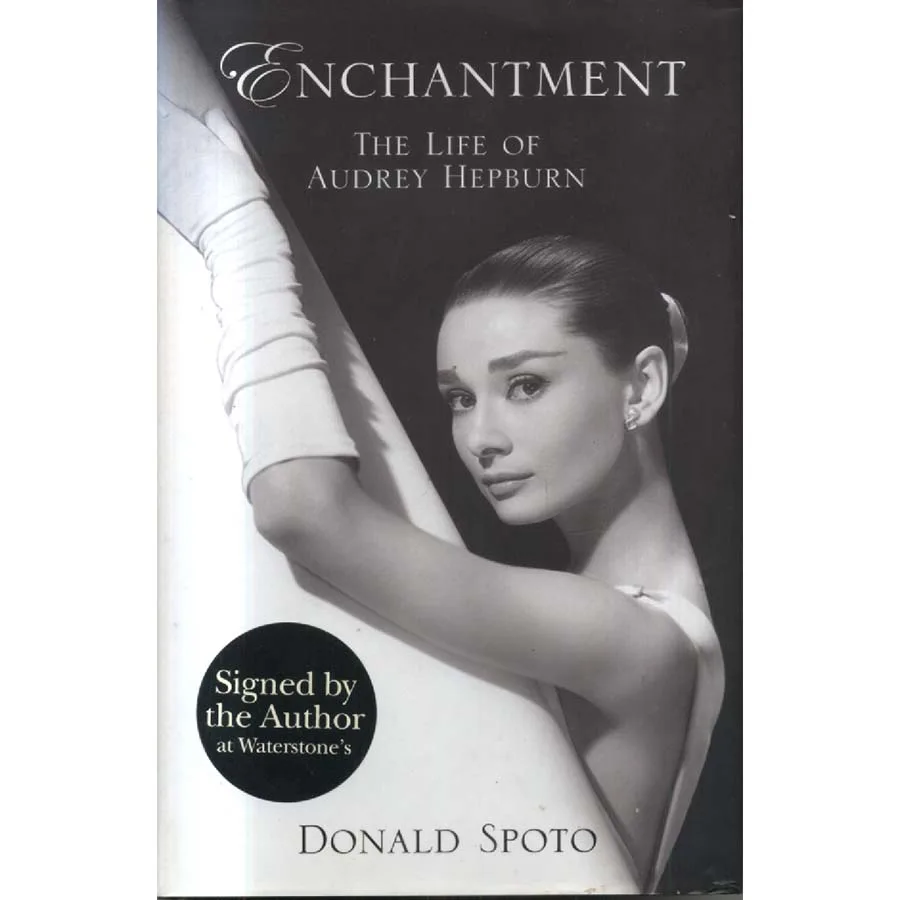
Publisher: Hutchinson
Format: Hardback
ISBN: 9780091796556
Enchantment – The Life of Audrey Hepburn (2006) by Donald Spoto
Hutchinson | ISBN: 9780091796556 | Condition: Very Good | Signed Copy
There are film stars, there are Hollywood legends, and then there was Audrey Hepburn, a woman who somehow managed to become one of the most recognisable faces in cinema history without relying upon scandalous behaviour, extravagant displays of celebrity self-importance or the apparently indispensable modern requirement to inform the public what she had eaten for breakfast. In Enchantment – The Life of Audrey Hepburn, published by Hutchinson in 2006, acclaimed biographer Donald Spoto explores the remarkable life of an actress whose elegance, intelligence and extraordinary screen presence made her an international icon, while her personal history revealed a far more complex, vulnerable and fascinating individual than the impossibly graceful figure immortalised in countless photographs.
Audrey Hepburn occupies a peculiar position in the history of popular culture. Decades after her greatest films, her image remains instantly recognisable, whether she is gazing into a jeweller’s window in Breakfast at Tiffany’s, wandering through Rome with Gregory Peck in Roman Holiday, or displaying the sort of effortless sophistication that has persuaded generations of women to invest in black dresses, oversized sunglasses and hairstyles requiring rather more maintenance than the publicity photographs might suggest.
Yet behind the famous face was a life that began far removed from Hollywood glamour. Born in Brussels in 1929, Hepburn spent much of her childhood in circumstances shaped by family difficulties, political upheaval and the gathering catastrophe of the Second World War. Her experiences during the German occupation of the Netherlands left a profound impression upon her, exposing her to hunger, fear, deprivation and the brutal realities of a conflict that would influence her understanding of suffering for the rest of her life.
This was not, in other words, a woman whose greatest early hardship consisted of being overlooked for a leading role in a school production.
Hepburn originally aspired to become a ballet dancer, devoting herself to the demanding discipline of classical dance before circumstances and physical limitations redirected her ambitions towards acting. Her background in ballet nevertheless contributed enormously to the distinctive grace and poise that later became central to her screen persona. She moved with an elegance that appeared entirely natural, although, like most achievements described as effortless, it was actually the product of considerable work.
Her breakthrough came with Roman Holiday in 1953, opposite Gregory Peck, in which she played a princess temporarily escaping the oppressive formalities of royal life. The performance won her the Academy Award for Best Actress and transformed her almost overnight into an international star. It also established the extraordinary Hepburn combination of innocence, wit, vulnerability and quiet determination, qualities that distinguished her from the more overtly glamorous leading ladies of the period.
Hollywood had discovered something rather unusual. Here was a young actress who did not conform to the established conventions of screen glamour, yet possessed an appeal that was almost impossible to manufacture. She seemed simultaneously aristocratic and approachable, sophisticated and innocent, delicate and surprisingly strong-willed. Studio executives, who generally preferred their stars to fit into easily recognisable commercial categories, were presented with the inconvenient spectacle of an actress succeeding precisely because she did not resemble anybody else.
A succession of celebrated films followed, including Sabrina, Funny Face, The Nun’s Story, Breakfast at Tiffany’s, Charade and My Fair Lady. Each contributed to the development of an extraordinary career, while demonstrating Hepburn’s versatility across romantic comedy, drama, musicals and more serious material. She could be charmingly mischievous, deeply moving or magnificently composed, often within the same performance.
Of course, Hollywood’s relationship with its female stars has always been a complicated business. The industry enthusiastically celebrated beauty while imposing extraordinary pressures upon the women expected to embody it. Hepburn’s distinctive appearance became a worldwide standard of elegance, although the personal experiences and physical hardships that helped shape her appearance were considerably less romantic than the fashion industry might have preferred to acknowledge.
Then there was her remarkable association with the French designer Hubert de Givenchy, whose creations helped establish one of the most enduring partnerships between fashion and cinema. Hepburn’s costumes became almost as famous as her performances, transforming simple silhouettes into international symbols of sophistication. The little black dress, in particular, achieved a cultural immortality that would probably have astonished its original manufacturer, although the fashion industry has been attempting to persuade people to purchase variations upon it ever since.
The Givenchy relationship also illustrates something important about Hepburn’s appeal. Her elegance was not simply a matter of expensive clothing. It involved posture, expression, movement, personality and an instinctive understanding of how to appear comfortable in circumstances where most people would feel hopelessly self-conscious. One suspects that Audrey Hepburn could have made an old raincoat look like a masterpiece of Parisian couture, which must have been infuriating for those obliged to spend enormous sums achieving considerably less impressive results.
Donald Spoto, whose biographical subjects have included some of cinema’s most celebrated and complicated personalities, looks beyond the familiar Hollywood imagery to examine the woman behind the legend. The glamour, fame and professional triumphs form only part of the story. Hepburn’s relationships, marriages, family life, personal disappointments and search for emotional security reveal the human being concealed beneath an image that sometimes seemed almost impossibly perfect.
Her private life was certainly not free from difficulties. The demands of an international acting career, the pressures of public attention and the complexities of marriage and motherhood all contributed to a life that could be considerably less serene than her public appearances suggested. Like many celebrated performers, Hepburn discovered that professional success and personal happiness were not necessarily supplied together as part of a convenient contractual arrangement.
There is something particularly interesting about the contrast between Hepburn’s public image and the emotional realities of her life. On screen, she could appear to inhabit a world of romance, beautiful clothes, charming gentlemen and elegant European settings. Away from the cameras, she faced many of the same uncertainties, disappointments and difficulties that trouble considerably less celebrated individuals. Fame may provide access to expensive restaurants and splendid hotels, but it has never proved especially effective at solving the more complicated problems of human relationships.
Spoto’s biography also explores the extraordinary circumstances of Hepburn’s later life, when she increasingly turned her attention away from cinema and towards humanitarian work. Her involvement with UNICEF became one of the most significant achievements of her final years, taking her to countries affected by poverty, famine and conflict, where she worked to draw international attention to the suffering of children.
This commitment was far more than an exercise in celebrity publicity. Hepburn had personal experience of wartime deprivation and understood something of the fear and suffering endured by children caught in circumstances beyond their control. Her humanitarian activities reflected a deeply felt concern for the vulnerable, and her international fame became a means of directing attention towards people whose own lives rarely attracted the interest of the world’s newspapers.
There is a profound irony in the fact that a woman celebrated throughout the world for her beauty ultimately devoted so much of her energy to circumstances in which beauty, glamour and fashionable elegance were entirely irrelevant. The woman who had become synonymous with diamonds, evening gowns and sophisticated screen romance spent much of her later life confronting hunger, illness and desperate poverty.
It was, perhaps, the most revealing expression of her character.
The enduring fascination with Audrey Hepburn also says something interesting about the nature of celebrity. Modern stars are often expected to maintain a relentless public presence, revealing intimate details of their lives, promoting commercial products and cultivating an image of constant excitement. Hepburn, by contrast, retained an element of privacy and understatement that seems increasingly unusual in a culture where some celebrities appear unable to visit a supermarket without issuing a photographic statement.
Her reputation has survived not merely because she was beautiful or famous, but because she possessed a distinctive quality that remains difficult to define. There was warmth behind the elegance, intelligence beneath the charm and an apparent sincerity that audiences responded to instinctively. She became an icon without seeming especially interested in behaving like one, which may be among the more reliable methods of achieving genuine distinction.
Naturally, the passage of time has also transformed Hepburn into a commercial phenomenon. Her image appears on posters, calendars, mugs, fashion accessories and countless other products, many of which would probably have left her quietly bewildered. The spectacle of a woman renowned for understated elegance being reproduced on an endless assortment of mass-produced merchandise is one of those contradictions that modern consumer culture seems perfectly capable of accepting without embarrassment.
Yet the films remain, and with them the extraordinary performances that first established her reputation. Whether playing a princess longing for freedom, a young woman transformed by fashion, or a character confronting more serious emotional and moral difficulties, Hepburn possessed the rare ability to make an audience care about what happened to her. It was a gift that no amount of expensive wardrobe design or studio publicity could have produced on its own.
Published in 2006, Enchantment offers readers an opportunity to revisit Hepburn’s life with the benefit of historical perspective, tracing her journey from a difficult European childhood to international cinematic fame and ultimately to her humanitarian work. Spoto’s subject is particularly rewarding because her life encompasses so many of the defining experiences of the twentieth century: war, deprivation, social change, the golden age of Hollywood, international celebrity and the growth of modern humanitarian activism.
The biography will appeal not only to admirers of Hepburn’s films, but also to readers interested in film history, fashion, celebrity culture and the complicated relationship between public image and private identity. It is a reminder that the most famous people are rarely as simple as the carefully selected photographs by which posterity remembers them.
And there is, of course, the additional pleasure of encountering a substantial biography from an age when a celebrity’s life could be examined in depth rather than reduced to a succession of inspirational quotations printed beneath attractive photographs on the internet. Hepburn’s story deserves rather more consideration than the observation that she looked magnificent in sunglasses, even if that particular achievement remains beyond dispute.
This 2006 Hutchinson edition is offered in Very Good condition by Crappy Old Books and is a signed copy, making it a particularly appealing acquisition for collectors and admirers of Audrey Hepburn. The signature adds an extra element of interest to an already desirable biography, offering something more personal than an ordinary unsigned example. As Audrey Hepburn died in 1993, the signature should not be mistaken for hers; the signing is best considered separately from the subject of the biography.
For collectors of cinema memorabilia, signed books and biographies of major twentieth-century cultural figures, this volume combines an absorbing subject with the additional appeal of a signed edition. It would make an excellent gift for anyone who has watched Breakfast at Tiffany’s more times than they care to admit, admires the elegance of classic Hollywood or wishes to discover something of the remarkable woman behind one of the most enduring images in film history.
There is also a certain pleasing suitability in purchasing a book about Audrey Hepburn in Very Good condition. A volume devoted to a woman famous for elegance and impeccable presentation ought, one feels, to have made some effort to maintain its own appearance. Fortunately, this example appears to have managed the business considerably more successfully than many of the celebrities who have attempted to imitate its subject.
A compelling portrait of one of cinema’s most beloved actresses, exploring the extraordinary journey from wartime hardship to Hollywood stardom, from international fashion icon to devoted humanitarian, and revealing the courage, vulnerability and humanity behind the unforgettable elegance.
Audrey Hepburn demonstrated that genuine style involves rather more than expensive clothes, that celebrity need not automatically produce unbearable self-importance, and that a life remembered for beauty may ultimately possess achievements of considerably greater importance.
It is a lesson that certain modern celebrities might profitably consider, preferably during one of the brief intervals between photographing themselves and announcing the launch of another exclusive skincare collection.
Crappy Old Books: celebrating the golden age of Hollywood, the enduring pleasures of a good biography and the particular satisfaction of discovering a signed copy without requiring a red carpet, a personal stylist or an invitation to the Academy Awards.
And perhaps the greatest tribute to Audrey Hepburn is that, more than thirty years after her death, the world continues to admire her not simply for how she looked, but increasingly for who she was.
Which, in an industry devoted to appearances, is quite an achievement.
Keep browsing: See more Biography books Other books by Donald Spoto
