


Little Book Of Land Speed Records
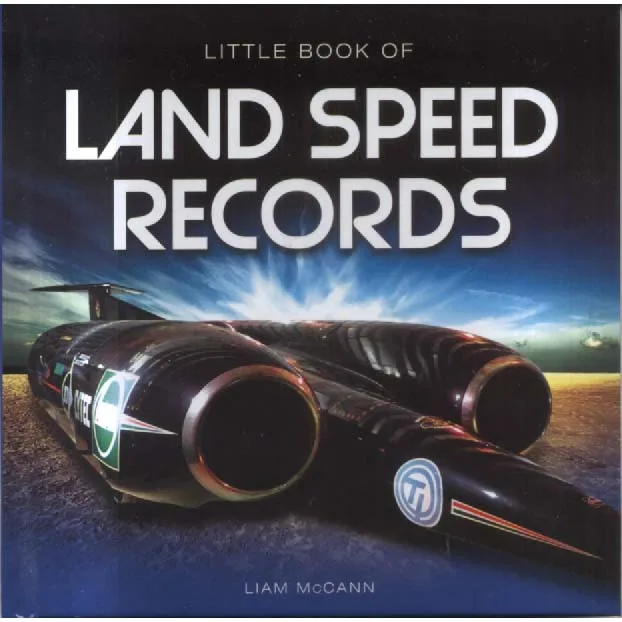
Publisher: Demand Media
Format: Hardback
ISBN: 9781910540442
Little Book of Land Speed Records (2015) by Liam McCann
Demand Media | ISBN: 9781910540442 | Condition: Very Good
There are people who enjoy driving, people who enjoy driving quickly, and then there are people who look at a perfectly serviceable motor car, decide that travelling at 100 miles per hour is hopelessly inadequate, and immediately begin investigating whether fitting an aircraft engine, a jet turbine or some other extravagantly powerful mechanical contraption might improve matters. In Little Book of Land Speed Records, published by Demand Media in 2015, Liam McCann celebrates one of humanity’s most magnificent and gloriously unnecessary obsessions: the determination to travel across the surface of the Earth faster than anybody else has ever managed, preferably without disintegrating into a spectacular cloud of expensive mechanical components.
The pursuit of the land speed record is among the most extraordinary chapters in the history of motoring. It has attracted inventors, engineers, racing drivers, aristocrats, adventurers and individuals whose understanding of reasonable personal risk appears to differ substantially from that of the average insurance assessor. While most motorists are perfectly content to arrive at their destination in one piece, land speed record contenders have traditionally been more interested in discovering precisely how fast a machine can travel before the laws of physics begin expressing serious objections.
The story begins in the pioneering days of motoring, when automobiles were still relatively new and the very idea of travelling faster than a galloping horse seemed an astonishing achievement. Early record attempts involved machines that now appear wonderfully primitive, frequently resembling ordinary carriages from which the horses had been removed and replaced with mechanisms of uncertain reliability. Nevertheless, the drivers possessed enormous courage, particularly given the rudimentary brakes, narrow tyres and complete absence of modern safety equipment.
As the twentieth century progressed, the pursuit of speed became an increasingly sophisticated competition between engineering brilliance and the stubborn realities of aerodynamics, friction, power and human survival. Engines grew larger, bodywork became more streamlined and record-breaking machines gradually evolved from recognisable motor cars into extraordinary projectiles whose principal concession to conventional motoring was the continued presence of wheels.
The British developed a particularly enthusiastic relationship with land speed record breaking, producing a succession of remarkable drivers and machines that captured the public imagination. Sir Malcolm Campbell became one of the most celebrated figures of the interwar years, repeatedly pushing the boundaries of automotive performance in his famous Blue Bird machines. His achievements combined technical ambition with considerable personal courage, at a time when speeds exceeding 200 miles per hour seemed almost unimaginably fast.
Campbell was followed by other extraordinary contenders, including John Cobb and George Eyston, whose enormous record-breaking machines represented some of the most ambitious automotive engineering projects of their age. These were not vehicles intended for negotiating roundabouts, collecting groceries or transporting elderly relatives to the seaside. They existed for one purpose alone: to travel very, very quickly in a straight line.
Naturally, even that apparently straightforward objective proved astonishingly complicated.
At extreme speeds, the air itself becomes a formidable opponent. A shape that looks perfectly aerodynamic while standing in a workshop may behave rather differently when travelling at several hundred miles per hour, particularly if the machine begins to lift, vibrate or demonstrate an unexpected ambition to become airborne. Tyres, wheels, suspension, steering and braking systems all face demands far beyond those encountered in ordinary motoring, while the driver must maintain control of a machine travelling distances measured in hundreds of feet every second.
The engineering challenges are remarkable, but the human element is perhaps even more extraordinary. Land speed record drivers must possess a peculiar combination of courage, concentration, technical understanding and absolute confidence in the competence of the people who have constructed their machines. They are required to sit inside a vehicle containing enormous amounts of energy, accelerate towards speeds at which small mistakes can become catastrophic, and remain sufficiently calm to recognise when something is going wrong.
It is not a profession ideally suited to individuals who become anxious when the motorway speedometer creeps above seventy.
The record attempts themselves have often taken place in some of the world’s most dramatic and inhospitable locations. The vast salt flats of Bonneville in Utah became synonymous with the pursuit of extreme speed, providing the long, open expanses necessary for vehicles to accelerate, achieve their maximum velocity and, one hopes, stop again before encountering anything particularly solid.
Other attempts have taken place on beaches, deserts and remote stretches of level ground, where teams of engineers, mechanics and support personnel have worked under difficult conditions to prepare machines whose entire existence may be justified by a successful run lasting only a few moments.
There is something wonderfully absurd about this arrangement. Years of design work, enormous financial investment, countless hours of testing and the combined expertise of some of the finest engineering minds may all be devoted to producing a machine whose ultimate achievement consists of travelling from one end of an empty piece of landscape to the other slightly faster than the previous machine.
And yet, that is precisely what makes the pursuit so fascinating.
The quest for speed has repeatedly pushed engineering beyond accepted limits, encouraging innovations in engine design, aerodynamics, materials, propulsion and vehicle stability. Although the record-breaking machines themselves are often of little practical use, the knowledge gained from their development contributes to a wider understanding of what technology can achieve.
The story also includes some of the most dramatic moments in British motoring history. Donald Campbell, following in the footsteps of his father Malcolm, became an internationally recognised record breaker, pursuing extraordinary achievements on both land and water. The Campbell family story alone demonstrates the remarkable combination of ambition, determination and danger that has characterised the struggle to push the boundaries of speed.
Then came the age of jet and rocket propulsion, when designers increasingly abandoned conventional automotive engines in favour of machinery more commonly associated with aircraft. At this point, the distinction between a motor car and a low-flying missile became somewhat academic. Vehicles were constructed with extraordinarily powerful engines, elongated bodies and cockpits that looked more suitable for military aviation than a Sunday afternoon drive.
The ultimate expression of this technological evolution came in 1997, when Andy Green drove ThrustSSC to a new world land speed record of 763.035 miles per hour, becoming the first person to officially exceed the speed of sound on land. The achievement was a magnificent triumph of British engineering, although one suspects that the local constabulary would have taken a rather dim view of somebody attempting anything similar on the A1.
ThrustSSC was an extraordinary machine, powered by two Rolls-Royce Spey jet engines and designed to cope with aerodynamic forces that would have destroyed a conventional motor car. Its achievement marked a remarkable moment in the history of speed, transforming what had once been a contest between powerful automobiles into a technological challenge approaching the boundaries of aeronautical engineering.
The record also demonstrated how far the pursuit had progressed since the earliest pioneers. What began with experimental motor vehicles travelling at speeds barely exceeding those of a modern family car had evolved into a competition involving supersonic machinery, sophisticated computational analysis and teams of specialists confronting engineering problems of almost unimaginable complexity.
Yet the essential motivation remained unchanged: somebody, somewhere, wanted to go faster.
This is perhaps the most endearing aspect of land speed record history. There is no obvious practical necessity for travelling at 700 miles per hour across a desert. The achievement does not make the weekly shopping easier, shorten the school run or improve the average commuter’s chances of reaching work on time. It is pursued because human beings have always been fascinated by limits, and because the discovery that something is exceptionally difficult seems to inspire certain individuals to devote their lives to doing it.
There is also the matter of national prestige. Record-breaking attempts have often become symbols of technological achievement, with successful drivers celebrated as national heroes and their machines regarded as evidence of a country’s engineering capabilities. The British, in particular, have displayed a remarkable enthusiasm for projects involving enormous expense, considerable danger and the possibility of achieving a record that serves no obvious commercial purpose.
It is a tradition that somehow manages to combine the finest qualities of British engineering with a wonderfully extravagant disregard for common sense.
Of course, the history of record breaking has not been without tragedy. Mechanical failures, accidents and the unforgiving nature of extreme speed have claimed lives, reminding everyone involved that the pursuit is far more than an entertaining technical exercise. The courage of the pioneers deserves admiration precisely because the dangers were real, particularly in earlier periods when the available knowledge and safety technology were far less advanced.
For the enthusiast, the development of land speed record machines also provides a fascinating visual history of automotive engineering. The early vehicles possess the unmistakable appearance of motor cars, albeit unusually large and powerful examples. Later designs become increasingly streamlined and specialised, until the familiar features of an automobile have almost disappeared beneath aerodynamic bodywork and propulsion systems borrowed from aircraft.
The transformation is extraordinary. Compare an early record-breaking carriage with ThrustSSC and one might reasonably conclude that the two machines belong to entirely different technological civilisations. Yet both represent stages in the same relentless pursuit of speed, separated by decades of invention, experimentation and occasionally spectacular miscalculation.
Published in 2015, Liam McCann’s Little Book of Land Speed Records offers an appealing introduction to this remarkable world of daring drivers, inventive engineers and machines constructed to challenge the limits of mechanical performance. The subject is rich in extraordinary personalities, astonishing achievements and technical ingenuity, making it ideal for readers who enjoy motoring history with rather more excitement than a discussion of fuel economy and the recommended interval between oil changes.
The book’s compact format is particularly appropriate for a subject involving such enormous speeds. There is something delightfully ironic about squeezing the history of machines capable of travelling at several hundred miles per hour into a relatively modest volume, although the alternative would presumably involve a book so large that it required its own support vehicle.
It is also an excellent reminder of the extraordinary changes in motoring technology over little more than a century. The early pioneers could scarcely have imagined vehicles travelling faster than sound, just as modern engineers may struggle to predict what future record attempts might achieve. The pursuit continues to inspire ambitious projects, even though each successive increase in speed demands ever greater technical ingenuity, funding and attention to safety.
For collectors of motoring literature, enthusiasts of engineering history and admirers of the more spectacular achievements of human ingenuity, Little Book of Land Speed Records is a particularly entertaining addition to the bookshelf. It celebrates the people who refused to accept that the existing record represented the final word on what was possible, and who responded to technical obstacles not by abandoning their ambitions but by developing even more powerful and improbable machinery.
There is, of course, a certain irony in reading about these achievements while sitting in a traffic jam. Somewhere in the history of motoring, engineers developed vehicles capable of exceeding 700 miles per hour, yet the ordinary motorist still finds themselves creeping through roadworks at four miles per hour behind a delivery van and wondering whether the journey might have been quicker by bicycle.
The land speed record represents the absolute pinnacle of automotive performance, while everyday motoring frequently represents the exact opposite. Perhaps this explains why such achievements retain their fascination. They offer a glimpse of what machinery can accomplish when freed from the practical limitations of speed restrictions, traffic congestion, potholes and the gentleman in front who appears to have forgotten where he intended to turn.
This 2015 Demand Media edition is offered in Very Good condition by Crappy Old Books, a bookseller that appreciates the remarkable achievements of motoring pioneers while remaining firmly committed to transporting its stock at considerably more modest speeds.
Unlike the machines described within its pages, this book requires no specialist fuel, aerodynamic testing, emergency parachutes or several miles of uninterrupted desert. It will function perfectly adequately while stationary, making it considerably more practical than most land speed record vehicles and rather better suited to the average domestic environment.
It would make an excellent gift for classic-car enthusiasts, motorsport historians, engineering students, speed-record devotees or anyone who has ever watched footage of a jet-powered vehicle thundering across a desert and wondered what extraordinary combination of ambition, courage and mechanical obsession persuaded somebody that this was a sensible way to spend their time.
A fascinating celebration of humanity’s relentless pursuit of speed, from the pioneering days of the motor car to the astonishing achievements of supersonic record-breaking machines, proving that the desire to go faster is one of the few human ambitions that technology has never quite managed to satisfy.
And perhaps the greatest irony of all is that after more than a century of engineering progress, during which mankind has developed vehicles capable of travelling faster than sound, the average British motorist still spends a significant proportion of their life sitting motionless on a motorway while illuminated signs announce delays caused by congestion.
One suspects that Malcolm Campbell would have been deeply unimpressed.
Crappy Old Books: bringing you the thrilling history of extreme motoring performance at a price that won’t require a sponsorship deal, an engineering consortium or the financial backing of a multinational oil company.
And remember, should you feel inspired to attempt a land speed record yourself, it is probably best to begin by checking the tyre pressures, informing your insurance company and finding somewhere rather longer than the local supermarket car park.
After all, achieving 700 miles per hour is impressive, but successfully stopping afterwards is generally considered an equally important part of the undertaking.
Keep browsing: See more Transport books Other books by Liam McCann
