


Modern Military Trucks
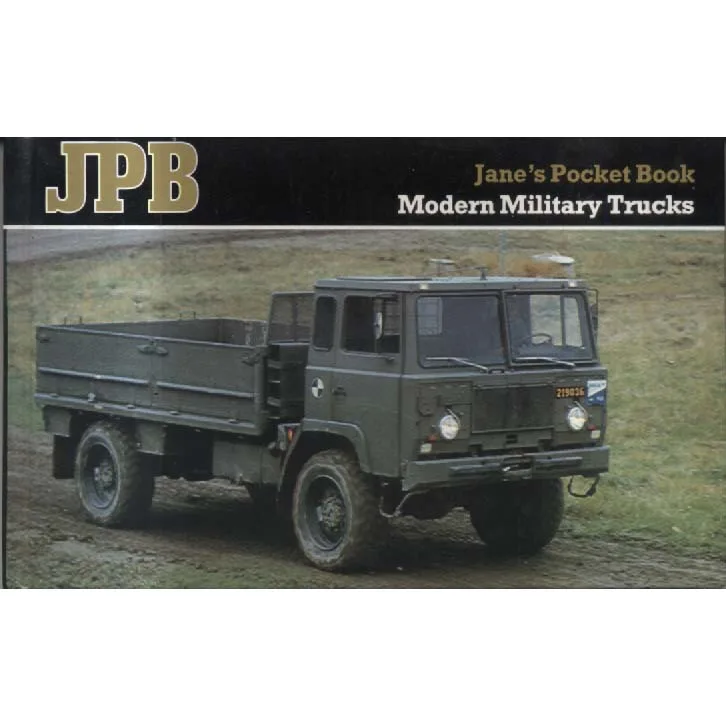
Publisher: Janes Publishing
Format: Hardback
ISBN: 0710600917
Modern Military Trucks (1981) by Christopher F. Foss
Jane’s Publishing | ISBN: 0710600917 | Condition: Good
There are military vehicles designed to inspire fear, admiration and national pride, and then there are military trucks, those magnificently unglamorous machines whose principal responsibility is to ensure that the soldiers, tanks, guns and assorted instruments of international disagreement actually arrive somewhere with sufficient fuel, ammunition and sandwiches to continue their activities. In Modern Military Trucks, published by Jane’s Publishing in 1981, distinguished military equipment specialist Christopher F. Foss turns his attention to the indispensable workhorses of modern armies, proving that warfare is not merely a matter of spectacular explosions and heroic advances, but also involves an extraordinary amount of driving around in large, muddy vehicles carrying things.
The military truck is one of the great unsung heroes of modern warfare. It rarely appears on recruiting posters, seldom receives the starring role in an action film and is unlikely to inspire a child to announce that they intend to become a lorry driver for an armoured division. Yet without military trucks, even the most formidable armed forces would quickly find themselves reduced to an expensive collection of heavily armed pedestrians, standing around wondering why the fuel, food and ammunition had failed to arrive.
Napoleon famously observed that an army marches on its stomach, although he neglected to explain how the contents of that stomach were supposed to reach the battlefield in the first place. By the twentieth century, the answer increasingly involved enormous numbers of motor vehicles, transporting everything from artillery shells and field kitchens to spare engines, medical equipment, bridging components and the seemingly limitless quantities of equipment required to keep a modern military organisation operational.
Christopher F. Foss, a respected authority on military vehicles and equipment, examines the world of military trucks at a particularly interesting moment in their development. By 1981, the armies of NATO, the Warsaw Pact and numerous other nations operated an extraordinary variety of specialised transport vehicles, designed to cope with conditions that would cause an ordinary commercial lorry driver to telephone his employer and announce that the road was completely unsuitable.
Military trucks were expected to operate across deserts, forests, mountains, muddy fields, frozen wastelands and roads that had recently been subjected to the attentions of enemy artillery. They needed to carry substantial loads, negotiate difficult terrain and continue functioning under circumstances in which a civilian vehicle might reasonably be expected to disintegrate into a collection of expensive spare parts.
The resulting machines were masterpieces of practical engineering, although not necessarily of elegance, comfort or fuel economy. Their designers were generally more concerned with ground clearance, load capacity, axle configuration and mechanical reliability than with providing heated leather seats, sophisticated entertainment systems or cup holders capable of accommodating a fashionable coffee.
Four-wheel drive, six-wheel drive and even larger multi-axle configurations became essential features of military transport, allowing vehicles to travel across difficult terrain while carrying substantial payloads. Winches, differential locks, heavy-duty suspensions, powerful diesel engines and reinforced chassis contributed to machines whose specifications reflected the unpleasant realities of military operations rather than the preferences of suburban motorists.
Of course, military trucks come in an astonishing variety of shapes and sizes. Some are relatively modest utility vehicles, intended to carry personnel and supplies around military installations. Others are enormous all-terrain machines capable of transporting heavy equipment through environments where the concept of a properly maintained road is little more than an optimistic rumour.
There are cargo trucks, tank transporters, recovery vehicles, fuel bowsers, communications vehicles, mobile workshops and countless specialised variants, each designed to satisfy some particular military requirement. The modern army is, in many respects, a vast travelling industrial enterprise, complete with its own transport network, maintenance facilities, medical services, catering arrangements and administrative complications.
Indeed, one suspects that the average military logistics officer spends considerably more time worrying about delivery schedules and vehicle availability than contemplating the finer points of battlefield heroism. An armoured regiment may possess the most sophisticated tanks in the world, but their usefulness becomes rather limited when somebody discovers that the fuel convoy has taken a wrong turning and is now attempting to negotiate a narrow village street in Belgium.
The military truck therefore occupies a position of enormous strategic importance. Armies may win battles through tactical brilliance, technological superiority and exceptional courage, but sustaining military operations requires vast quantities of relatively ordinary supplies delivered with remarkable consistency. There is little point in possessing a splendid collection of artillery if the shells are sitting in a warehouse two hundred miles away because the transport fleet has become stuck in the mud.
The international variety of military truck design is another fascinating aspect of the subject. Different countries developed vehicles suited to their geography, military doctrines, industrial capabilities and expectations of warfare. British, American, German, French, Soviet and other manufacturers produced machines with distinctive engineering approaches, often reflecting the particular conditions under which their armed forces expected to operate.
British military vehicles, for example, were often built with a reassuring emphasis on rugged practicality, although generations of military drivers may have developed rather different opinions about the comfort of their cabs. The Americans possessed the industrial resources to produce vast fleets of standardised transport vehicles, while Soviet designers frequently favoured robust machines intended to cope with appalling roads, severe winters and the occasional inconvenience of being operated by somebody with only a passing acquaintance with preventative maintenance.
The Soviet approach was particularly interesting. Vehicles were expected to survive conditions that might reasonably be described as hostile to both machinery and human happiness. Enormous tyres, substantial ground clearance and uncomplicated mechanical systems were valuable advantages when operating across frozen terrain, deep mud or remote regions where the nearest repair facility might be several hundred miles away.
Western manufacturers, meanwhile, explored their own combinations of engineering sophistication, off-road performance and logistical standardisation. The challenge was not merely producing a vehicle capable of crossing difficult terrain, but ensuring that thousands of examples could be maintained, supplied with spare parts and operated by soldiers who were not necessarily trained mechanical engineers.
Published during the Cold War, Modern Military Trucks also captures the military technology of an era dominated by the possibility of a major conventional conflict in Europe. In 1981, NATO and Warsaw Pact forces maintained enormous inventories of military vehicles, and the logistical demands of any hypothetical confrontation would have been staggering. Behind every tank division stood a vast supporting organisation responsible for keeping machinery supplied, repaired and operational.
This was the age of military exercises involving enormous convoys of olive-drab vehicles rumbling along European roads, frequently accompanied by soldiers looking as though they had been awake for several days and would greatly appreciate a hot meal. For civilians encountering such convoys, the experience could be mildly inconvenient, particularly when attempting to overtake twenty-seven heavily loaded trucks on a winding country road.
Military truck enthusiasts, however, would undoubtedly have regarded the spectacle rather differently. Where the ordinary motorist saw a traffic obstruction, the knowledgeable observer might identify different manufacturers, axle arrangements, specialised bodies and technical configurations, perhaps becoming so absorbed in the details that they failed to notice the queue of increasingly irritated motorists forming behind them.
One of the great attractions of military vehicle literature is its emphasis on function rather than fashion. Civilian motor cars are frequently marketed through images of glamour, excitement and personal freedom, while military trucks are designed around considerably more straightforward questions. How much can they carry? How far can they travel? Can they climb that slope? Will they start in freezing conditions? And, perhaps most importantly, can an exhausted mechanic repair them in the rain using a limited selection of tools and language unsuitable for polite company?
There is an admirable honesty about such machines. Their appearance is dictated largely by practical necessity, producing designs that can range from brutally utilitarian to strangely handsome. A well-proportioned military truck possesses a certain purposeful dignity, even if it resembles something that might have been constructed from railway equipment, agricultural machinery and a substantial quantity of green paint.
There is also something almost reassuring about the sheer mechanical solidity of these vehicles. Modern civilian cars increasingly depend upon sophisticated electronics, integrated computer systems and components that appear designed to require replacement as complete and extraordinarily expensive assemblies. Older military trucks, by comparison, often belong to a world of substantial steel components, conventional mechanical systems and the belief that most difficulties can eventually be overcome with sufficient tools, determination and a very large hammer.
Naturally, this apparent simplicity should not be mistaken for a complete absence of engineering sophistication. Military transport vehicles must satisfy demanding operational requirements, balancing durability, mobility, carrying capacity, range and maintainability. The resulting engineering compromises can be extremely complex, particularly when a vehicle is expected to perform reliably in environments where both roads and workshops are conspicuous by their absence.
For collectors of military history and enthusiasts of heavy vehicles, Foss’s book offers a fascinating perspective on machinery that is frequently overlooked in favour of more dramatic equipment. Tanks, fighter aircraft and warships tend to dominate popular military literature, while the transport vehicles responsible for supporting them receive comparatively little attention. Yet the study of military logistics reveals an essential truth about warfare: the ability to move supplies can be just as important as the ability to destroy the enemy.
The book is also a valuable period piece. Published in 1981, it presents military truck technology from the perspective of the early 1980s, when many vehicles now regarded as historic were still in everyday service. The specifications, designs and operational concepts belong to a world before the end of the Cold War, the widespread introduction of modern digital military systems and the enormous changes in vehicle technology that followed.
Some of the machines discussed in literature of this period have since disappeared from front-line service, while others have enjoyed extraordinarily long careers, proving that a well-designed military truck can possess a working life considerably greater than the average family car. Indeed, certain military vehicles seem almost determined to outlive the governments that originally purchased them, reappearing decades later in remote corners of the world where their continued operation is sustained by mechanical ingenuity, cannibalised spare parts and an impressive disregard for the manufacturer’s recommended retirement date.
The surplus military vehicle market has also created a dedicated community of civilian enthusiasts who acquire, restore and preserve these remarkable machines. Ownership of a vintage military truck is not, however, an undertaking for the faint-hearted. Storage can be complicated, fuel consumption is frequently alarming and even the relatively simple operation of changing a tyre may require equipment normally associated with a commercial transport depot.
Parking presents another difficulty. A vehicle designed to transport several tons of ammunition across a battlefield may be perfectly capable of negotiating difficult terrain, yet prove surprisingly unsuitable for a suburban driveway constructed with the expectation that its largest visitor would be a Ford Fiesta.
And then there is the question of domestic approval. Informing one’s family that one has purchased an elderly military truck is unlikely to produce the same reaction as announcing the acquisition of a sensible second-hand hatchback. The explanation that it possesses excellent off-road capabilities, six driven wheels and a particularly interesting transfer gearbox may not be especially persuasive when the machine occupies the entire front garden and frightens the neighbours.
Fortunately, purchasing a book about military trucks offers many of the intellectual pleasures of the hobby without the practical inconveniences. One may admire the engineering, compare specifications and contemplate the extraordinary capabilities of these vehicles while remaining safely indoors, without purchasing several hundred litres of diesel or investigating whether the local council permits the permanent storage of an ex-army recovery vehicle outside a terraced house.
Jane’s Publishing has long been associated with authoritative reference works on military equipment, and a volume by Christopher F. Foss is naturally of particular interest to readers seeking informed coverage of military vehicle technology. His expertise and the book’s period perspective make it an appealing addition to collections concerned with the development of wheeled military transport and the wider history of twentieth-century military engineering.
This 1981 Jane’s Publishing edition is offered in Good condition by Crappy Old Books, a bookseller that recognises the importance of preserving useful older reference books, particularly those devoted to enormous mechanical objects that are considerably easier to accommodate on a bookshelf than in the back garden.
Unlike the vehicles it describes, this particular example requires no special driving licence, no heavy recovery equipment and no detailed understanding of differential locking systems. Its fuel economy is exemplary, its road tax is nonexistent and its carrying capacity is limited only by the strength of the reader’s imagination.
An excellent acquisition for military historians, vehicle enthusiasts, modellers, collectors of Jane’s reference publications, former service personnel and anyone interested in the machinery that keeps armies moving, Modern Military Trucks provides an absorbing glimpse into the specialised world of military transport during the late Cold War.
It may also prove invaluable to the scale modeller attempting to establish precisely which type of truck should accompany a particular armoured formation, thereby avoiding the embarrassment of constructing an otherwise historically accurate military diorama featuring a vehicle that was not introduced until fifteen years after the event depicted.
A fascinating celebration of the heavy-duty workhorses of modern warfare, from modest utility trucks to enormous all-terrain transporters, and a reminder that even the mightiest army is ultimately dependent upon somebody turning up with the supplies.
After all, generals may devise brilliant strategies, politicians may deliver stirring speeches and armoured divisions may advance magnificently across the battlefield, but sooner or later somebody has to arrive with the petrol, spare parts, toilet paper and tea bags.
And when that moment comes, the military truck suddenly becomes the most important vehicle in the entire army.
Crappy Old Books: proudly supplying military transport literature without requiring a convoy permit, camouflage netting, six-wheel drive or the services of a regimental quartermaster.
Because while a tank may win the battle, it is usually a rather less glamorous truck that brings the ammunition, collects the broken equipment and ensures that everybody gets something to eat afterwards.
And unlike a tank, it might even be persuaded to deliver the post.
Keep browsing: See more War books Other books by Christopher F Foss
