


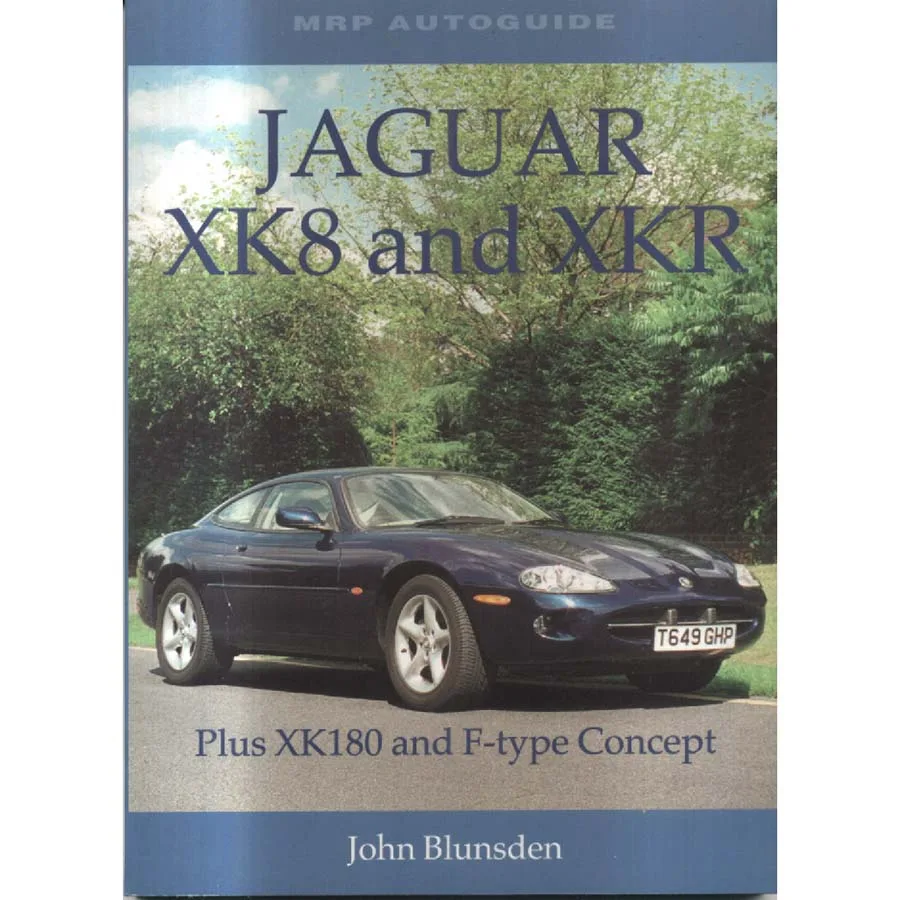
Jaguar XK8 And XKR - Plus XK180 And F-type Concept
Publisher: Motor Racing Publications
Format: Paperback
ISBN: 9781899870530
Jaguar XK8 and XKR – Plus XK180 and F-Type Concept (2000) by John Blunsden
Motor Racing Publications | ISBN: 9781899870530 | Condition: Good
There are motor cars, there are beautiful motor cars, and then there are Jaguars, magnificent British machines designed to make their owners feel like sophisticated international playboys while occasionally reminding them that the electrical system was assembled by somebody with a mischievous sense of humour. In Jaguar XK8 and XKR – Plus XK180 and F-Type Concept, published by Motor Racing Publications in 2000, respected motoring writer John Blunsden explores one of the most exciting chapters in Jaguar’s modern history, when the company rediscovered its sporting confidence, embraced contemporary engineering and produced a range of grand touring cars that looked as though they belonged outside a Monte Carlo casino rather than in a supermarket car park in Wolverhampton.
The Jaguar XK8 arrived in 1996 as a thoroughly desirable replacement for the long-serving XJS, a car which had somehow managed to remain in production for twenty-one years despite the world changing around it almost beyond recognition. When the XJS first appeared, Britain was still adjusting to decimalisation, flared trousers were considered fashionable and the internet was largely a subject for conversations between unusually enthusiastic scientists. By the time it departed, mobile telephones were becoming commonplace and the British motor industry had experienced enough upheaval to fill several substantial volumes of industrial tragedy.
Jaguar therefore had an enormous responsibility on its hands. The replacement needed to preserve the marque’s traditions of elegance, performance and refinement while appealing to a new generation of wealthy motorists who expected modern reliability, sophisticated engineering and the ability to arrive at a dinner party without having spent the preceding afternoon discussing replacement fuel pumps with the AA.
The result was the XK8, a spectacularly elegant grand tourer whose sweeping curves, long bonnet and beautifully proportioned bodywork deliberately recalled the great Jaguars of the past. There were unmistakable echoes of the legendary E-Type, although the XK8 was a distinctly more comfortable and civilised proposition, designed for drivers who appreciated sporting performance but no longer regarded climbing over a substantial door sill as an essential part of the motoring experience.
Beneath that graceful exterior lay Jaguar’s new AJ-V8 engine, a significant technological development for a company historically associated with its famous straight-six and V12 powerplants. The new 4.0-litre V8 brought contemporary engineering to the marque’s grand touring range, providing smooth performance, impressive refinement and the reassuring sensation that a substantial number of horses were available whenever the driver felt the need to make a suitably dignified departure.
Of course, dignity is a relative concept when one has several hundred horsepower at one’s disposal, particularly if the traffic lights have just changed and a gentleman in a German sports car appears to be questioning the honour of the British motor industry.
Then came the XKR, the supercharged version of the XK8, which took the already impressive grand tourer and introduced the delightful complication of considerably more power. Equipped with a supercharged V8 producing around 370 horsepower, the XKR demonstrated that Jaguar’s engineers were perfectly capable of building a fast, refined luxury motor car and then deciding that it would be much more entertaining if it accelerated with sufficient enthusiasm to rearrange the contents of the driver’s briefcase.
The XKR was an especially appealing combination of old-fashioned British grand touring style and thoroughly modern performance. It possessed the elegance of a distinguished gentleman’s motor car, the interior of a comfortable private club and the ability to accelerate with an urgency that suggested the distinguished gentleman might have developed an unexpected interest in escaping from the police.
Yet Jaguar was not content simply to produce attractive production cars. The late 1990s also witnessed some fascinating explorations of the company’s sporting future, including the spectacular XK180 concept car. Unveiled in 1998 to celebrate the fiftieth anniversary of the legendary XK120, the XK180 was a dramatic open sports car that looked as though Jaguar’s designers had been allowed to indulge their wildest fantasies without the usual interference from accountants, insurance assessors or people responsible for ensuring that ordinary motorists could actually climb into the thing.
With its low-slung bodywork, open cockpit and aggressive styling, the XK180 was a glorious demonstration of what Jaguar could achieve when freed from the practical demands of mass production. It was not merely a styling exercise but a celebration of the company’s sporting heritage, recalling an era when sports cars were expected to possess long bonnets, extraordinary proportions and the ability to make passing pedestrians stop and stare.
And then there was the F-Type concept, revealed in 2000, offering another tantalising glimpse of a possible future Jaguar sports car. Compact, stylish and unmistakably sporting, the concept represented the continuing ambition to create a spiritual successor to the E-Type, a task made considerably more difficult by the fact that the original had become one of the most celebrated automobiles ever produced.
Replacing the E-Type, even spiritually, was always going to be a delicate business. It was rather like announcing that one intended to produce a sequel to Shakespeare, improve upon the design of the Spitfire or develop a new national dish to replace fish and chips. The result might be excellent, but there would inevitably be elderly gentlemen standing nearby explaining that the original was better and that civilisation had been in decline since approximately 1963.
John Blunsden’s book brings together these fascinating strands of Jaguar’s development at a particularly important moment in the company’s history. The XK8 and XKR represented the reality of contemporary Jaguar grand touring, while the XK180 and F-Type concepts revealed the dreams, ambitions and design possibilities that might shape the marque’s future.
Published in 2000, the volume possesses the additional attraction of being a contemporary account of these developments. It comes from a time when the XK8 and XKR were still relatively new, the XK180 remained an exciting concept and the F-Type name represented a tantalising possibility rather than the production sports car that would eventually appear more than a decade later.
This makes the book especially interesting from a historical perspective. It captures the hopes and expectations surrounding Jaguar at the turn of the millennium, when the company was attempting to balance its distinguished past with the realities of modern international car manufacturing. It was a period when the British motor industry had undergone dramatic transformations, foreign ownership had become an established reality and Jaguar was seeking to preserve its distinctive identity within an increasingly competitive global market.
The XK8 itself was a fascinating symbol of that balancing act. Its appearance was deliberately traditional, embracing the flowing shapes and understated elegance associated with Jaguar’s greatest designs, while its engineering reflected the company’s need to compete with sophisticated modern alternatives from Germany, Japan and elsewhere. The car had to appeal simultaneously to enthusiasts who remembered the E-Type and buyers who expected a luxury grand tourer to start every morning without requiring a prayer, a screwdriver and a sympathetic neighbour.
For all the advances in engineering, however, Jaguar ownership retained a certain distinctive character. A Jaguar was never simply a rational purchase made after comparing fuel economy, servicing costs and projected depreciation. It was an emotional commitment, a declaration that one appreciated elegance, tradition and mechanical sophistication sufficiently to accept that some aspects of the ownership experience might prove character-building.
The interiors alone were enough to distinguish these machines from many of their contemporaries. Leather upholstery, polished wood veneers and a sense of traditional craftsmanship created an atmosphere more reminiscent of a particularly comfortable gentleman’s club than a modern industrial product. One could almost imagine a discreet attendant appearing from the dashboard to offer a newspaper and enquire whether the driver required another cup of tea.
The XK8 and XKR also belonged to an era when the grand touring car still possessed a clearly defined personality. It was not intended to be a stripped-out racing machine or a practical family hatchback. Its purpose was to transport two people, with occasional accommodation for passengers possessing unusually short legs, over considerable distances in comfort, style and at speeds that made the journey rather more interesting than the Highway Code might recommend.
This distinction matters because the grand tourer represents one of motoring’s most civilised ideas. It combines performance with luxury, encouraging the driver to enjoy the journey rather than merely endure it. In theory, one could leave London in the morning, cross the Channel, travel through France and arrive somewhere on the Mediterranean coast looking as fresh and sophisticated as when one departed. In practice, there would probably be delays at Dover, roadworks near Paris and an argument about the hotel reservation, but at least the car would look magnificent throughout.
For Jaguar enthusiasts, Blunsden’s volume offers an appealing exploration of a model range that has matured into an increasingly interesting modern classic. The earliest XK8s are now approaching thirty years old, and examples once found outside expensive hotels and fashionable restaurants can occasionally be encountered in the hands of enthusiasts who have discovered that purchasing a used luxury car is considerably cheaper than maintaining one.
There lies one of the great ironies of automotive depreciation. A vehicle that originally cost as much as a modest house deposit may eventually become affordable to somebody working with a surprisingly modest motoring budget. Unfortunately, the replacement parts have not necessarily received the same message, and a bargain Jaguar can occasionally demonstrate that although depreciation reduces the purchase price, it does absolutely nothing to diminish the original manufacturer’s engineering ambitions.
Nevertheless, the appeal remains powerful. The XK8 and XKR represent a particularly handsome period of Jaguar design, combining recognisable sporting heritage with contemporary technology and impressive performance. They are cars that have aged with considerable dignity, their smooth lines offering a refreshing contrast to modern automotive styling trends involving enormous radiator grilles, aggressive lighting arrangements and bodywork apparently designed to intimidate pedestrians into surrendering the pavement.
The concept cars covered in the book add another dimension to the story. Automotive history is filled with magnificent prototypes that never reached production, spectacular engineering experiments abandoned by accountants and designs that influenced future vehicles in ways not immediately obvious at the time. The XK180 and F-Type concepts belong to that fascinating world of automotive possibility, where designers can imagine what might be achieved before the practical difficulties of manufacturing, regulation and commercial viability intervene.
There is something wonderfully romantic about a concept car. It exists in a world where everything is possible, nobody has yet complained about the boot capacity and the finance department has not demanded that the beautiful bespoke headlights be replaced with something borrowed from a family saloon. The transition from motor-show fantasy to showroom reality is frequently a painful process, which perhaps explains why some of the most exciting automobiles remain forever preserved as prototypes.
Published by Motor Racing Publications, a name long associated with serious automotive literature, this book will appeal particularly to readers interested in Jaguar design, engineering and the evolution of Britain’s sporting motor cars. It represents a pleasing opportunity to revisit the XK8 era through the eyes of a knowledgeable motoring writer at a time when these cars were still among the most desirable machines on British roads.
This 2000 edition is offered in Good condition by Crappy Old Books, a bookseller that appreciates the finer achievements of British engineering, particularly when they can be admired without the inconvenience of obtaining comprehensive insurance, replacing expensive tyres or discovering that an apparently minor electrical fault requires the removal of half the dashboard.
Unlike an elderly Jaguar, this volume should not require a diagnostic computer, replacement timing-chain tensioners or a particularly understanding bank manager. It may possess the modest signs of age expected of a second-hand book, but its running costs are negligible, its fuel consumption is zero and the only scheduled maintenance involves occasionally removing the dust from its cover.
An excellent addition to any collection of Jaguar literature, British motoring history, automotive design books or publications devoted to modern classic cars, Jaguar XK8 and XKR – Plus XK180 and F-Type Concept will appeal to owners, prospective buyers, enthusiasts and anyone who remembers the excitement surrounding Jaguar’s sporting renaissance at the turn of the millennium.
It would also make a thoughtful gift for somebody who has always wanted an XK8 or XKR but has not yet developed the financial recklessness necessary to purchase one. A book is, after all, an excellent way of enjoying the ownership experience without having to investigate suspicious noises from the rear suspension or explain to one’s partner why the annual servicing bill resembles the national debt of a small European country.
A fascinating celebration of Jaguar’s elegant grand tourers and spectacular sporting concepts, capturing a period when British automotive design combined traditional craftsmanship, modern performance and the irresistible conviction that a motor car should be beautiful enough to admire even when it was standing still.
And perhaps that is the essential difference between a Jaguar and an ordinary car. An ordinary car transports you to your destination. A Jaguar transports you to your destination while persuading you that you are a considerably more interesting person than you actually are.
Whether this illusion survives the arrival of the repair invoice is another matter entirely.
Crappy Old Books: delivering the pleasures of classic Jaguar ownership without the oil leaks, expensive servicing, mysterious dashboard warning lights or unexpected conversations with the AA.
And if you are fortunate enough to own an XK8 or XKR, this book will look splendid on the passenger seat. Just try not to leave it there with the roof down when the traditional British summer weather makes its inevitable appearance.
Keep browsing: See more Transport books Other books by John Blunsden
