


Typewriting
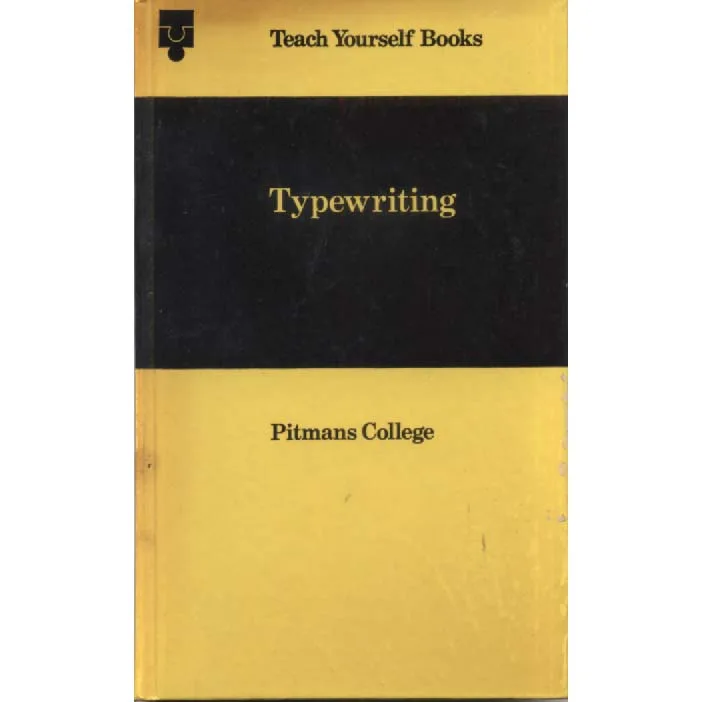
Publisher: Teach Yourself Books
Format: Hardback
ISBN: 0340057394
Typewriting (1971) by Pitmans College
Teach Yourself Books | ISBN: 0340057394 | Condition: Good
There was a time, not so very long ago, when the ability to operate a typewriter was considered an essential professional accomplishment, alongside answering a telephone politely, taking shorthand and knowing exactly how much correction fluid could be applied to a document before it became structurally unsound. In Typewriting, published in 1971 as part of the celebrated Teach Yourself Books series, Pitmans College sets out to teach the aspiring typist the noble art of transforming thoughts into neatly arranged letters on paper, using nothing more sophisticated than ten fingers, a mechanical contraption and an apparently inexhaustible supply of patience.
For younger readers, a typewriter was a remarkable device resembling a computer keyboard attached to a small industrial machine. Unlike modern computers, however, it possessed no internet connection, no predictive text, no autocorrect and absolutely no sympathy for mistakes. Press the wrong key and the error remained there, glaring accusingly from the page, until you corrected it by some laborious mechanical or chemical process. The alternative was to start the entire sheet again, a prospect that encouraged an admirable degree of concentration and occasionally some remarkably inventive language.
Pitmans College, an institution synonymous with practical business education and the cultivation of respectable office skills, understood that competent typing was not simply a matter of hitting the correct keys. It required posture, rhythm, accuracy, speed, discipline and the ability to manipulate paper, margins, tabs and carriage returns without becoming hopelessly entangled in the machinery. Typewriting was a craft, and like most crafts, it demanded practice, persistence and an acceptance that one’s early efforts might resemble the work of a nervous chimpanzee operating a railway signal box.
This instructional volume belongs to an era when offices reverberated with the distinctive clatter of typewriters, interrupted by the occasional bell announcing the approaching end of a line. Rows of secretaries and clerks produced letters, invoices, memoranda, reports and official documents with astonishing efficiency, often while simultaneously dealing with telephones, filing systems and managers who apparently believed that a five-page letter could be typed, corrected and dispatched within three minutes.
The typewriter was also one of the great levellers of professional life. Whether you were preparing correspondence for a multinational corporation, composing a furious letter to the local council or writing your first thoroughly unsuccessful novel, the same fundamental rules applied. You had to insert the paper correctly, position the margins, strike the keys with reasonable accuracy and resist the temptation to hurl the machine through the nearest window when the ribbon became tangled.
Of course, by 1971 the typewriter had become a thoroughly established feature of modern civilisation. Electric models were increasingly common, although the traditional manual machine remained a familiar companion in homes, schools and workplaces. The personal computer, meanwhile, was still some years away from transforming the office into an environment where employees could spend an entire afternoon attempting to discover why a printer had inexplicably decided to go offline.
One of the particular pleasures of a book such as Typewriting is the glimpse it offers into the everyday working practices of a vanished age. There is something almost touching about an era in which the correct positioning of a sheet of paper was a subject worthy of careful instruction, and where the ability to produce a properly aligned business letter could open the door to a respectable career. Today, of course, we possess word processors capable of producing beautiful documents in seconds, which we then spend forty-five minutes trying to format because Microsoft Word has developed an inexplicable objection to the second paragraph.
The business world of 1971 took typing seriously. Qualifications in the subject were widely recognised, employers expected measurable standards of accuracy and speed, and aspiring office workers devoted considerable effort to developing the necessary skills. A competent typist could produce professional correspondence without looking at the keyboard, a feat that remains impressive even in our own age of smartphones, tablets and people attempting to write lengthy messages using two thumbs while walking into lampposts.
This book also serves as a reminder that modern technology has not entirely eliminated the usefulness of traditional skills. Touch typing remains enormously valuable, even if the machinery has changed beyond recognition. The arrangement of letters on the keyboard has survived the transition from mechanical typewriters to sophisticated computers, largely because humanity decided that reorganising the keys would be more trouble than learning to live with an arrangement originally devised in the nineteenth century.
Indeed, the QWERTY keyboard represents one of civilisation’s most extraordinary examples of technological persistence. We have developed satellites, nuclear reactors, artificial intelligence and machines capable of exploring other planets, yet we continue arranging the letters of the alphabet in a pattern that requires the user to remember that the letter Q lives next to W for reasons that are not immediately obvious to anybody.
For collectors of vintage educational books, enthusiasts of mechanical technology or readers fascinated by the history of office life, Typewriting is a wonderfully evocative survivor. It captures a period when clerical skills were taught with great seriousness, and when the phrase ’word processing’ had yet to become a familiar part of everyday language. The exercises, instructions and underlying discipline belong to a world that has largely disappeared, although the fundamental challenge of persuading one’s fingers to strike the correct keys remains reassuringly unchanged.
It is also a potentially entertaining acquisition for anyone fortunate enough to own a vintage typewriter. Those beautiful old machines, whether modest portable models or enormous office contraptions built with the apparent expectation of surviving an artillery bombardment, have enjoyed something of a revival among enthusiasts who appreciate the physical satisfaction of producing words without being interrupted by software updates, notifications or advertisements for products they mentioned once in a private conversation.
There is a peculiar pleasure in using a manual typewriter. Each letter requires deliberate physical action, every line advances through a mechanical process, and the finished page emerges as an actual object rather than a collection of electronic instructions residing somewhere inside a machine. Admittedly, this pleasure diminishes considerably when one discovers a spelling mistake three lines from the bottom of an otherwise immaculate page, but no technology is entirely without its disadvantages.
This 1971 edition of Typewriting is offered in Good condition by Crappy Old Books, a bookseller that appreciates the enduring charm of instructional volumes devoted to skills that modern civilisation has supposedly rendered obsolete. The book has survived more than half a century of technological progress, during which the world has moved from typewriters to word processors, desktop computers, laptops, tablets and mobile phones, only to discover that people are still perfectly capable of making dreadful spelling mistakes.
An excellent addition to a collection of vintage Teach Yourself Books, commercial education manuals, office memorabilia or historical computing material, it would also make a delightful gift for a typewriter enthusiast, a lover of retro technology or someone who insists that everything was better before computers arrived and ruined civilisation.
It might even prove useful to the determined individual wishing to master the traditional art of touch typing, particularly if they have acquired an elderly typewriter and are presently using it with the tentative enthusiasm of someone attempting to defuse an unexploded bomb.
A charming relic of the days when typing was a respectable profession, office machinery possessed moving parts, and the words ’fatal error’ usually meant that somebody had spilled coffee into the mechanism.
And perhaps the greatest advantage of the typewriter was this: when it stopped working, you could generally see which part had broken, and nobody suggested clearing your browser cache, reinstalling the drivers or turning the internet off and on again.
Those really were simpler times.
Keep browsing: See more Academic books Other books by Pitmans College
