


Red Planet
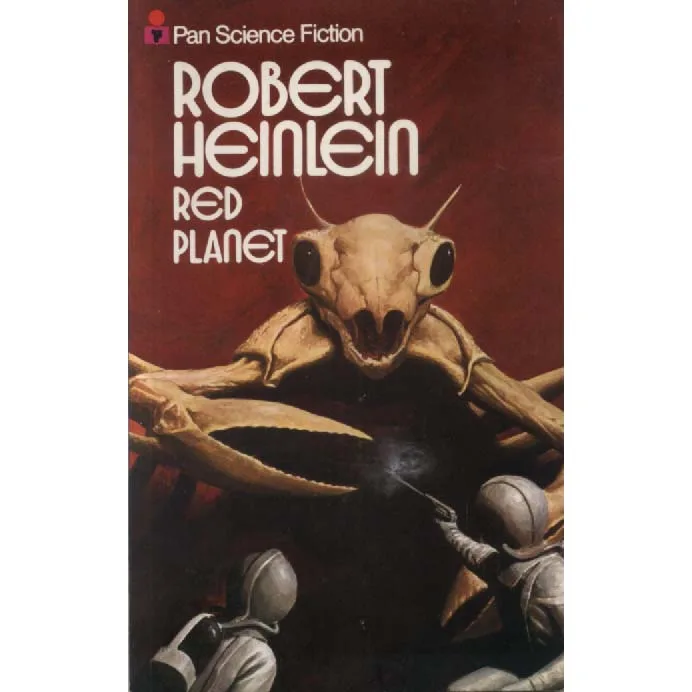
Publisher: Pan Books
Format: Paperback
ISBN: 9780330107129
Red Planet (1973) by Robert A. Heinlein
Pan Books | ISBN: 9780330107129 | Condition: Good
Mars. The Red Planet. A world of frozen deserts, ancient mysteries, peculiar inhabitants and, inevitably, human beings determined to make an administrative mess of the whole place. In Red Planet, Robert A. Heinlein transports us to a future in which humanity has managed to establish colonies on another world, only to discover that moving millions of miles away from Earth does absolutely nothing to cure the species of its enthusiasm for bureaucracy, petty authority and thoroughly questionable political decisions.
Originally published in 1949, Red Planet is one of Heinlein’s classic juvenile science-fiction adventures, although the term ’juvenile’ should not be taken to suggest that the book is exclusively concerned with childish matters. Quite the opposite. Beneath its exciting tale of Martian exploration, adolescent rebellion and mysterious alien life lies a surprisingly sophisticated examination of freedom, colonialism, political authority and the irritating tendency of those in power to assume that everybody else ought to do exactly as they are told.
Our heroes are Jim Marlowe and Frank Sutton, two young colonists attending school on Mars, an establishment that proves educational in considerably more ways than its administrators intended. Jim also possesses an unusual companion named Willis, a charming and decidedly peculiar Martian creature capable of imitating sounds and speech. Willis is considerably more interesting than the average school pet, not least because he belongs to a native species whose true nature and significance are far more remarkable than the human settlers initially appreciate.
What begins as a relatively conventional tale of schoolboys, friendships and adventures gradually develops into something rather more serious. When Jim and Frank stumble upon information suggesting that the colonial authorities have plans which may prove disastrous for the settlers, they find themselves caught up in a struggle involving survival, resistance and the awkward question of who actually has the right to govern a planet that was already occupied long before humanity arrived with its paperwork.
Heinlein was particularly good at constructing futures in which technological achievements had advanced magnificently while human stupidity remained reassuringly unchanged. Spaceships, advanced machinery and interplanetary settlements are all very well, but someone will still insist upon implementing an unpopular regulation, preferably without consulting the people expected to endure it. The distance between Earth and Mars apparently provides no protection against committees, officials or individuals convinced that a position of authority automatically confers wisdom.
There is also the intriguing matter of the Martians themselves. Rather than merely providing an assortment of conveniently hostile monsters for the human characters to shoot, Heinlein introduces an alien civilisation with its own extraordinary qualities and an understanding of existence rather different from humanity’s. The resulting encounters give the novel an imaginative depth that distinguishes it from more straightforward tales of space exploration and planetary conquest.
For readers familiar with Heinlein’s later and more philosophically argumentative novels, Red Planet offers an entertaining opportunity to observe some of his recurring interests in an earlier form. Individual liberty, responsibility, self-reliance, the legitimacy of government and the importance of refusing to accept nonsense simply because it has been officially sanctioned are all present. Fortunately, the characters also find time to have an adventure, rather than spending the entire novel delivering lectures on political philosophy over breakfast.
There is something particularly appealing about vintage science fiction that imagined humanity’s expansion into space long before anyone had actually set foot on the Moon. Heinlein’s Mars belongs to an age when the planet remained tantalisingly mysterious, its surface inviting writers to populate it with canals, ancient civilisations and possibilities that modern planetary exploration has rather inconsiderately complicated. Reality may have provided us with photographs of rocks, dust and more rocks, but fiction had already furnished the planet with an entire civilisation and a much more interesting social calendar.
This Pan Books edition, identified as dating from 1973 although no publication year is stated inside the book, represents another pleasing survivor from the golden age of affordable paperback science fiction. It comes from a period when books could be purchased for comparatively modest sums, slipped into a jacket pocket and read on a train without anyone suggesting that the experience ought to involve a subscription service, electronic device or personalised advertising.
For collectors of Robert A. Heinlein, enthusiasts of classic science fiction and readers who appreciate a good old-fashioned planetary adventure with a thoughtful undercurrent, Red Planet remains a thoroughly worthwhile discovery. It combines the excitement of exploring an unfamiliar world with the considerably more familiar experience of discovering that the people supposedly running things may not have the faintest idea what they are doing.
This Pan Books edition is offered in Good condition by Crappy Old Books, where elderly paperbacks are treated with the respect due to survivors of several decades of changing literary fashions, technological revolutions and the occasional unfortunate encounter with a cup of tea. The publication year of 1973 is attributed to this edition, but is not actually printed in the book itself, a small bibliographical mystery that seems entirely appropriate for a novel involving mysterious Martians.
An excellent addition to any vintage science-fiction collection, particularly for those who prefer their interplanetary adventures to feature strange creatures, rebellious youngsters, questionable government decisions and the occasional suggestion that humanity might benefit from behaving rather less like humanity.
After all, if we ever do establish permanent settlements on Mars, we can be reasonably confident of one thing: within six months somebody will have invented a planning committee, imposed a parking regulation and started arguing about who is responsible for emptying the bins.
Mars may be another world, but unfortunately we’ll still be taking ourselves along.
Keep browsing: See more Science-Fiction books Other books by Robert A Heinlein
