


Rocketship Galileo
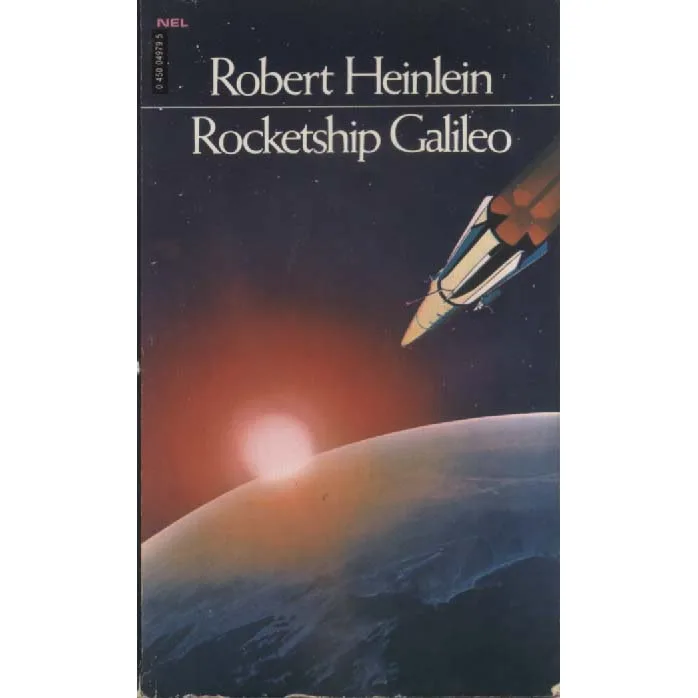
Publisher: New English Library
Format: Paperback
ISBN: 0450049795
Rocketship Galileo (1980) by Robert Heinlein
New English Library
ISBN: 0450049795
Condition: Good
Long before space travel became the preserve of multinational agencies, billionaire launch companies and highly polished livestreams, Robert Heinlein imagined a simpler approach.
Build your own rocket.
Find some intelligent teenagers.
Go to the Moon.
What could possibly go wrong?
Originally published in 1947, Rocketship Galileo was Heinlein’s first juvenile novel and helped establish the brisk, idea-driven style that would make his young-adult science fiction enormously influential. It is a story of engineering, adventure, scientific curiosity and the deeply optimistic belief that sufficiently competent people can solve almost anything if given enough tools and preferably a workshop.
The story follows a group of technically gifted boys who are recruited by scientist Dr Donald Cargraves for an extraordinary project: converting an experimental rocket into a spacecraft capable of reaching the Moon.
This is not the sort of educational opportunity generally listed by school careers advisers.
Still, it beats work experience in an office.
The preparations themselves form a large part of the fun. Heinlein takes machinery seriously. Rockets are not magical silver tubes that simply rise because the plot requires it.
They have engines.
Fuel.
Mass.
Navigation problems.
Life-support requirements.
And a tremendous capacity to become fatal if somebody has overlooked a small but important detail.
This is one of the great pleasures of early Heinlein.
Competence is exciting.
People calculate things.
They repair things.
They understand why machines behave as they do.
There is a wonderfully old-fashioned faith in engineering running through the story, as though humanity’s future depends mainly on making sure someone remembered to tighten every bolt.
Eventually, of course, they reach the Moon.
And naturally, the Moon refuses to remain merely an interesting geological destination.
Because a novel consisting entirely of successful scientific measurements and everyone returning home on schedule would have been disappointingly sensible.
The young explorers discover evidence that they are not alone.
And things become considerably more dangerous.
What begins as a pioneering expedition develops into a proper lunar adventure involving secrecy, conflict and a very unwelcome discovery.
Heinlein combines this with the political anxieties of the immediate post-war era, giving the story an unmistakable 1940s flavour.
The Second World War had only recently ended.
Rocket technology had suddenly become terrifyingly real.
Nuclear science had transformed global politics.
And space travel was moving from fantasy towards something engineers could at least begin discussing without being immediately escorted from the building.
Rocketship Galileo sits right at that fascinating moment.
It is science fiction looking eagerly forward while still carrying a great deal of recent history behind it.
Modern readers will inevitably notice aspects that belong firmly to the period.
The all-male group of young adventurers.
The assumptions about authority.
The wonderfully earnest enthusiasm for machinery.
And the general expectation that teenagers presented with a nuclear-powered spacecraft will behave with greater discipline than most adults manage during a delayed train journey.
But that period character is part of the appeal.
This is vintage science fiction before space exploration became familiar.
The Moon was still mysterious.
Nobody had walked there.
Nobody had photographed its surface in modern detail.
And sending human beings across that distance remained an astonishing dream.
Heinlein makes that dream feel practical.
Not easy.
Not safe.
But possible.
That distinction is important.
The book belongs to the era of science fiction that encouraged readers not merely to imagine the future, but to believe somebody might actually build it.
Preferably somebody who understood mathematics.
There is also the characteristic Heinlein message that intelligence should be used rather than admired decoratively.
His heroes succeed through knowledge, courage and cooperation.
Which sounds obvious until one considers how much fiction depends on everyone ignoring the clearly competent person until chapter seventeen.
For readers of classic science fiction, vintage juvenile adventure, early space-travel stories or Heinlein generally, Rocketship Galileo is a fascinating piece of genre history as well as a brisk adventure in its own right.
It shows the future before the future arrived.
Before Apollo.
Before satellites became ordinary.
Before anyone had to explain to tourists why luggage allowances for lunar travel might be restrictive.
This 1980 New English Library edition is in Good condition, having survived rather longer than the average experimental rocket might reasonably be expected to.
Available from Crappy Old Books, where lunar travel is currently unavailable, but postage remains considerably cheaper.
Keep browsing: See more Science-Fiction books Other books by Robert Heinlein
