


Rendezvous With Rama
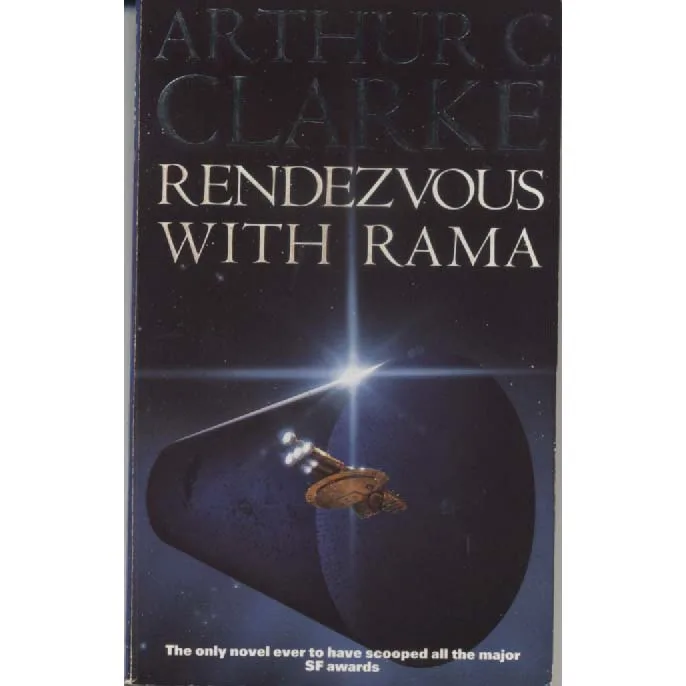
Publisher: Orbit
Format: Paperback
ISBN: 9781857231588
Rendezvous with Rama (1996) by Arthur C. Clarke
Orbit
ISBN: 9781857231588
Condition: Good
There are first-contact stories in which aliens arrive, explain themselves, threaten humanity, offer wisdom, demand resources or generally behave in the reassuringly theatrical manner expected of extraterrestrials.
Arthur C. Clarke’s Rendezvous with Rama takes a more unsettling approach.
Something enormous enters the Solar System.
Nobody knows what it is.
And it does not appear remotely interested in introducing itself.
Originally published in 1973, Rendezvous with Rama is one of Clarke’s great novels of cosmic mystery: a story built not around invasion, war or interstellar diplomacy, but around curiosity.
The object, eventually named Rama, is vast, cylindrical and unmistakably artificial.
Which is the sort of discovery that tends to ruin an astronomer’s afternoon.
A spacecraft is sent to investigate, and the crew enters Rama before it swings around the Sun and disappears again into deep space.
What follows is part exploration story, part engineering puzzle and part sustained reminder that human beings are very small and the universe is under no obligation to explain itself.
Inside Rama, Clarke creates one of science fiction’s most memorable environments.
The cylinder contains an entire artificial world.
There are plains, structures, immense internal spaces and strange features whose purpose is not immediately clear.
Gravity behaves according to the rotation of the vessel rather than the expectations of anyone who grew up on Earth.
Distances become difficult to judge.
The horizon bends upward.
And every new discovery raises approximately three additional questions.
It is architecture on a scale large enough to make ordinary buildings feel like cupboards.
The crew explores this extraordinary environment with a mixture of scientific discipline and completely understandable astonishment.
There are no helpful plaques.
No instruction manuals.
No friendly alien guide called Zog.
Just artefacts.
Patterns.
Machines.
And the persistent possibility that humanity may be wandering around inside something designed by beings so advanced that even recognising the furniture could be a challenge.
Clarke is particularly good at this kind of awe.
He does not need monsters hiding behind doors.
The scale itself is unnerving.
A structure does not have to be hostile to make you feel insignificant.
Sometimes it merely has to be several kilometres long and obviously built by somebody who considered that perfectly reasonable.
That sense of mystery gives the novel its lasting power.
Clarke resists the temptation to explain everything.
The reader learns what the explorers learn, and many of the largest questions remain stubbornly unanswered.
Modern storytelling often assumes that every mystery must eventually be unpacked, labelled and accompanied by a sequel explaining the origin story.
Clarke understands that sometimes the unexplained thing is more interesting.
Rama does not need to deliver a speech.
Its existence is enough.
There is also plenty here for readers who enjoy the harder side of science fiction.
Orbital mechanics, gravity, spacecraft operations and the practical problems of exploration matter.
This is not space as decorative wallpaper.
People have to think about how things actually work.
Which is unfortunate because Rama has apparently been built by someone operating several levels above the average human engineering department.
The tension comes not from constant combat but from limited time.
Rama is passing through the Solar System.
The explorers cannot stay indefinitely.
Every discovery creates another reason to keep looking.
And every hour brings them closer to the moment when they must leave.
It is archaeology conducted against a celestial timetable.
Except the archaeological site is moving.
Very quickly.
Through space.
The novel also captures Clarke’s characteristic combination of optimism and humility.
Human beings are intelligent enough to investigate Rama, brave enough to enter it and clever enough to understand parts of what they see.
But understanding parts is not the same as understanding the whole.
That distinction matters.
Clarke’s universe is not built for human convenience.
We are participants, not necessarily the main event.
Which is refreshing, if slightly damaging to the collective ego.
For readers of classic science fiction, alien-artefact stories, space exploration and novels in which the central character may effectively be a gigantic rotating cylinder, Rendezvous with Rama remains essential reading.
It is thoughtful, elegant and full of that rare science-fiction quality: genuine wonder.
This 1996 Orbit edition is in Good condition, meaning it has survived its own journey through time considerably more successfully than most mysterious objects entering the Solar System.
Available from Crappy Old Books, where unexplained cylindrical spacecraft are currently out of stock, but classic science fiction remains available.
Keep browsing: See more Science-Fiction books Other books by Arthur C Clarke
