


The Secret War Against Hanoi
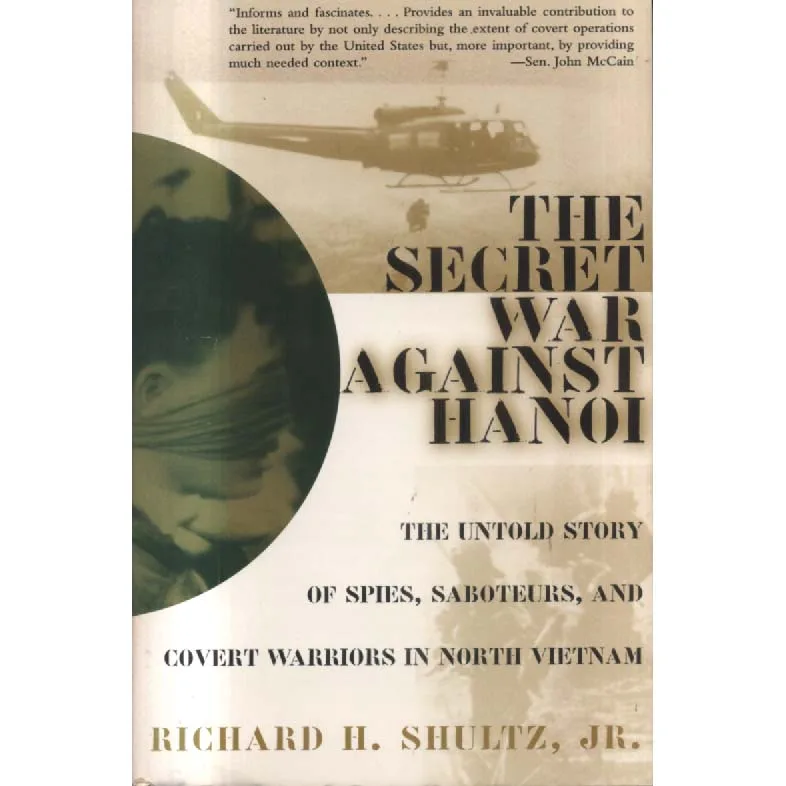
Publisher: Perennial
Format: Paperback
ISBN: 9780060932534
The Secret War Against Hanoi (2000) by Richard H. Shultz Jr.
Perennial
ISBN: 9780060932534
Condition: Very Good
Wars, as governments occasionally discover, are much tidier on maps than they are in reality.
Richard H. Shultz Jr.’s The Secret War Against Hanoi explores the covert side of the Vietnam War: the clandestine operations, psychological warfare, sabotage, raids, intelligence missions and assorted officially-deniable activities carried out against North Vietnam away from the better-known battlefield narrative.
In other words, this is the war behind the war.
The sort of war conducted by organisations whose preferred filing system appears to involve stamps marked SECRET, TOP SECRET and, one imagines, PLEASE DO NOT LEAVE THIS ON THE TRAIN.
Shultz examines the efforts of the United States and South Vietnam to destabilise, disrupt and pressure Hanoi through covert operations. These activities included maritime raids, reconnaissance, infiltration, propaganda and attempts to interfere with North Vietnamese infrastructure and communications.
Some operations were ambitious.
Some were ingenious.
Some were probably best described as optimistic.
And some demonstrate the enduring governmental principle that if something is sufficiently complicated, expensive and secret, somebody will eventually approve it.
Drawing on declassified material and interviews, Shultz reconstructs programmes that for years remained obscure or only partially understood. That makes the book particularly interesting because it deals not simply with military action, but with the gap between what governments publicly acknowledge and what they quietly attempt.
Vietnam provides an especially rich environment for this.
The conflict already involved conventional warfare, guerrilla warfare, political struggle, espionage, diplomacy and propaganda.
Adding secret operations was therefore less a new complication than another layer on an already impressive administrative lasagne.
One of the book’s central concerns is the effectiveness of these missions.
Covert warfare always sounds wonderfully efficient in theory.
A small team slips across a border.
A transmitter begins broadcasting.
A supply route is disrupted.
The enemy becomes confused.
Victory follows.
Reality, unfortunately, has an irritating tendency to notice that plans exist.
Agents can be captured.
Operations can be compromised.
Intelligence can be wrong.
Local conditions can refuse to cooperate.
And governments can discover that secrecy does not automatically convert a dubious strategy into a good one.
Shultz examines the organisational and political problems surrounding the covert campaign, including rivalries between agencies, confusion over objectives and disagreements about how far operations should go.
Which will sound reassuringly familiar to anyone who has ever worked in an organisation containing more than two departments.
The difference here is that the meetings involved sabotage and international conflict rather than disagreements about the office printer.
The book also sheds light on the psychological dimension of warfare.
Covert operations were not only about physically damaging targets. They were intended to create uncertainty, undermine confidence and influence behaviour.
Propaganda, deception and carefully constructed messages all became tools of war.
The underlying assumption was simple enough: if you cannot always destroy the enemy’s capabilities, perhaps you can persuade him that everything is going terribly.
Unfortunately, governments on both sides were already fairly experienced at telling people that everything was going extremely well.
This makes The Secret War Against Hanoi more than an account of unusual military missions.
It is also a study of bureaucracy, strategy and political decision-making under pressure.
Shultz asks what these clandestine programmes were intended to achieve, why they were structured as they were, and whether the people directing them actually understood the environment in which they were operating.
That last question tends to appear quite frequently in books about Vietnam.
For readers accustomed to the familiar images of helicopters, jungle patrols and conventional combat, the covert campaign offers a very different perspective on the conflict.
Here the battlefield includes radio broadcasts, intelligence networks, coastal waters, secret bases and briefing rooms filled with men discussing activities that officially were not happening.
It is the sort of history that reminds you how much of any major conflict remains invisible while it is actually taking place.
Only decades later do documents emerge, participants begin talking and historians discover that the already complicated story was, in fact, considerably more complicated.
For readers interested in the Vietnam War, intelligence history, covert operations, Cold War strategy, special operations or the darker corners of twentieth-century American foreign policy, The Secret War Against Hanoi offers a detailed and absorbing account of an important but much less familiar part of the conflict.
It is serious military history, but its subject matter repeatedly demonstrates that reality can be stranger than espionage fiction.
The difference is that in fiction, somebody usually understands the plan.
This copy is in Very Good condition, which is fortunate because covert operations have historically treated paper considerably less gently.
Available from Crappy Old Books, where all operations are overt, all prices are visible, and none of our parcels require plausible deniability.
Keep browsing: See more War books Other books by Richard H Shultz Jr
