


The Apes Relexion
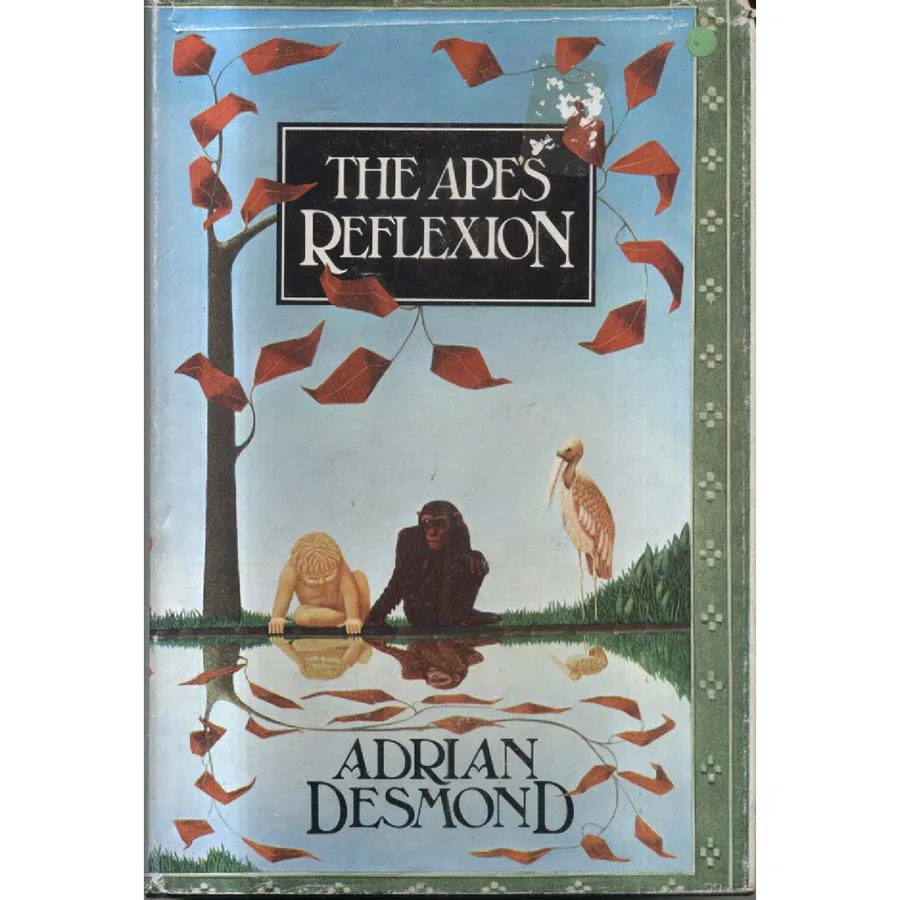
Publisher: Blond and Briggs
Format: Hardback
ISBN: 0856340693
The Ape’s Reflexion (1979) by Adrian Desmond
Blond and Briggs
ISBN: 0856340693
Condition: Good
Human beings have traditionally been extremely pleased with themselves.
We have language, culture, morality, tools, self-awareness, philosophy, central heating and the ability to spend entire afternoons arguing about parking spaces. Clearly, therefore, we must occupy an entirely separate category from the rest of the animal kingdom.
Adrian Desmond’s The Ape’s Reflexion arrives to make this distinction considerably less comfortable.
Published in 1979, the book explores the unsettling similarities between human beings and our closest primate relatives, particularly chimpanzees and gorillas. It examines research into ape intelligence, communication, behaviour and self-awareness, asking where the supposedly enormous gulf between “man” and “animal” actually begins.
The answer turns out to be inconveniently difficult to locate.
For centuries, language was regarded as one of humanity’s great exclusive possessions. Animals might bark, howl, grunt and make threatening noises at one another, but humans alone could apparently communicate with sophistication.
Then researchers began teaching apes signs and symbols.
This created difficulties.
If a chimpanzee could learn signs, combine symbols and apparently communicate ideas, was it actually using language? Or merely performing an elaborate learned routine in expectation of food?
And if the latter, anyone who has ever attended a corporate training day may wish to avoid drawing the distinction too confidently.
Desmond looks at the famous experiments involving apes taught forms of human communication, alongside broader observations of primate behaviour in captivity and the wild. These studies raised increasingly awkward questions about intelligence, intention and the uniqueness of human thought.
Then there is the mirror.
Self-recognition sounds straightforward until you try to explain why it matters. Looking into a mirror and understanding that the creature staring back is yourself requires a concept of the self — something long regarded as a particularly sophisticated human achievement.
Some apes appear capable of making precisely that connection.
Which means the bathroom mirror has unexpectedly become philosophical equipment.
The book ranges beyond language into tool use, social relationships, aggression, cooperation and behaviour that seems disturbingly familiar. The more closely primates were observed, the harder it became to maintain the comforting old picture of humans standing majestically on one side of an intellectual chasm while animals shuffled around harmlessly on the other.
Apes use tools.
They form alliances.
They deceive.
They cooperate.
They fight.
They display affection, rivalry and social calculation.
Frankly, give them paperwork and they could probably establish a local authority.
Desmond is particularly interested in what these discoveries mean for our understanding of ourselves. If qualities once considered uniquely human can also be found, at least in simpler forms, among other primates, then perhaps humanity is not separated from the animal world by a single miraculous boundary.
Perhaps we are part of a continuum.
Darwin had already caused enough trouble by suggesting something along those lines.
A century later, primatologists were apparently determined to continue the argument.
There is also a darker side to the comparison. Observations of chimpanzees revealed that aggression and organised violence were not necessarily inventions created by civilisation. The same animals capable of affection and cooperation could also behave brutally.
So even some of humanity’s less attractive characteristics might not be entirely our own achievement.
A disappointing result for anybody hoping that war was at least something we had invented independently.
Published at a particularly fascinating moment in primate research, The Ape’s Reflexion captures the excitement surrounding discoveries that were forcing scientists, philosophers and ordinary readers to reconsider what exactly separates humans from other animals.
It is science, natural history and philosophy all tangled together around one enormous question:
What makes us human?
Desmond does not provide the reassuring answer that we are clearly superior because we have trousers and libraries.
Instead, the book suggests that looking carefully at apes may be one of the best ways of understanding ourselves.
Hence the wonderfully appropriate title.
The ape is our reflection.
Or perhaps our “reflexion”.
And the longer you look, the less flattering the mirror occasionally becomes.
For readers interested in primatology, evolution, animal intelligence, human behaviour and the history of science, this is a fascinating late-1970s exploration of a subject that remains compelling today.
This copy is in Good condition, having survived since 1979 despite being handled repeatedly by members of one particular species of unusually literate ape.
Available from Crappy Old Books, where evidence of advanced primate behaviour includes cataloguing second-hand books and expecting other primates to buy them.
Keep browsing: See more Animals books Other books by Adrian Desmond
