


Liberty Today
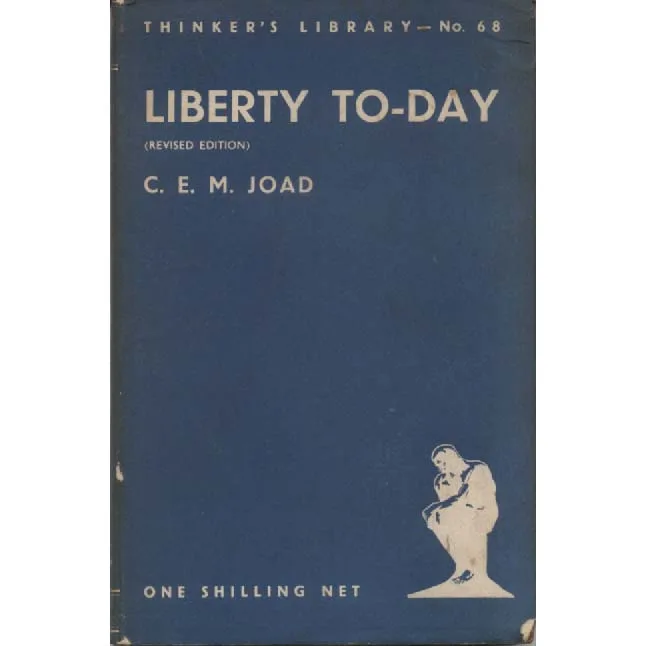
Publisher: Thinkers Library
Format: Hardback
ISBN: none
Liberty Today (1938) by C. E. M. Joad
Thinkers Library
ISBN: None
Condition: Good
With dust jacket
There are books about liberty written in calm times, and then there are books about liberty published in 1938, when Europe was rapidly demonstrating why perhaps somebody ought to write one.
C. E. M. Joad’s Liberty Today comes from the unmistakably anxious atmosphere of the late 1930s, when dictatorship was advancing across Europe, political extremism was becoming increasingly respectable in some quarters, and democracy was beginning to look rather less permanent than people had previously assumed.
Joad, philosopher, broadcaster, public intellectual and professional asker of awkward questions, sets out to examine what liberty actually means, why it matters and how easily it can disappear when societies become frightened, authoritarian or simply too tired to defend it.
Which makes the title Liberty Today sound almost aggressively optimistic.
Published as part of the Thinkers Library, the book belongs to a series designed to make serious arguments about politics, philosophy, religion and society available to ordinary readers without requiring them first to obtain a university fellowship and several yards of mahogany shelving.
Joad was extremely well suited to the task.
He had a gift for taking large philosophical questions and making them readable, argumentative and relevant to everyday life. Rather than treating liberty as an abstract word suitable for speeches and commemorative plaques, he asks what freedom actually requires in practice.
Freedom of thought.
Freedom of speech.
Freedom of political action.
Freedom from arbitrary authority.
All the usual things everyone strongly supports until somebody begins saying something inconvenient.
That tension sits at the heart of the subject.
Liberty is easy to praise in principle.
It becomes considerably more complicated when it protects people you dislike, opinions you reject or behaviour that makes you want to summon a committee immediately.
Joad explores these problems against the background of a world in which authoritarian governments were openly suppressing dissent, controlling information and subordinating individual freedom to political ideology.
In 1938, none of this was remotely theoretical.
Hitler had been in power for five years.
Mussolini had ruled Italy for more than a decade.
Stalin’s Soviet Union was deep into repression and purges.
Europe was edging towards a war that many people could already see coming and apparently still hoped might somehow decide not to.
Against that background, a discussion of liberty carried rather more urgency than an undergraduate seminar scheduled for Friday afternoon.
Joad’s concern is not simply with dictatorship abroad, either. Liberty can be weakened gradually and domestically, through fear, conformity, censorship, intolerance or the willingness of citizens to hand difficult decisions to authority and stop asking questions.
There is an uncomfortable modernity to that observation.
Technologies change.
Political slogans change.
People remain remarkably inventive when it comes to finding new reasons why somebody else should not be allowed to speak.
The book also reflects Joad’s wider philosophical interests. He was deeply concerned with the relationship between the individual and society, the responsibilities attached to freedom and the distinction between genuine liberty and simply doing whatever one happens to want.
Because liberty without responsibility tends to become less philosophical fairly quickly.
Part of the fascination today lies in reading the book with knowledge Joad could not yet possess.
We know what happened after 1938.
We know the war came.
We know the scale of totalitarian violence that followed.
We know how fragile democratic institutions proved in several countries.
That knowledge gives the book an additional layer of historical tension.
You are reading someone thinking about liberty while standing remarkably close to one of the great catastrophes of modern history.
There is also something rather wonderful about the Thinkers Library format itself.
These books were designed to circulate ideas rather than merely decorate shelves. They were affordable, compact and intended for people who thought serious subjects ought to be discussed beyond universities and gentlemen’s clubs.
A dangerous concept, obviously.
Once ordinary people start thinking, there is no telling where it might end.
For readers interested in political philosophy, civil liberties, inter-war Britain, democracy, authoritarianism or the history of ideas, Liberty Today is a fascinating period document with questions that remain stubbornly relevant.
It is also an attractive collectible item in its own right.
This 1938 copy is in Good condition and retains its dust jacket, a particularly pleasing survival for a Thinkers Library volume of this age. Dust jackets have a longstanding habit of being discarded, torn, used as bookmarks, exposed to tea or otherwise failing to participate in history quite as successfully as the books they were meant to protect.
The survival of this one therefore adds considerably to the charm.
A thought-provoking little book from a year when liberty was becoming a dangerously practical concern rather than merely a philosophical one.
Available from Crappy Old Books, where freedom of thought is encouraged, freedom from buying books remains entirely your own responsibility, and surviving dust jackets are treated with the respect due to minor miracles.
Keep browsing: See more Non-Fiction books Other books by CEM Joad
