


How To Win Friends And Influence People
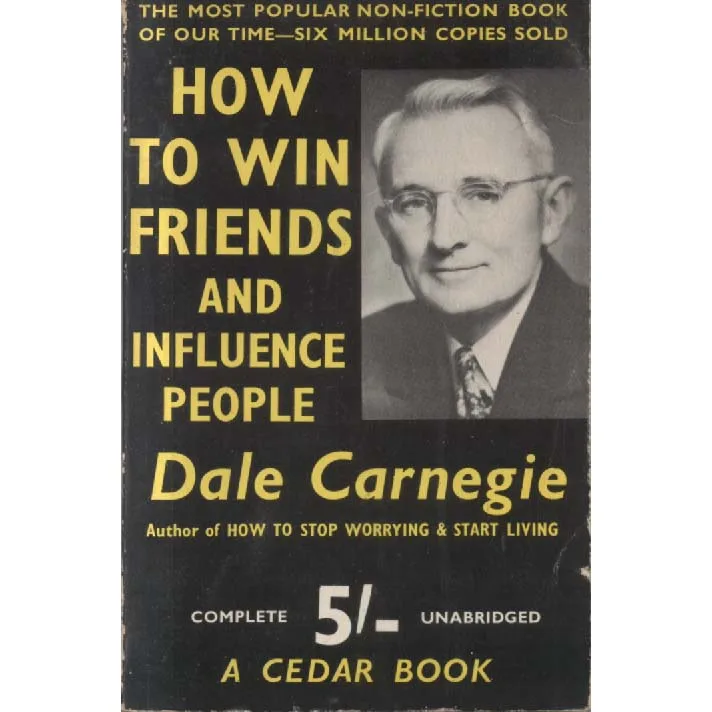
Publisher: Cedar Book
Format: Paperback
ISBN: none
How to Win Friends and Influence People (1967) by Dale Carnegie
Cedar Book
ISBN: None
Condition: Good
There are books that tell you how to become rich, books that tell you how to become happy, and books that tell you how to become mysteriously efficient before breakfast. Dale Carnegie took a slightly more practical route and decided to explain how to get along with other human beings, which, considering the evidence available, may have been the more ambitious project.
First published in 1936, How to Win Friends and Influence People became one of the most famous self-help books ever written, largely because its central advice is both remarkably simple and alarmingly difficult to follow consistently.
Take an interest in people.
Listen properly.
Remember names.
Avoid unnecessary arguments.
Show appreciation.
Do not behave as though every conversation is an opportunity to demonstrate that you are the cleverest person in the room.
In other words, Carnegie constructed an international publishing phenomenon around several ideas that sound obvious until you spend five minutes at a committee meeting.
This 1967 Cedar Book edition presents Carnegie’s classic guide to dealing with people in business, friendships, negotiations and everyday life. The book is full of anecdotes, examples and practical principles designed to make social interaction less confrontational and more productive.
Carnegie’s great strength is that he rarely presents his ideas as abstract psychology. Instead, he tells stories about people who persuaded, offended, encouraged, annoyed or impressed one another, then extracts the lesson.
Usually the lesson is that shouting “You’re wrong” is not an especially sophisticated negotiating technique.
A recurring theme is that people are deeply interested in themselves.
This may not be the most shocking discovery in the history of social science, but Carnegie turns it into a useful principle: if you want people to like you, talk about things that matter to them rather than waiting impatiently for your turn to talk about yourself.
He also recommends using people’s names, giving sincere appreciation and avoiding criticism where possible.
The word “sincere” is important.
Carnegie is not really advocating oily manipulation, despite the slightly sinister possibilities suggested by the title. The book is much more concerned with changing your own behaviour than with acquiring some sort of conversational mind-control ray.
Indeed, much of the advice amounts to recognising that other people possess pride, ambitions, anxieties and opinions of their own.
Revolutionary stuff.
The business examples are particularly interesting from a modern perspective. They come from a world of salesmen, executives, industrialists and face-to-face negotiations, before email allowed everyone to misunderstand one another much more efficiently.
Yet many of Carnegie’s principles have aged surprisingly well.
People still dislike being criticised.
They still enjoy being appreciated.
They still prefer talking to someone who appears genuinely interested in them.
And they still occasionally spend twenty minutes arguing about something that could have been resolved in thirty seconds by saying, “You may have a point.”
This longevity explains why the book has remained in print for generations. Styles of business change, technologies come and go, but human beings continue to be complicated, sensitive creatures who respond remarkably well to being treated with respect.
There is also something charming about reading an older edition of a book whose subject is essentially timeless. This 1967 copy comes from an era when “networking” presumably involved shaking hands rather than collecting hundreds of online contacts one has no intention of ever speaking to.
No apps.
No personal branding.
No motivational hashtags.
Just the radical proposition that being pleasant and paying attention might occasionally prove useful.
Of course, the title remains magnificently confident.
How to Win Friends and Influence People.
Not How to Slightly Improve Your Social Skills.
Not Some Thoughts on Getting Along With Colleagues.
No. Carnegie is going straight for friends and influence, and preferably quite a lot of both.
That optimism is part of the book’s appeal. It belongs to a tradition of practical self-improvement that assumes people can change their habits if they understand what they are doing wrong and make a genuine effort to behave differently.
Whether they actually will is another matter.
This copy is in Good condition, which is entirely appropriate for a book devoted to making a favourable impression without pretending to be perfect.
Ideal for readers of classic self-help, business psychology, personal development and social history, or anyone who has ever left a conversation and realised approximately three hours later what they should have said.
Available from Crappy Old Books, where winning friends is optional, but buying books remains strongly encouraged.
Keep browsing: See more Non-Fiction books Other books by Dale Carnegie
