


Beyond This Horizon
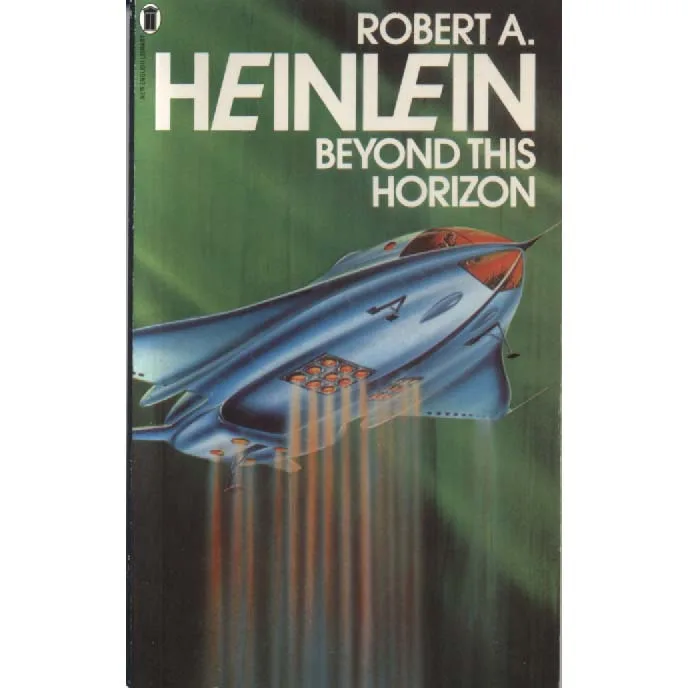
Publisher: New English Library
Format: Paperback
ISBN: 9780450032899
Beyond This Horizon (1985) by Robert A. Heinlein
New English Library
ISBN: 9780450032899
Condition: Good
Robert A. Heinlein’s Beyond This Horizon is one of those wonderfully ambitious science-fiction novels in which humanity has apparently solved several enormous social problems and immediately set about creating a fresh batch of extremely complicated ones.
Originally published in the 1940s, the novel imagines a future society transformed by selective breeding, advanced medicine, genetic planning and a level of material abundance that means most ordinary economic problems have largely disappeared. Which sounds excellent, right up until everyone starts arguing about what sort of humans ought to exist in the first place.
At the centre of the story is Hamilton Felix, a man living in a world where genetic inheritance has become something people actually discuss deliberately rather than merely discovering through family resemblance and unfortunate hairlines.
This future civilisation has achieved extraordinary things. Disease has been greatly reduced, technology has removed much of the hardship associated with daily life, and carefully controlled breeding programmes have produced generations of increasingly healthy people.
Naturally, this has not made society simple.
Heinlein was never especially interested in futures where everyone sits around peacefully enjoying improved public transport. His societies usually arrive with philosophical arguments, political complications, odd customs and at least one character prepared to explain why everybody else has misunderstood civilisation.
Beyond This Horizon is no exception.
The book explores questions about genetics, freedom, individuality, social planning and the dangerous assumption that because something can be engineered, it necessarily should be. The future presented here is not simply utopian or dystopian; it is much more awkward than that.
People live comfortably, but the structure beneath that comfort raises difficult questions. Who decides which traits are desirable? How much planning is too much planning? What happens when scientific advancement starts interfering with ideas of personal choice?
And perhaps most importantly: if humanity finally eliminates most of its problems, will humanity quietly enjoy the achievement?
Obviously not.
There is also a wonderfully odd cultural mixture running through the book. The society is technologically advanced yet retains customs that feel almost deliberately archaic, including personal weapons and elaborate ideas about honour. Heinlein clearly enjoyed creating futures in which technological progress did not automatically make people behave like emotionally balanced committee members.
Hamilton moves through this world encountering conspiracies, social tensions and questions about the future direction of the human species. What begins as speculative sociology gradually develops into something broader, mixing political intrigue, science-fiction ideas and Heinlein’s characteristic fascination with unconventional social systems.
It is particularly interesting today because genetic engineering is no longer purely the stuff of speculative fiction. Modern science has made some of the questions Heinlein was playing with considerably less theoretical, even if we have fortunately not yet reached the point where prospective parents are issued spreadsheets and asked to select preferred personality traits.
The novel also displays many of the themes that would later become strongly associated with Heinlein: individual liberty, distrust of unnecessary authority, unconventional social arrangements and the persistent suspicion that competent people should probably be left alone to get on with things.
Whether you agree with all of Heinlein’s conclusions is almost beside the point. Half the enjoyment comes from watching him construct a society, poke holes in it, argue with himself through various characters and then introduce another complication before anyone has had time to recover.
This 1985 New English Library edition offers a classic slice of early Heinlein: intellectually restless, politically provocative, occasionally peculiar and full of ideas that remain surprisingly thought-provoking decades after they were written.
An excellent choice for Heinlein collectors, Golden Age science-fiction enthusiasts, readers interested in speculative genetics, or anyone who enjoys stories about people solving humanity’s future while being only moderately successful at understanding humanity itself.
This copy is in Good condition, meaning it shows the respectable signs of having already survived part of the future Heinlein was attempting to imagine.
Available from Crappy Old Books, where genetic optimisation remains strictly optional and all books are selected by the considerably less scientific method of finding interesting old things and selling them.
Keep browsing: See more Science-Fiction books Other books by Robert A Heinlein
