


The Naked Sun
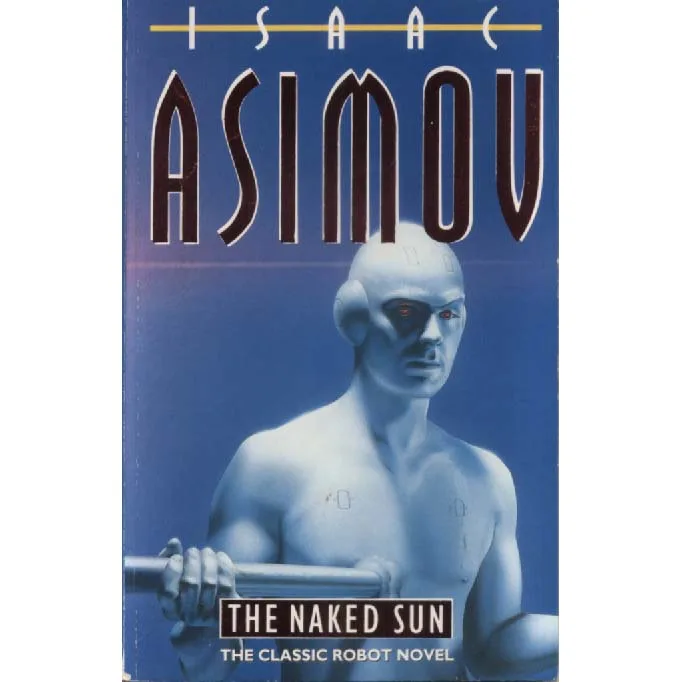
Publisher: HarperCollinsPublishers
Format: Paperback
ISBN: 9780586010167
The Naked Sun (1996) by Isaac Asimov
HarperCollinsPublishers
ISBN: 9780586010167
Condition: Good
Isaac Asimov’s The Naked Sun is a murder mystery set in a future where people have achieved extraordinary technological sophistication, colonised distant worlds, surrounded themselves with robots, and finally perfected the dream of never having to meet anyone in person.
So, naturally, somebody gets murdered.
Originally published in 1957, The Naked Sun is the second of Asimov’s Robot detective novels, following The Caves of Steel. Once again, Earth detective Elijah Baley is paired with the humanoid robot R. Daneel Olivaw, a partnership that combines traditional police work with the slight complication that one of the detectives is governed by the famous Three Laws of Robotics and the other is not entirely comfortable with robots, open spaces or, frankly, much of the future.
This time, Baley is sent to Solaria, a sparsely populated planet where every human lives on an enormous private estate and social contact has been reduced almost entirely to remote communication. People “view” one another through holographic technology rather than meeting face-to-face, and the idea of actual physical proximity is regarded with roughly the same enthusiasm most of us reserve for discovering someone has sneezed directly onto our lunch.
For Baley, this is particularly awkward. Having grown up in the vast enclosed cities of Earth, he is deeply uncomfortable with the outdoors. Solaria, meanwhile, is practically all outdoors.
It is therefore less a case of sending the right man for the job and more a case of sending the man most likely to spend the entire investigation wishing somebody would build a roof over the planet.
The mystery begins with the death of a Solarian man under circumstances that appear almost impossible. The planet’s inhabitants rarely encounter one another physically, robots are everywhere, and the society is organised in such a way that murder ought to be extraordinarily difficult.
Unfortunately, nobody appears to have informed the murderer.
Asimov uses the investigation to explore much more than the mechanics of a crime. Solaria itself becomes one of the novel’s most intriguing characters: a society built around extreme individualism, automation and social isolation, where human beings have arranged their lives for maximum efficiency and minimum inconvenience and somehow managed to make everything profoundly strange.
Robots perform the work. Estates stretch across huge areas. Human contact is minimised. Children are raised within carefully controlled systems. The Solarians themselves regard this arrangement as perfectly sensible, which is generally a warning sign in science fiction.
Baley gradually discovers that understanding the crime means understanding the society that produced it. Customs that appear bizarre to an outsider are entirely normal to the people of Solaria, while assumptions that seem obvious to Baley may not apply at all.
This is where Asimov is particularly good. The detective story is not merely transported into the future and decorated with robots; the futuristic society actually changes the nature of the crime, the suspects and the investigation itself.
And then there is Daneel Olivaw.
Daneel is almost indistinguishable from a human being, except for the inconvenient fact that he is a robot and is therefore compelled to obey the Three Laws. This makes him extremely useful in some situations and spectacularly awkward in others, particularly when detective work requires considering whether someone might intentionally harm another human being.
Baley and Daneel’s relationship gives the book much of its appeal. Their contrasting perspectives allow Asimov to explore questions about humanity, technology, prejudice and dependence without turning the novel into a philosophical lecture conducted by a toaster.
There is also a pleasing irony to reading The Naked Sun today. A society in which people avoid physical meetings, communicate remotely and rely increasingly on technology to mediate social interaction may have seemed wildly futuristic in 1957.
Now it merely sounds like someone has scheduled another video call.
That does not make Asimov prophetic in every detail, of course. Solaria is deliberately exaggerated, but that exaggeration is part of the fun. The novel takes tendencies already present in human behaviour and pushes them to unsettling extremes.
It also remains a very readable mystery. Asimov keeps the plot moving, drops clues carefully and uses the unusual rules of Solarian society to keep both Baley and the reader slightly off balance.
This 1996 HarperCollins edition is in Good condition, meaning it has acquired the sort of modest signs of previous ownership one would expect from an actual book that has existed in the physical world and, unlike the people of Solaria, has probably been handled by more than one human being.
An excellent choice for Asimov collectors, classic science-fiction readers, robot enthusiasts, detective-fiction fans and anyone curious to discover what happens when Agatha Christie is relocated to another planet and half the suspects would rather communicate by hologram.
Available from Crappy Old Books, where actual physical contact with second-hand books is still permitted.
Keep browsing: See more Science-Fiction books Other books by Isaac Asimov
