


The Drowned World
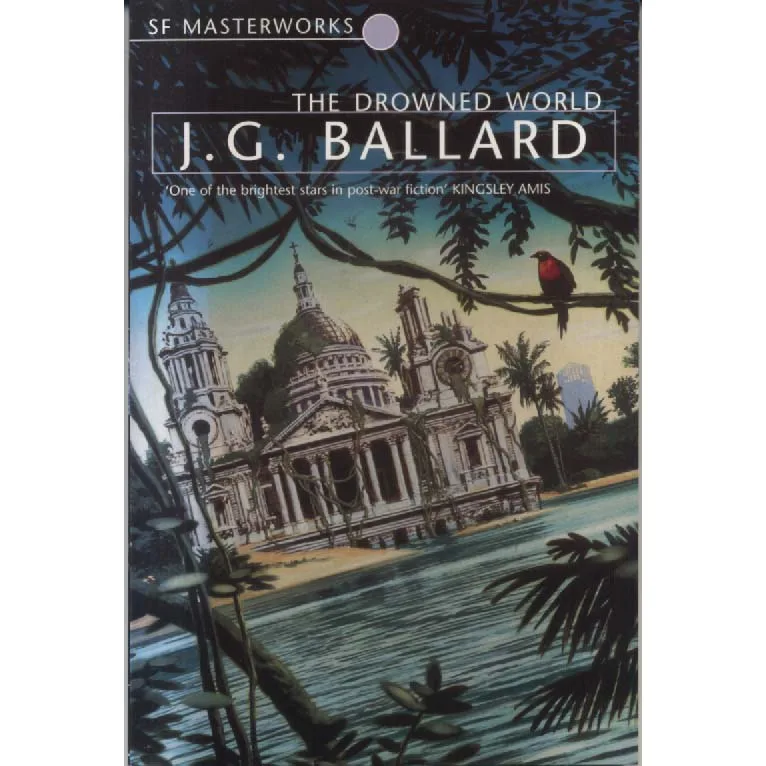
Publisher: Millennium
Format: Paperback
ISBN: 9781857988833
Here you go:
The Drowned World (1999) by J. G. Ballard
Millennium
ISBN: 9781857988833
Condition: Near Fine
J. G. Ballard’s The Drowned World is what happens when climate change stops being a graph, becomes a lagoon, and then starts encouraging everyone to have deeply unsettling dreams about prehistoric reptiles.
Originally published in 1962, this is one of Ballard’s defining early novels: a strange, hypnotic, sun-blasted vision of a future Earth transformed by rising temperatures and flooded cities. By the time this Millennium edition appeared in 1999, the story had acquired that slightly uncomfortable quality possessed by certain older science-fiction novels: it was supposed to be speculative.
The world of the novel is tropical, flooded and increasingly unrecognisable. London has become a half-submerged wilderness of lagoons, silt, giant vegetation and ruined buildings. Humanity has retreated northwards, leaving scientific teams to investigate what remains of the drowned cities. Which is exactly the sort of assignment that sounds adventurous until you realise your workplace is an abandoned hotel surrounded by alligators.
At the centre of the story is Dr Robert Kerans, a biologist studying the transformed environment while gradually becoming less interested in leaving it. Around him, the landscape seems to be exerting a psychological pull on the surviving humans, drawing them towards older, stranger states of consciousness. The past is not merely returning environmentally; something ancient appears to be stirring inside the people as well.
Ballard was never especially interested in science fiction as a parade of gadgets, spaceships and competent men explaining propulsion systems to one another. His preferred territory was the human mind under pressure, preferably while civilisation was collapsing in an architecturally interesting way.
And few civilisations collapse as attractively as this one.
The drowned city becomes almost dreamlike: luxury hotels rot beneath the sun, streets disappear under water, and familiar urban spaces turn into something primeval. The effect is less disaster movie and more fever dream, as if London has been left unattended for several million years and nature has decided to remodel.
The novel also contains one of Ballard’s recurring obsessions: the idea that catastrophe may not simply be something people want to escape from. His characters are often strangely attracted to ruined landscapes, psychological extremes and situations that any sensible insurance company would strongly advise against.
That gives The Drowned World its peculiar power. It is not merely a story about surviving environmental disaster. It is about people beginning to accept, even embrace, the transformation around them. Civilization recedes physically and mentally, while something older begins to take its place.
The atmosphere is magnificent: oppressive heat, brilliant sunlight, stagnant water and vegetation forcing its way through the remains of the modern world. You can practically feel the humidity coming off the pages, which is impressive considering the book contains no actual water damage and this copy is in Near Fine condition.
Ballard’s prose gives the whole thing a detached, hallucinatory quality. Events can be violent and bizarre, yet they unfold with the calm inevitability of a dream. It is the literary equivalent of watching the end of the world through sunglasses while someone quietly explains that this may actually be psychologically beneficial.
For readers who know Ballard mainly from Empire of the Sun or Crash, this is an excellent route into his early speculative fiction. The themes that would occupy him throughout his career are already firmly present: altered environments, psychological breakdown, modernity turning against itself and people adapting to catastrophe in ways that are not remotely reassuring.
It is also a fascinating piece of environmental science fiction from an era before “climate fiction” had become a convenient publishing category. Ballard simply imagined a radically altered planet and concentrated on what such a place might do to the people trapped inside it.
The answer, broadly speaking, is: nothing good, but something extremely interesting.
This 1999 Millennium edition is in Near Fine condition, making it an especially nice copy for Ballard collectors, science-fiction readers, enthusiasts of post-apocalyptic literature, or anyone who likes their dystopias hot, wet and psychologically disconcerting.
Available from Crappy Old Books, where the world may be ending, but at least the book is still in excellent condition.
Keep browsing: See more Science-Fiction books Other books by JG Ballard
