


Sports Cars - History And Development
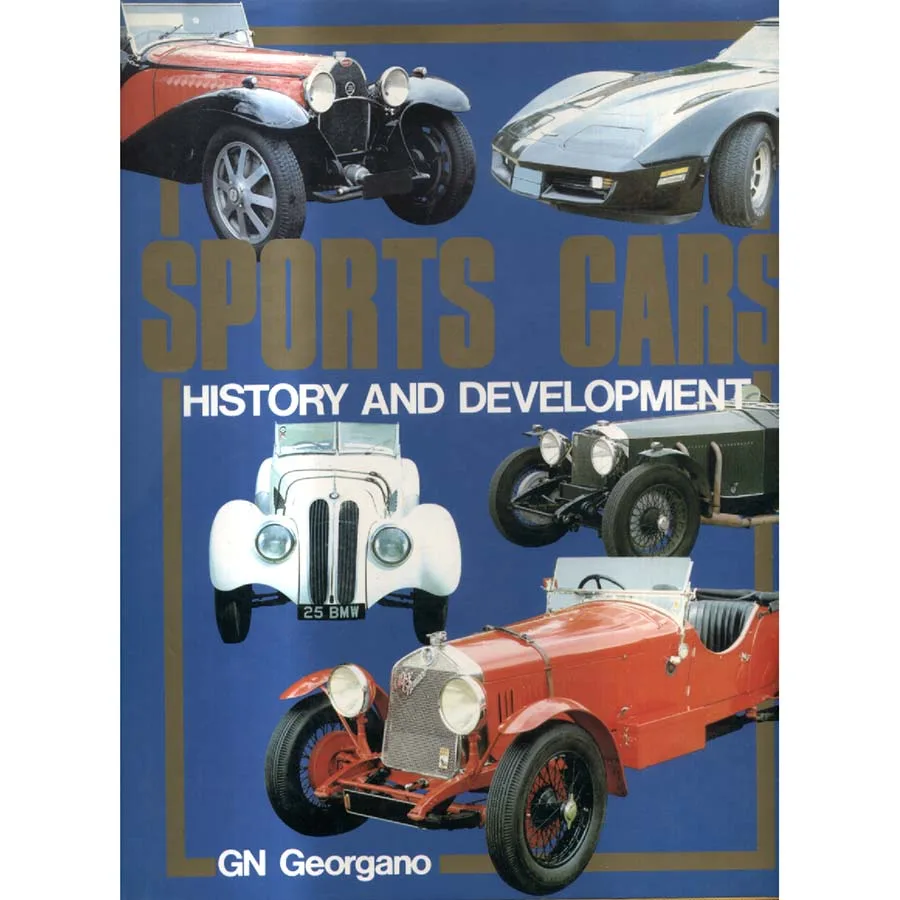
Publisher: Johnston and Company
Format: Hardback
ISBN: 918703610X
Here you go:
Sports Cars – History and Development (1987) by G. N. Georgano
Johnston and Company
ISBN: 918703610X
Condition: Very Good
There are ordinary cars, whose purpose is to get you to work, carry shopping and occasionally transport a wardrobe with the back seats folded down. And then there are sports cars, whose purpose is to make the journey to the supermarket feel as though you are qualifying at Le Mans.
G. N. Georgano’s Sports Cars – History and Development takes a broad and highly enjoyable look at the evolution of the sports car, tracing how the idea developed from relatively primitive early machines into increasingly fast, sophisticated and desirable pieces of automotive theatre.
Published in 1987, the book arrives from an especially interesting point in motoring history. By then, the classic sports car had already been through several distinct ages: the heroic pre-war machines, the elegant post-war roadsters, the Italian exotica of the 1960s and 1970s, and the increasingly technical performance cars of the 1980s. This means Georgano was writing at a moment when many cars we now consider untouchable classics were still merely rather expensive used cars.
The result is a fascinating historical overview of machines built when speed was achieved with engineering, bravery and a certain indifference to whether the driver had any surviving vertebrae afterwards.
The book explores the manufacturers, designers and technological developments that shaped the sports car, showing how the formula changed over time. Lightweight construction, more powerful engines, better suspension, improved brakes and increasingly aerodynamic bodies all played their part in transforming the sports car from a slightly alarming open machine into something capable of enormous speed while still offering at least a theoretical possibility of arriving alive.
Naturally, the great names feature heavily. Britain, Italy, Germany, France and elsewhere all contributed to the mythology, producing cars whose reputations were built as much on racing success and visual drama as on actual practicality. Nobody, after all, ever bought a sports car because it had excellent rear-seat legroom.
There is also something wonderfully nostalgic about looking back at performance cars from the perspective of 1987. Modern cars routinely possess power figures that would once have belonged exclusively to racing machinery, yet older sports cars often achieved excitement with far less. A small engine, a low seating position and enough wind noise could apparently convince the driver that 60 mph was approximately Mach 2.
Georgano, one of the best-known motoring historians of his generation, brings a proper sense of historical perspective to the subject. Rather than simply assembling photographs of expensive machinery and declaring everything magnificent, he places the cars within the wider development of automotive design and engineering.
That makes the book useful not only to enthusiasts but also to readers interested in how technology changes over time. Sports cars have often acted as laboratories for ideas later adopted elsewhere, with developments in braking, suspension, aerodynamics and engine design gradually filtering into more ordinary vehicles.
Admittedly, very few family hatchbacks have inherited the important sports-car tradition of making it almost impossible to get in without falling over.
The illustrations naturally form a large part of the appeal. There is something endlessly satisfying about browsing photographs of machines built before every car was required to accommodate fourteen airbags, satellite navigation, parking cameras and a heated steering wheel. Many of the cars here contain little more than an engine, seats, instruments and a determined belief that comfort merely adds weight.
The book also captures the strange contradiction at the heart of the sports car. They are often less practical, more expensive, thirstier, noisier and considerably harder to maintain than sensible cars, yet sensible cars rarely inspire people to hang photographs of them on bedroom walls.
Nobody ever stared longingly at a beige company saloon and whispered, “One day.”
For classic-car enthusiasts, collectors, petrolheads and anyone interested in the history of automotive engineering, Sports Cars – History and Development offers an entertaining journey through one of motoring’s most glamorous branches. It is the story of what happens when engineers are allowed to stop worrying quite so much about luggage capacity and concentrate instead on making something quicker, lighter and vastly more exciting.
This copy is in Very Good condition, meaning it has survived the intervening decades considerably better than many of the cars featured inside, several of which are probably now distributed between restoration workshops, private collections and boxes labelled “miscellaneous carburettor parts”.
Available from Crappy Old Books, where the books may be old, but at least none of them require an engine rebuild before you can enjoy them.
Keep browsing: See more Transport books Other books by GN Georgano
