


The Jupiter Legacy
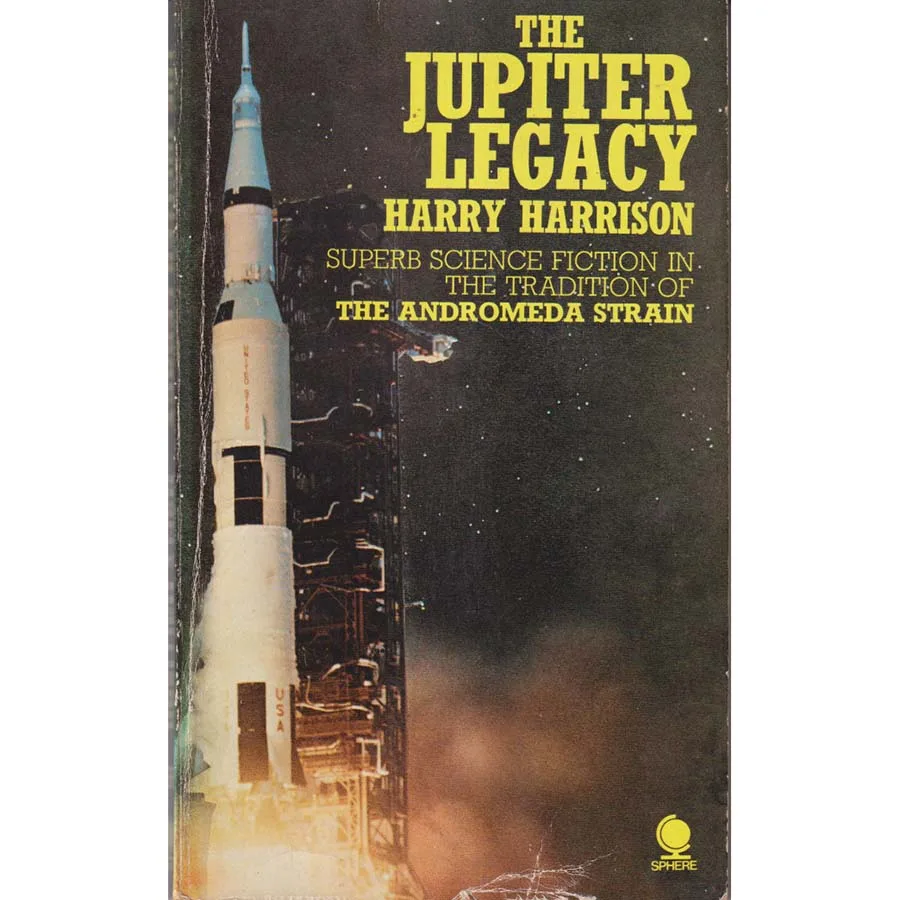
Publisher: Sphere
Format: Paperback
ISBN: 0722143583
The Jupiter Legacy by Harry Harrison, published by Sphere in 1972, is classic early-1970s science fiction from an age when the future still involved giant planets, dangerous missions, mysterious discoveries and the reasonable assumption that humanity would eventually leave Earth because somebody had found something worth worrying about.
Harry Harrison was one of the great workhorses of twentieth-century science fiction, capable of combining big ideas with fast-moving plots and the useful understanding that futuristic technology is much more entertaining when somebody is having trouble with it.
The Jupiter Legacy takes us out towards the largest planet in the Solar System, where scale immediately becomes a problem.
Jupiter does not do modesty.
It is enormous.
Its storms are enormous.
Its gravity is enormous.
Even the word “planet” begins to feel slightly inadequate.
Naturally, science fiction writers took one look at it and thought:
“We should send people there.”
This is part of the charm of older space fiction.
Human beings were always being dispatched towards things that sensible people would probably observe from a much greater distance.
The future, as imagined in books like this, is full of exploration, risk and technological ambition.
There are no package holidays.
No orbital wellness retreats.
No cheerful announcement that your shuttle will be boarding from Gate 14.
Space remains difficult.
Which is as it should be.
The novel belongs to that period when planetary exploration still carried a strong sense of mystery. Space probes were revealing more about the Solar System, but enormous gaps remained in what we knew.
That left writers with room to speculate.
And speculate they did.
Jupiter could be scientific frontier, hostile environment, mystery, opportunity and threat all at once.
The title itself suggests inheritance.
A legacy.
Something waiting to be discovered, understood or perhaps regretted.
Science fiction is very fond of legacies because they usually mean somebody in the past has left something behind.
And if the book is any good, it is rarely a tasteful sideboard.
There may be secrets.
There may be technology.
There may be consequences.
There may be a very reasonable point at which someone should say:
“Perhaps we should stop touching things.”
Someone almost certainly continues touching things.
Harrison’s style makes these ideas approachable rather than ponderous.
He does not usually require the reader to sit through eighty pages of theoretical explanation before anything happens.
The science may be important, but so are movement, tension and people making decisions under pressure.
Often poor decisions.
Again, very human.
Published by Sphere in 1972, this edition has all the appeal of a proper vintage science-fiction paperback from the era when bookshops were full of planets, rockets, strange landscapes and covers promising futures that have now partly arrived and partly become magnificently wrong.
That is one of the pleasures of old science fiction.
You get two futures.
The future imagined by the author.
And the future we actually ended up with.
Sometimes they overlap.
Sometimes they miss one another by several light-years.
For collectors of Harry Harrison, vintage SF, planetary adventure or 1970s paperbacks, The Jupiter Legacy is a pleasing period title.
It also suits readers who like science fiction with a sense of scale, danger and the faint suspicion that humanity may have discovered something before being emotionally ready for it.
Condition: Good. A sound used copy with normal signs of age and handling. Published in 1972, it has now survived long enough to become retro-futuristic in its own right.
ISBN: 0722143583.
A brisk and entertaining slice of vintage science fiction, full of planetary mystery, future technology and the reassuring old-fashioned belief that mankind’s problems may eventually become interplanetary.
Sold by Crappy Old Books — where the future is vintage, Jupiter is still enormous, and the postage remains Earthbound.
Keep browsing: See more Science-Fiction books Other books by Harry Harrison
