


Budapest Through The Eyes Of An Architect
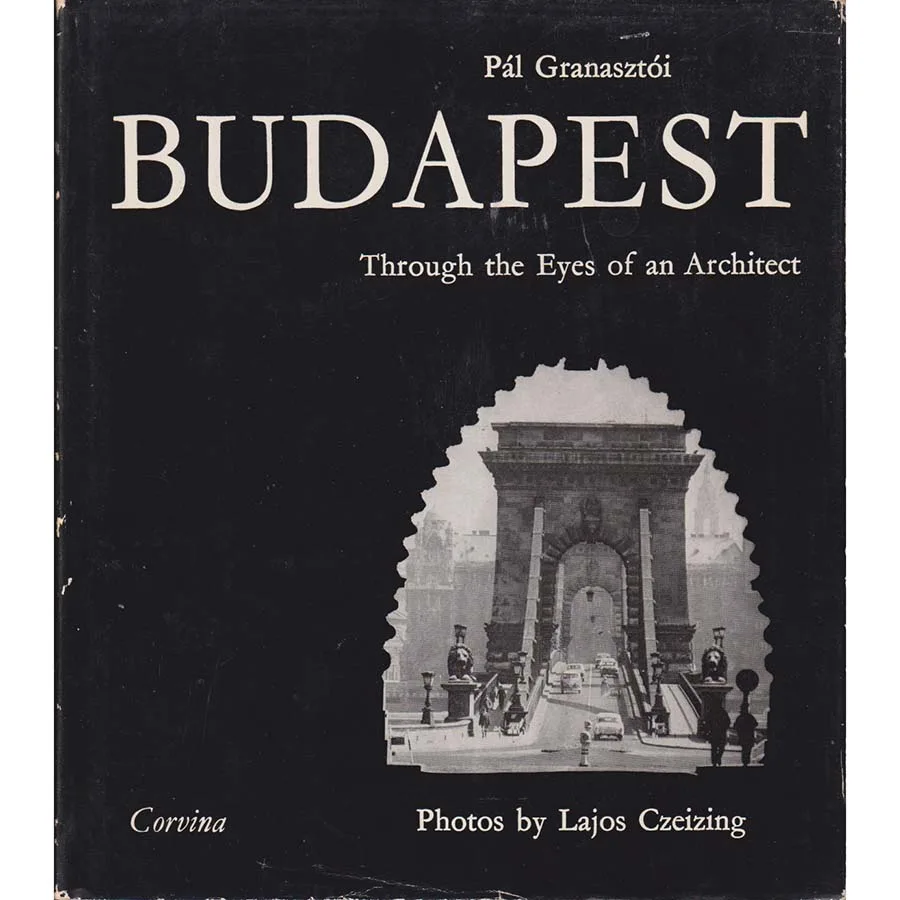
Publisher: Corvina Press
Format: Hardback
ISBN: none
Budapest Through the Eyes of an Architect by Pál Granasztói, published by Corvina Press in 1972, is exactly what the title suggests: a look at Budapest from the point of view of someone who does not merely see streets and buildings, but immediately starts wondering why they are arranged like that, who designed them, what came before, and whether somebody ought to have thought a little harder about the corner.
Budapest is ideal material for this sort of treatment.
It is a city of grand boulevards, bridges, domes, courtyards, apartment blocks, monuments, hills, river views and enough architectural history layered on top of itself to keep a professional observer happily occupied for years.
The Danube divides the city neatly enough.
Architecture proceeds to make everything else complicated.
Buda rises.
Pest spreads.
Bridges attempt diplomacy.
The skyline does its best to look monumental from almost every direction.
Granasztói approaches the city not simply as a collection of attractive landmarks, but as an urban organism shaped by planning, history, geography and successive generations of people deciding that the previous generation had not quite finished the job.
That is one of the pleasures of books written by architects.
Ordinary people look at a square and think:
“That’s nice.”
An architect looks at it and begins discussing scale, sightlines, massing, circulation and the relationship between public space and built form.
Ten minutes later everyone else has learned something accidentally.
Published in 1972, the book also offers a very particular period view of Budapest.
This was a city living within the political and social world of socialist Hungary while surrounded by architecture inherited from much earlier periods.
Imperial grandeur.
Nineteenth-century expansion.
Historic streets.
Modern planning.
Post-war rebuilding.
All of it forced to coexist.
Cities are good at that.
They rarely throw away the old argument before beginning the new one.
This makes the book particularly interesting today, because an architectural portrait is never only about buildings.
It is also about what a city valued at the time.
What was preserved.
What was altered.
What was considered modern.
What was considered obsolete.
And which structures everyone assumed would still be standing fifty years later.
Sometimes they were right.
Sometimes somebody built a car park.
The title Budapest Through the Eyes of an Architect has a pleasantly serious 1970s confidence about it.
No “Hidden Gems”.
No “Top Ten Instagrammable Spots”.
No suggestion that the reader needs to experience the city in forty-eight hours.
Instead, the assumption is that Budapest is worth looking at properly.
A radical idea.
Corvina Press produced many handsome cultural books on Hungary, and this fits that tradition nicely: informative, visual and designed to introduce readers to the country through art, architecture and place rather than through hurried tourism.
It is the sort of book that encourages slower attention.
A façade becomes more than decoration.
A bridge becomes part engineering, part urban planning and part national symbol.
A street stops being merely somewhere to walk and becomes evidence.
That is where old architectural books become especially enjoyable.
They teach you to notice things.
After a while you begin looking at your own town differently.
This can become inconvenient.
Suddenly you are irritated by window proportions.
For readers interested in architecture, urban history, Budapest, Hungary, town planning or the visual culture of Eastern and Central Europe, this is a particularly attractive vintage title.
It should also appeal to anyone who enjoys city books from before the age when every travel guide felt compelled to tell you where to buy artisanal coffee.
Condition: Good. A sound used copy with normal signs of age and handling. Published in 1972, it has now survived long enough to become part of the period it once described as contemporary.
No ISBN stated.
A thoughtful architectural portrait of Budapest, full of buildings, streets, planning, history and the useful reminder that cities make much more sense once somebody explains why all the difficult bits are where they are.
Sold by Crappy Old Books — where the architecture is grand, the urban planning is debatable, and fortunately nobody has pedestrianised the bookshelf.
Keep browsing: See more Architecture books Other books by Pal Granasztoi
