


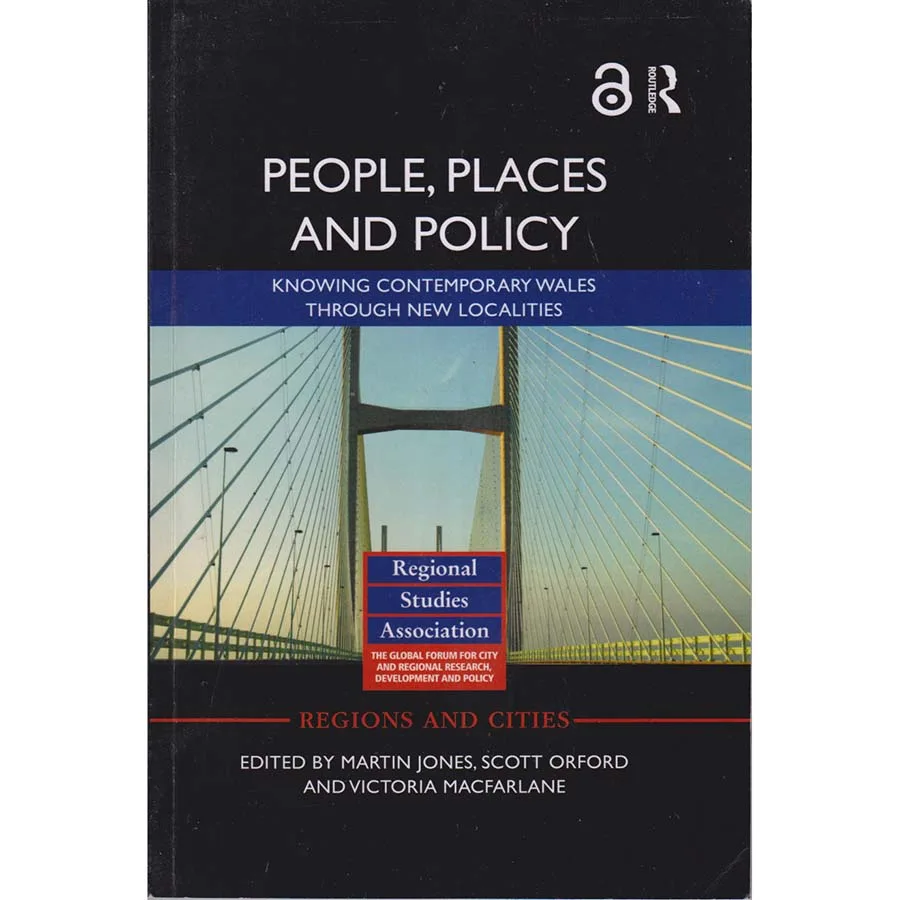
People Places And Policy - Knowing Contemporary Wales Through New Localities
Publisher: Routledge
Format: Paperback
ISBN: 9780367871505
People, Places and Policy: Knowing Contemporary Wales Through New Localities by Martin Jones, Scott Orford and Victoria MacFarlane, published by Routledge in 2019, is a serious academic examination of contemporary Wales and the awkward fact that a country is rather more complicated than the lines drawn around it on a map.
Wales, after all, is easy enough to identify geographically.
Understanding how it actually works is another matter.
People live in different places, travel across different boundaries, use different services, identify with different communities and experience economic and social change in ways that stubbornly refuse to fit neatly into administrative boxes.
This book tackles precisely that problem.
Rather than treating Wales as one uniform entity stretching politely from Holyhead to Chepstow, the authors examine how people, places and public policy interact through the idea of new localities.
Which sounds slightly like something invented by a committee.
And, to be fair, this is a book about geography and policy, so committees are never very far away.
The central idea is that the places people actually live their lives do not always correspond neatly with traditional boundaries.
A person may live in one local authority, work in another, shop in a third, use healthcare somewhere else and still insist that their real community is a place which technically disappeared from the administrative map in 1974.
This is especially relevant in Wales, where geography has always been unusually influential.
Mountains interfere.
Valleys channel movement.
Cities pull in commuters.
Rural areas behave differently from urban ones.
And occasionally two places separated by only a few miles may have social and economic lives that barely overlap.
The book explores these patterns using evidence, data and spatial analysis to ask how contemporary Wales might be understood more realistically.
Where are the meaningful social and economic connections?
How do people actually move?
Where do services operate?
Which places function together?
And how much of public policy is still based on boundaries that make more sense to administrators than to the people living inside them?
These are important questions because governments have a great fondness for dividing countries into areas.
Regions.
Authorities.
Zones.
Partnerships.
Boards.
Catchments.
Strategic areas.
Then, after several years, somebody discovers that ordinary people have continued travelling wherever they please.
The authors bring together geography, social science and public policy to examine a Wales shaped by devolution, economic restructuring, changing communities and increasingly sophisticated geographical data.
It is not a tourist-book Wales of castles, sheep and suspiciously empty mountain roads.
This is Wales as a functioning modern country.
People commute.
Housing markets overlap.
Public services cross boundaries.
Cities expand.
Communities change.
And policymakers try to work out which lines should go where.
Published by Routledge, the book has the reassuringly serious air of something that may contain maps, datasets and sentences beginning with phrases such as “the spatial distribution of…”
This is academic territory.
Nobody is going to suddenly announce ten amazing facts about Cardiff.
But that seriousness is exactly what makes the book useful.
For students and researchers in human geography, planning, public policy, Welsh studies and regional development, People, Places and Policy offers a detailed framework for understanding Wales through the relationships between communities rather than simply through inherited administrative boundaries.
It is also interesting for anyone fascinated by how countries are organised in practice.
We tend to think of places as fixed things.
A town is a town.
A region is a region.
A boundary is a boundary.
But human geography has the inconvenient habit of pointing out that people do not always cooperate.
They commute.
They migrate.
They shop elsewhere.
They form networks.
They move house.
They cross county lines without notifying anybody.
The result is that the country on the map and the country people actually inhabit are never quite the same thing.
That makes this a particularly useful snapshot of contemporary Wales in the late 2010s, at a time when questions of regional inequality, devolution, service provision and economic development were becoming increasingly prominent.
And because Wales continues changing, the book will inevitably acquire another function with time.
Today it is contemporary analysis.
Eventually it will become historical evidence showing how Wales looked just before somebody reorganised everything again.
Because if there is one thing public administration enjoys almost as much as creating boundaries, it is replacing them.
Condition: Good. A sound used copy with normal signs of age and handling. Published in 2019, it is positively youthful by Crappy Old Books standards and has barely had time to become obsolete through administrative reform.
ISBN: 9780367871505.
A substantial academic study of contemporary Wales, exploring how real communities, economic relationships and everyday patterns of movement interact with the boundaries and policies designed to govern them.
Sold by Crappy Old Books — where Wales remains in the same place, even if nobody can quite agree where all the internal boundaries should go.
Keep browsing: See more Politics books Other books by Martin Jones Scott Orford and Victoria MacFarlane
