


Herodotus - Book VIII
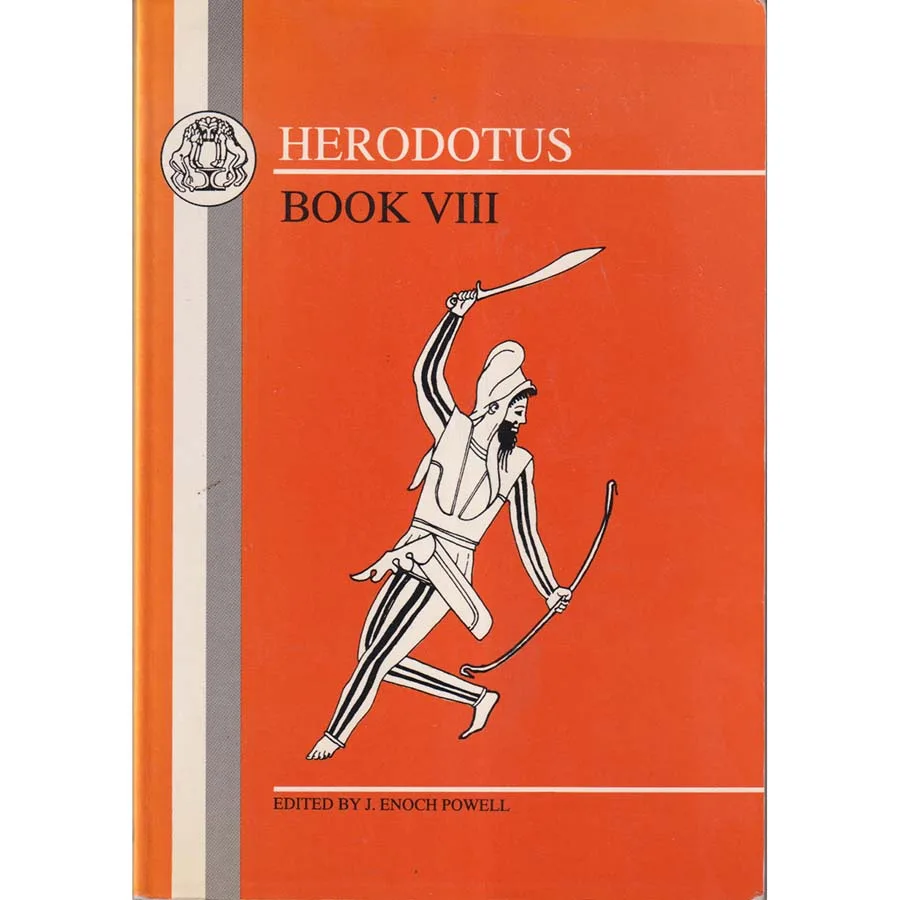
Publisher: Bristol Classical Press
Format: Paperback
ISBN: 0862920043
Herodotus - Book VIII, edited by J. Enoch Powell and published by Bristol Classical Press in 1993, takes us to one of the more spectacular episodes in ancient history: the Persian invasion of Greece and the moment when an enormous imperial fleet discovered that having considerably more ships does not necessarily help if somebody persuades you to squeeze them all into the wrong stretch of water.
Book VIII of Herodotus is dominated by the events surrounding the Battle of Salamis, fought in 480 BC, when the Greek states attempted the difficult task of cooperating with one another for long enough to prevent Xerxes and the Persian Empire from taking complete control of Greece.
Cooperation between Greek city-states was never straightforward.
Athens had opinions.
Sparta had opinions.
Everybody else had opinions.
Somebody was almost certainly threatening to go home.
And in the middle of it all was Themistocles, manoeuvring allies, enemies and occasionally reality itself in an effort to keep the Greek fleet together.
Herodotus is particularly enjoyable because he does not write military history as though armies and fleets consist entirely of arrows moving around a map.
There are arguments.
Rumours.
Oracles.
Political calculations.
Personal rivalries.
Heroic behaviour.
Cowardly behaviour.
And a great many people confidently asserting things that turn out not to be true.
In other words, civilisation had already achieved most of its important administrative traditions by the fifth century BC.
Book VIII includes the evacuation and occupation of Athens, the destruction of the Acropolis, the manoeuvring of the opposing fleets and, above all, the great naval confrontation at Salamis.
The Greeks faced an empire with vastly greater resources, while simultaneously attempting not to fall out among themselves before the battle began.
This turns out to be surprisingly important.
Salamis is one of those battles that has acquired almost legendary status because so much appeared to depend upon it.
The narrow waters favoured the smaller Greek force, limiting the advantage of Persian numbers and producing exactly the sort of confusion that occurs when too many warships are trying to perform complicated manoeuvres while people are firing things at them.
There were no radios.
No GPS.
No satellite reconnaissance.
Just flags, shouted orders, oars, rams and an enormous incentive not to make a navigational error.
Herodotus, writing within living memory of these events, mixes history with stories, speeches, traditions and colourful anecdotes in the wonderfully characteristic manner that earned him both admiration and several thousand years of people arguing about exactly how much of everything he says should be believed.
That is part of the pleasure.
Modern history often arrives with footnotes and statistical tables.
Herodotus occasionally gives you an extraordinary story and leaves future generations to sort it out.
This Bristol Classical Press edition is intended for readers approaching the original Greek, with the sort of scholarly assistance required when ancient prose begins looking less like a language and more like somebody has scattered accents across the page during an earthquake.
It belongs to the great tradition of classical texts that assume the reader genuinely wants to engage with the original language.
No simplified cartoon Persian Wars.
No “Herodotus in Five Easy Steps”.
Just Greek, notes, scholarship and the quiet possibility that a single sentence may occupy most of the evening.
For students of ancient Greek, classical civilisation, military history and the Persian Wars, Book VIII is particularly rewarding because it combines grand strategy with wonderfully human behaviour.
Kings make decisions.
Commanders argue.
Politicians scheme.
Sailors fight.
Entire cities are abandoned.
And history turns on the ability of rival states to stop quarrelling for approximately long enough to deal with a much larger problem.
A temporary achievement humanity continues to find impressive.
Published in 1993, this edition has now itself acquired a pleasant degree of academic vintage.
It comes from the era of university bookshops, heavily annotated reading lists and students arriving at seminars carrying enough classical texts to cause permanent shoulder damage.
Condition: Good. A sound used copy with normal signs of age and handling. It remains perfectly suitable for study, translation or simply staring thoughtfully at the Greek while hoping the meaning will eventually reveal itself.
ISBN: 0862920043.
A serious classical edition of one of the most exciting books of Herodotus, featuring invasion, politics, naval warfare and one of history’s most famous demonstrations that geography sometimes has stronger opinions than generals.
Sold by Crappy Old Books — where the Persians have already invaded, the Greeks are still arguing, and the vocabulary is entirely your problem.
Keep browsing: See more Ancient Classics books Other books by J Enoch Powell
